A Provocation on Schedule: What's Behind Washington's Warning to Poland

Baltic Security Monitor | Geopolitical Commentary
According to a Telegraph report published July 3, citing sources close to Polish President Karol Nawrocki, the United States has warned Warsaw that Russia is preparing an armed "provocation" on Polish territory. This isn't an isolated signal — it's the third layer of a warning that different sources have been sharpening for two weeks. Worth unpacking level by level.
Level one: what the Telegraph actually reported
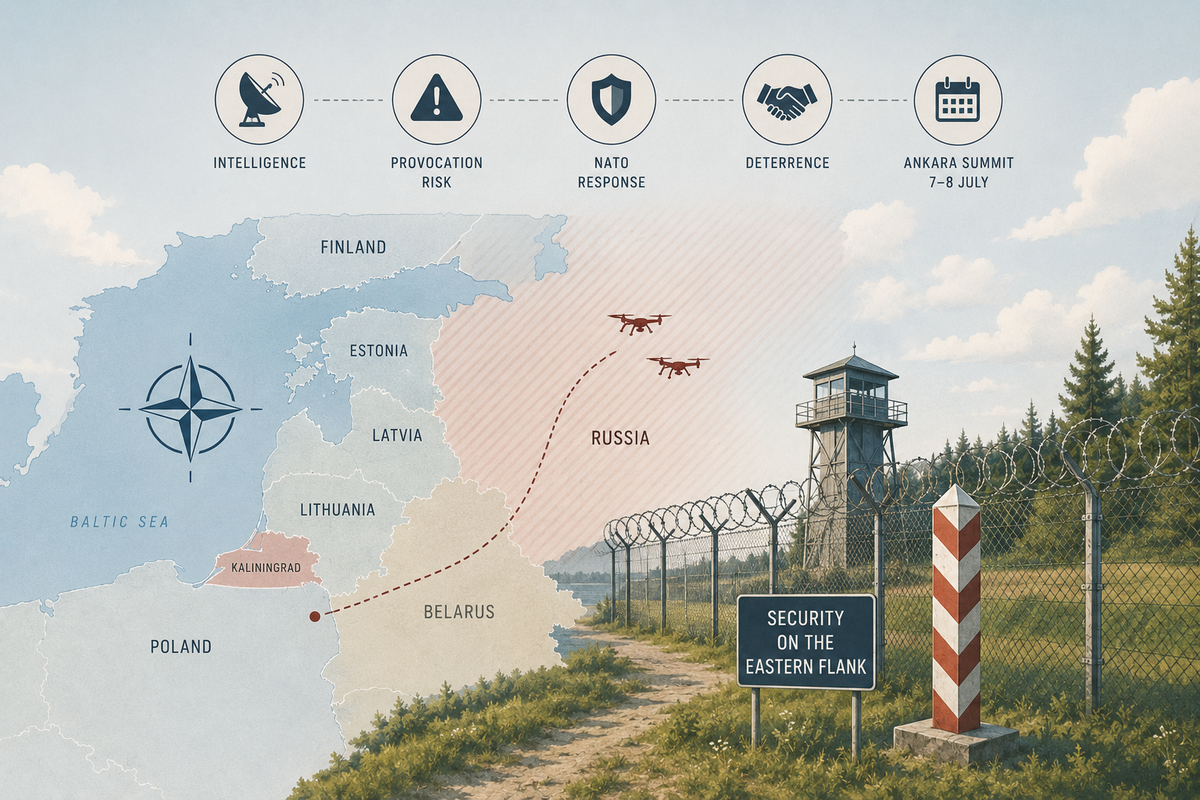
The paper's sources outline two possible points of origin — Kaliningrad, home to Russian nuclear weapons, or Belarus. Scenarios range from missile and drone strikes on critical infrastructure to simulated air raids designed to force Poland to activate its air-defence systems. The most extreme variant the sources don't rule out is a small-scale ground incursion by Russian or Belarusian units across the border.
The critical detail: under this scenario, Moscow could later try to pin the "provocation" on Ukraine. That detail sets this warning apart from generic "threat from Russia" rhetoric — this isn't framed as open aggression, but as an operation built on deliberately confused authorship. A Baltic security source confirmed to the paper that such plans had indeed been discussed in Moscow.
Level two: the regional backdrop
The Telegraph isn't the first or only source of this signal. On June 26, the Guardian, citing Western sources, reported that Russia was preparing a possible "provocation" against the Baltic states or Poland. Latvian intelligence stated plainly at the time: "We see indications that Russia is preparing military provocations against the Baltic countries or Poland" — while clarifying this fell well short of a full-scale attack. A senior source from a second NATO member added that the alliance was "picking up intelligence" that Putin was "planning something against the Baltic states" — potentially to test US resolve to defend the alliance's smallest members.
Chatham House Russia expert Keir Giles noted at the time that Moscow would look for ways to reverse the current battlefield dynamic — either through horizontal escalation (spreading the conflict to other countries) or some other move outside Ukraine. That tracks with the logic of both reports: pressure is mounting not because Russia is advancing in Ukraine, but because it's stuck there — while absorbing increasingly damaging long-range strikes on its own territory.
Level three: the voice of restraint
Against this backdrop, a counter-signal deserves equal weight. On June 29, Lithuania's Ministry of Defence stated it sees no signs Russia is preparing a large-scale military attack on the Baltic states, though the risk of sabotage remains high. That's an important check against over-dramatization: even sources inside the region with the most reason to worry draw a sharp line between "provocation" and "invasion" as distinct categories of threat.
The historical precedent is instructive. On September 10, 2025, nearly 20 Russian drones crossed Polish airspace from Ukraine and Belarus, penetrating 300 kilometers. NATO invoked Article 4 of the founding treaty; Russia denied any intent to strike Polish targets; the incident ended there. That doesn't mean the current cycle of warnings should be dismissed — but it does mean similar signals have surfaced before without escalating further.
BSM analysis: why now
The timing speaks for itself. These warnings surface days before NATO's Ankara Summit (July 7–8) — the alliance's most consequential political gathering of the year, where defence-spending commitments and the future of support for Ukraine are on the agenda. A hypothetical "provocation" at precisely this moment would serve a double purpose: testing alliance cohesion at its point of maximum public attention, while sending a signal to Ukraine's Western backers ahead of key decisions.
At the same time, this warning is an intelligence assessment of probability, not a forecast — built on observed pressure the Kremlin is under from Ukraine's deep-strike campaign. Pressure and intent aren't the same thing. Three sources, three levels of detail, the same underlying ambiguity: a concrete scenario without a concrete date.
A provocation built on deliberately confused authorship only works as long as no one is willing to name the author in advance. The Telegraph's report is already an act of naming. That, more than the scenario itself, is what matters for the region.
Baltic Security Monitor (osint-baltic.com) — an analytical publication covering security on NATO's northeastern flank.