A Cheap Interceptor for an Expensive War: Alexa Spatium and the Baltic Drone-Defence Economics


Baltic Security Monitor | Analytical Briefing Snapshot: 2026-08-22T11:06:10.592Z
OSINT indices for the day
| Indicator | Value | 24h dynamics |
|---|---|---|
| Composite threat index | 0.19 | flat: 0.00 change over 6h and 24h |
| Force Posture | 0.53 | no movement in the digest — WARNING-level reading against a calm composite |
| Logistics | 0.00 | zero |
| Info/Cyber | 0.00 | zero |
| Border/Air/Maritime | 0.00 | zero |
Events logged in 24h: 1 · High confidence: 0 Quarantine: 0 · Source failures: 0
A day with a minimal raw-data footprint — just one tracked event in 24 hours, none of them high-confidence. But the one event that did surface matters: Ukraine has fielded its first domestically built jet-powered drone interceptor, Alexa Spatium, designed to catch fast jet-powered "Geran" drones. This is not a frontline footnote — it is part of an economic logic the Baltic states are already replicating in their own drone wall: swap expensive air-defence missiles for cheap interceptors wherever the target is a mass-produced cheap drone rather than a cruise missile.
Top event of the day
🔵 1. Alexa Spatium — Ukraine's first jet-powered drone interceptor
OSINT score: 0.19 — WATCH (new entry)
Ukraine's Ministry of Defence announced on 21 August that Alexa Spatium — the country's first domestically developed jet-powered drone interceptor — has entered service. The aircraft was built by Ukrainian engineers to destroy small aerial, ground and surface targets in combat conditions; the manufacturer has not been publicly disclosed. Its primary targets are the jet-powered variants of Russia's "Shahed" family — Geran-3, Geran-4 and Geran-5 — plus the propeller-driven Shahed-131; it can also be used against reconnaissance drones and helicopters.
The key technical detail is the turbojet engine itself. Ukraine's earlier interceptors — including the widely used Sting, costing as little as roughly $2,500 per unit — were propeller-driven and effectively downed slower Shaheds and Geran-2s, but could not keep pace with faster jet-powered variants. Alexa Spatium is one of several jet-powered interceptors emerging in parallel — alongside SkyFall's JetKiller and Firebolt Engineering's Griffen — and closes exactly that gap: high top speed, substantial operating ceiling, and agile maneuverability. The launch complex is mobile, fitting on a pickup truck with minimal site preparation, and the aircraft returns to its launch point for reuse if it does not complete an intercept. Since the start of 2026, the Defence Ministry has codified and authorised 413 unmanned aircraft systems for service, nearly all of them Ukrainian-made.
BSM analysis: This is the next round of a cost-tier arms race in air defence. Russia added jet engines to its Geran drones specifically to outrun propeller-based interceptors; Alexa Spatium restores that parity. For BSM, the news matters less as a single piece of hardware and more as a marker of how fast Ukraine's low-cost interceptor industry is maturing — precisely the category the Baltic states are now importing at scale.
Baltic context: why this isn't only a Ukrainian story
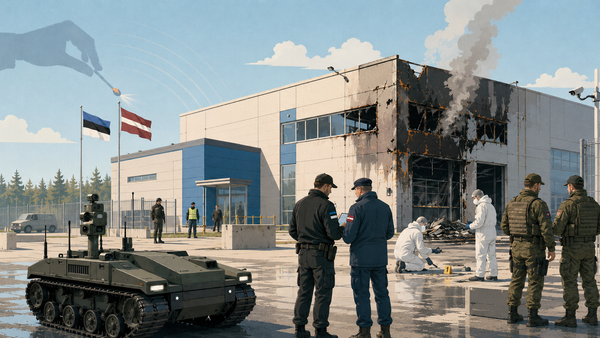
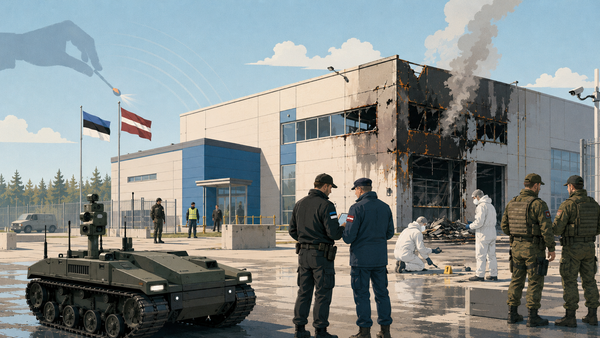
Estonia, Latvia and Lithuania are building a joint "Baltic Drone Wall" — a layered detection-and-interception network along the eastern border combining electronic warfare, kinetic interceptors and distributed sensors. Latvia, Estonia and Belgium are already receiving BLAZE interceptors, and Estonia unveiled its DroneHive automated launch system at Eurosatory 2026 for faster response. The three Baltic states are jointly preparing to spend roughly €12.2 billion under the EU's SAFE programme on weapons, with unmanned systems, counter-drone equipment and air defence among the top priorities.
The economics track Alexa Spatium's own logic: firing a roughly €3 million IRIS-T missile at a $20,000 Shahed is not sustainable; a roughly $15,000 kinetic interceptor solves the same problem while preserving medium-range missile stocks for the targets they were actually built to defeat. The Baltic states are directly absorbing Ukrainian know-how through bilateral industrial-integration mechanisms — licensing and co-producing Ukrainian interceptor technology for their own Drone Wall and the Eastern Flank Watch programme. In August 2026, NATO ran its first Innovation Range trials for unmanned systems at the Sēlija training area in Latvia, and the Baltic Trust 26 exercise there specifically tested integrating counter-UAS interceptor technology into a shared detection-and-cueing network.
BSM analysis: Alexa Spatium is not an isolated item of Ukrainian defence-industry news — it is another building block in the same cost model the Baltic states are constructing to defend their own airspace. For a region logging weekly airspace violations by drones, the pace and maturity of Ukraine's low-cost interceptor market is a head start Tallinn, Riga and Vilnius have every incentive to import as fast as possible.
A note on data quality
Today's cycle deserves a pipeline caveat: only one event was logged in 24 hours, none of it high-confidence, while the Logistics, Info/Cyber and Border/Air/Maritime sub-indices sat simultaneously at zero — the classic "artificial calm" pattern, where activity concentrates in a single category. At the same time, Force Posture reads 0.53 (WARNING-level) with no movement over 6h or 24h and no corresponding entry in the top events that would explain that reading. The only visible event of the day is a defence-technology announcement scoring 0.19, which does not obviously map onto a 0.53 Force Posture value. This looks more like a carried-over sub-index reading from a prior cycle on a thin-data day than a fresh escalation. BSM continues to flag this discrepancy and does not treat the Force Posture level as a confirmed signal absent a corresponding top-5 event.
Bottom line
A day with a minimal raw OSINT footprint does not mean no signal: the arrival of Alexa Spatium is a reminder that the jet-interceptor arms race is moving faster than the news cycle around it — and that this race is now a shared Baltic-Ukrainian project, not just a frontline story.
Baltic Security Monitor (osint-baltic.com) — an analytical outlet covering security on NATO's northeastern flank. All OSINT coefficients are calculated by an automated indexing system based on open sources.