37 Dead After Myla Depot Strike: Ukraine Orders Nationwide Ammunition-Storage Audit After Second Deadly Blast in Two Months

Baltic Security Monitor | Analytical Brief
As of 29 August 2026, 20:00 EEST
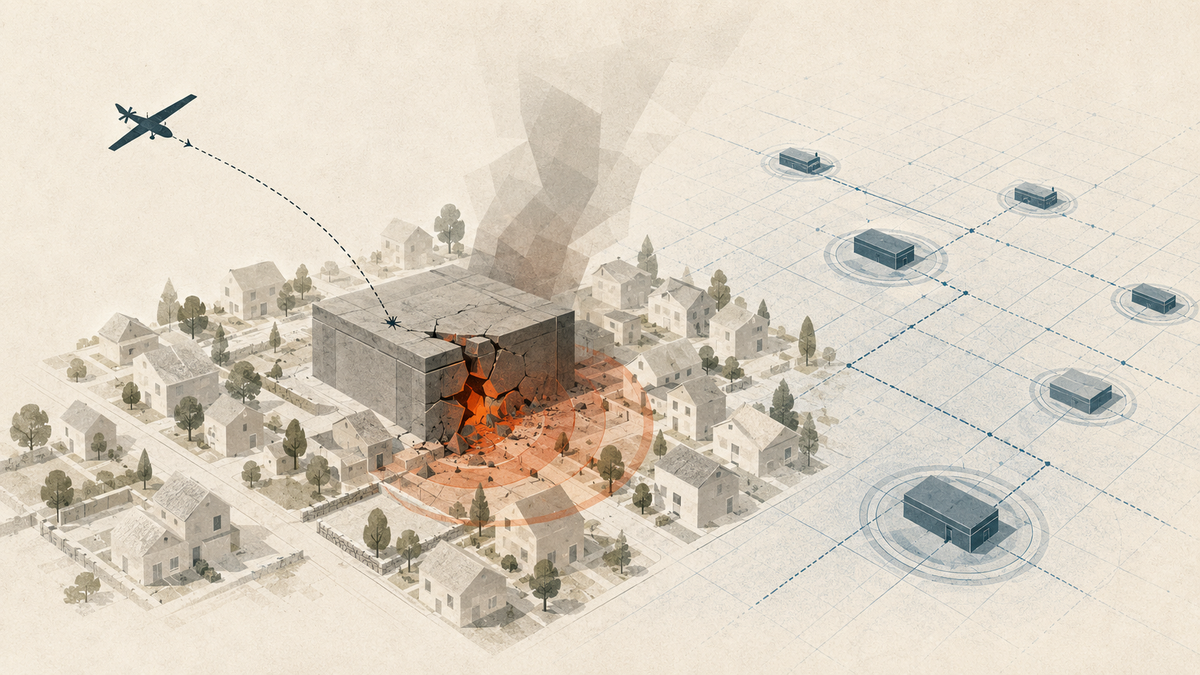
On the evening of 28 August, a Russian drone struck an ammunition storage facility in the village of Myla, Bucha district, Kyiv region, igniting a large fire that spread into residential streets and triggering a series of secondary detonations. By the morning of 29 August, authorities had confirmed at least 37 dead and 42 injured, including four children. Regional officials reported around 50 damaged residential buildings and more than 370 people evacuated. According to Tymur Tkachenko, head of the Kyiv Oblast Military Administration, 34 of the 37 people killed were residents of a nearby care home for the elderly and disabled. Among the dead was Taras Didych, head of the local Dmytrivka community, who was reportedly among the first responders on scene.
President Volodymyr Zelenskyy described the storage of explosives next to residential housing as "terrible negligence" and said criminal proceedings had been opened over official negligence. The Prosecutor General's Office said it was reviewing the legality of how explosive materials were placed and stored on the site, as well as the conduct of the officials who authorized it. Ukraine's Defence Ministry stated that storing ammunition near residential buildings is unacceptable and ordered every commander across the security and defence forces, and the domestic defence industry, to carry out a full audit of their storage sites.
The story here is not the strike itself but that the system had already been taught this lesson and failed to absorb it. The July incident in Vyshneve exposed the identical vulnerability and produced concrete personnel consequences. A repeat within two months turns an isolated violation into a systemic force-protection and logistics problem that a single audit order will not, on its own, resolve.
BSM analysis: a lesson that didn't hold
Myla is the second secondary-detonation ammunition incident in the Kyiv region in two months. A 6 July strike on a facility in Vyshneve triggered large secondary explosions and killed 22 people. A subsequent investigation by Ukraine's Security Service found that ammunition had been stored in facilities unsuited for the purpose, without required permits, in close proximity to housing. Two executives at state enterprises within the Ukroboronprom defence conglomerate were detained on negligence charges and dismissed; the conglomerate's director general resigned days later. Prime Minister Serhiy Koretskyi acknowledged bluntly that Vyshneve "did not become a lesson," calling repeated mistakes in "the fifth year of the full-scale invasion" criminal negligence.
That is the material shift from July: the earlier probe produced findings and dismissals tied to one enterprise, but not a public audit of comparable sites nationwide. The Defence Ministry's order now moves from a single-facility investigation to a blanket inspection mandate — an implicit admission that the problem is systemic rather than local. The full ownership, chain of command, and inventory of the Myla site had not been publicly disclosed as of the evening of 29 August.
Why it matters for Ukraine and the Baltic region
For Ukraine, dispersed and hardened ammunition storage is not an administrative footnote — it is a precondition for sustaining logistics under continued Russian long-range strikes. Concentrating explosives, drones, and ammunition near housing turns a single successful hit into a dual-effect event: destroyed materiel and maximized civilian casualties. The stakes are compounded by Ukraine's parallel push to scale up domestic production of long-range drones and missiles, components that must be stored, assembled, and distributed without creating predictable, high-value targets for Russian reconnaissance.
For NATO's eastern and north-eastern flank, the episode is a concrete wartime-logistics lesson. Poland, the Baltic states, and Nordic allies are all expanding ammunition stockpiles and logistics infrastructure as part of deterrence posture; the resilience of that build-up depends directly on dispersed depots, hardened storage, separation from civilian infrastructure, and the ability to relocate inventories quickly under threat.
Bottom line
The near-term test is not the audit announcement itself but whether it produces actual relocation and dispersal of storage sites away from residential areas — or repeats the pattern from July, where personnel consequences followed but systemic change did not. Russia, meanwhile, continues to target logistics hubs and depots where secondary detonations amplify the effect of a single drone or missile strike; overnight strikes on 29 August reportedly also hit logistics facilities near Mykolaiv and Izmail. How many other sites in Ukraine resemble Myla remains an open question — and the answer will determine whether this is the last incident in the series.
Baltic Security Monitor (osint-baltic.com) — an analytical publication covering security on NATO's north-eastern flank.
All OSINT indices are calculated by an automated indexing system based on open sources.