ZNPP Has Run on Diesel Generators for Over a Week: IAEA Warns of Roughly 10 Days of Fuel Left

Baltic Security Monitor | Analytical Brief As of 30 August 2026, 14:00 EEST
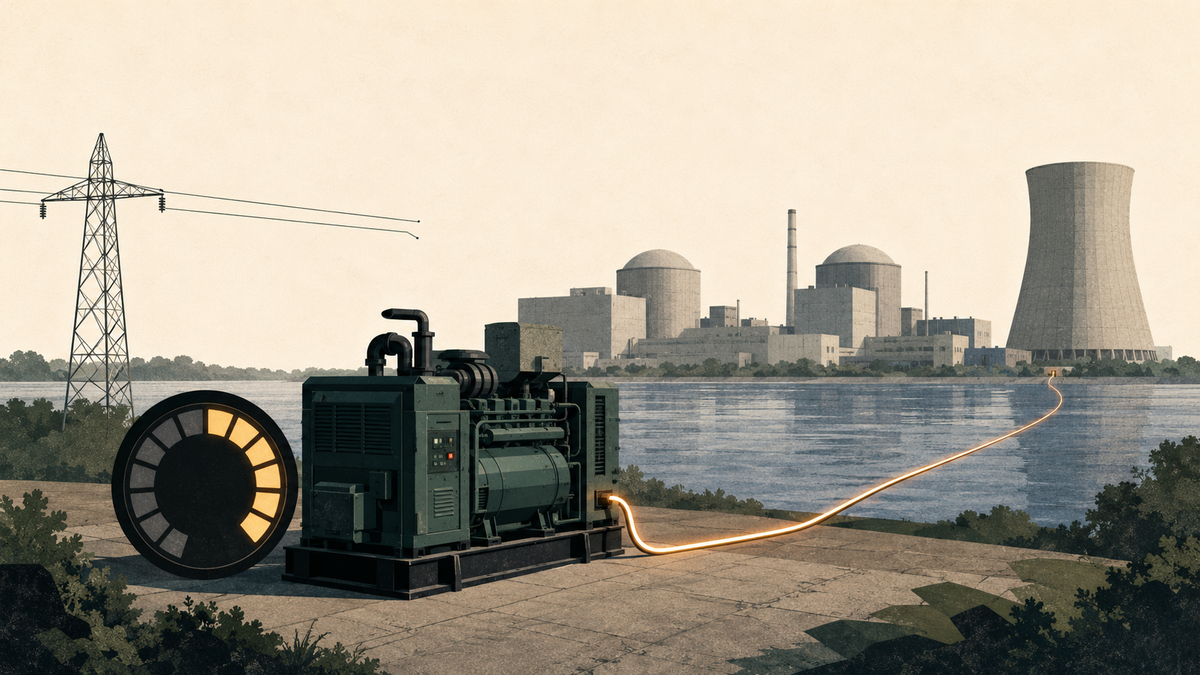
The Russian-occupied Zaporizhzhia Nuclear Power Plant has been without off-site electricity for more than a week and is running entirely on emergency diesel generators. The plant lost its last remaining external power line — the 330 kV Ferosplavna-1 connection — on 20 August, following military activity on the northern side of the Dnipro River. This is the 27th complete blackout at the plant since the occupation began in 2022, and the 15th so far in 2026, according to Ukraine's Energoatom.
IAEA Director General Rafael Grossi warned that the plant's on-site diesel reserve is sufficient for roughly 10 days at the current consumption rate. The site had not received a delivery to its own fuel storage facility in about six months, but IAEA personnel observed several dozen metric tons of diesel being transferred to the plant on 27–28 August from another off-site location. The agency is simultaneously trying to negotiate a localized ceasefire to allow repair crews to restore the Ferosplavna-1 line. All six reactors have been shut down since 2022, but electricity remains essential for cooling the reactor cores and spent-fuel pools — without it, even shut-down reactors risk fuel damage. Over the same week, the IAEA also recorded three drone incidents on the plant's grounds, one of which injured two workers; responsibility for these incidents has not been independently established.
The notable part isn't the blackout itself — the plant has lost external power dozens of times since 2022. What's new is that the IAEA has, for the first time, put a concrete and short time horizon on the risk: roughly 10 days until a possible total loss of power if neither the line is repaired nor more fuel arrives. That turns a chronic vulnerability into a countdown.
BSM analysis: from chronic vulnerability to a countdown
Previous blackouts at Zaporizhzhia mostly lasted hours, occasionally days — in July, for instance, the plant went without external power for about an hour before all 19 available diesel generators automatically kicked in. The current outage is qualitatively different: it has now run for more than a week, and the bottleneck has shifted from the power line itself to the backup fuel supply. The fact that the plant went roughly six months without a routine delivery to its own storage facility, and that an emergency shipment of several dozen tons had to be sourced from an alternate off-site location on 27–28 August, indicates that the plant's emergency fuel logistics currently depend on ad hoc deliveries rather than a steady supply chain.
That marks a structural shift from earlier phases of the war, when the power line itself was the dominant story. Now a logistics variable has been added on top of it — access for repair crews and fuel suppliers into an active combat zone, IAEA-brokered local ceasefires, and whether the agency can secure repair access before the 10-day reserve runs out.
Why it matters for Ukraine and the Baltic region
For Ukraine, Zaporizhzhia remains one of the highest-consequence critical-infrastructure risks of the war. Even with all reactors shut down, prolonged reliance on emergency generators removes normal electrical redundancy and makes nuclear safety dependent on three variables that cannot be fully controlled in an active war zone: generator reliability, the regularity of fuel deliveries, and access for repair crews.
For the broader European security picture, a serious nuclear-safety failure at Zaporizhzhia would carry political, humanitarian, and economic consequences well beyond Ukraine's borders. For Baltic and Nordic critical infrastructure, the episode reinforces the same resilience lesson as BSM's recent coverage of Russian fuel logistics: redundant power, protected supply routes, and rapid repair access are prerequisites for any critical infrastructure operating under drone, missile, or sabotage threat — and nuclear sites are no exception.
Bottom line
The next ten days are not a forecast but a measurable deadline: either the IAEA secures a local ceasefire and the Ferosplavna-1 line is repaired, or enough new fuel reaches the site, or the generator reserve begins running down amid active hostilities nearby. None of those outcomes is currently guaranteed. That the IAEA has, after 27 blackouts since 2022, chosen to publicly attach a specific time limit to this one is itself a signal: the agency assesses the current situation as approaching the edge of the plant's normal resilience margin, not as another entry in a long series of routine interruptions.
Baltic Security Monitor (osint-baltic.com) — an analytical publication covering security on NATO's north-eastern flank. All OSINT indices are calculated by an automated indexing system based on open sources.