Ukraine Leads NATO Mine-Clearance Forces for the First Time as Sea Breeze Wraps with the Day's Top Score

Baltic Security Monitor | Analytical Brief Snapshot: 2026-07-24T11:05:15.951Z
Today's OSINT Indices
| Indicator | Value | Change since 23 July |
|---|---|---|
| Composite threat index | 0.13 | ↑ from 0.10 — first rise in two days, flat within the day (Δ6h = Δ24h = 0.00), still below the 21 July level (0.14) |
| Force Posture | 0.20 | ↑ from 0.06 — tripled, the day's biggest jump |
| Logistics | 0.04 | ↓ from 0.15 — receded after the 23 July spike |
| Info/Cyber | 0.00 | unchanged — zero for a second consecutive day |
| Border/Air/Maritime | 0.23 | ↑ from 0.21 — still the top sub-index, third day running |
Events logged in 24h: 10 · High-confidence: 0 Quarantined: 0 · Source failures: 0
Short summary of the day
The composite ticked up for the first time in two days, but the gain is explained almost entirely by one sub-index — Force Posture — while Logistics fell back to a low reading. This looks like a mirror image of what happened on 23 July: back then the spike was in Logistics, tied to the conclusion of Exercise Neptune Strike 26-3; today a similarly shaped spike shows up in Force Posture, tied to the conclusion of a different exercise, Sea Breeze 2026.2. The day's most concrete story isn't an index spike at all — it's an institutional fact: Ukraine's navy has, for the first time, been certified by NATO to command multinational mine-countermeasure forces.
Key signal: Ukraine certified by NATO to command mine-clearance forces
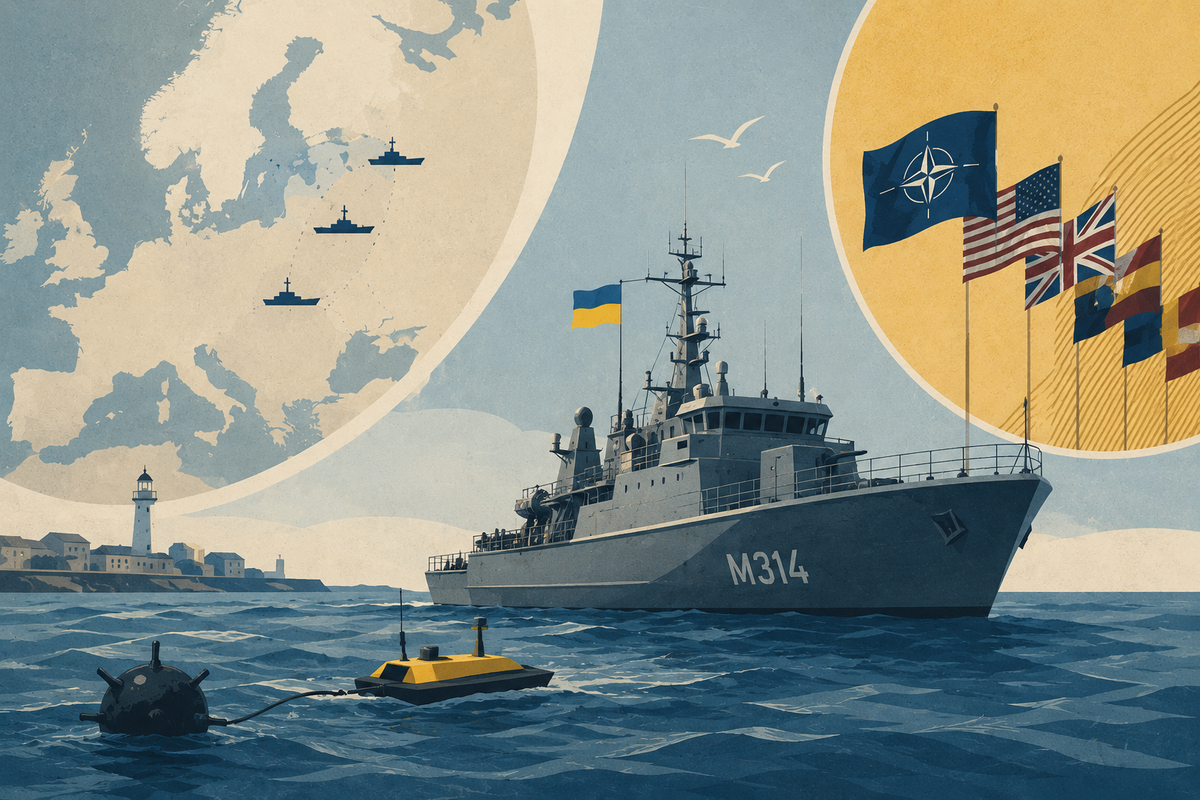
The maritime phase of Exercise Sea Breeze 2026.2 — the year's second iteration, co-hosted by the US and Ukraine through US Sixth Fleet and NATO's Allied Maritime Command (MARCOM) — ran in Portland, UK, from 13 to 24 July, focused on mine countermeasures: mine-hunting by MCM vessels, explosive ordnance disposal, dive and salvage operations, and the use of uncrewed underwater and surface vehicles [1] [2]. Participants included Bulgaria, Denmark, Estonia, France, Georgia, Greece, Japan, Latvia, Poland, Spain, Sweden, Türkiye, the UK, the US and Ukraine [1].
The key outcome: a Ukrainian naval unit successfully passed NATO's NEL-2 evaluation, earning certification to command multinational mine-countermeasure forces — a first in the history of Ukraine-NATO cooperation in this domain [2]. This is not a declarative or political statement but a verifiable institutional fact: a specific pass/fail evaluation against a NATO standard.
BSM analysis: The highest score in the top five over the entire four-day observation period (0.41) went to this item — and that's justified. Among the ten entries in the digest, this is the only one that combines the conclusion of a major multinational exercise with a verifiable institutional achievement, rather than a routine command rotation or conference.
Top 5 Digest Events
🟣 1. Allied and partner naval forces strengthen Ukraine's mine countermeasures readiness during Exercise Sea Breeze
OSINT score: 0.41 — WATCH (new entry, highest score of the series)
Details in "Key signal" above.
🔵 2. Spain leads NATO's North Atlantic naval task force
OSINT score: 0.39 — WATCH (holding for a third straight day at the same score)
(Full analysis — 21 July digest.) This is the longest run of an unchanged score in the four-day observation history: the figure didn't move when Neptune Strike 26-3 concluded on 23 July, nor after — which makes sense, since the item tracks a year-long command rotation (through June 2027), not the exercise itself.
🔵 3. Task Force X-Central Mediterranean: Italy and ACT trial multi-domain integration
OSINT score: 0.27 — WATCH (holding for a third straight day at the same score)
(Full analysis — 21 July digest.)
🟣 4. "From steel to security": inside NATO's defence factories
OSINT score: 0.24 — WATCH (new entry, unusual type)
A NATO video on Allied production capacity — armoured vehicles in France, helicopters in Poland, ammunition in Czechia — with interviews from defence-industry executives on scaling output. Per NATO.int's own metadata, the video was published on 9 July 2026 — 15 days before it entered the digest. This is the third instance in this series (after the CIMIC conference on 23 July and the Ukraine-support video) of NATO institutional content entering the index with a significant delay; the hypothesis of a systematic processing lag for this content type (video and archival material, rather than operational news) now has three consecutive, independent data points. 🟡
BSM analysis: The recurrence of this pattern is itself a useful methodological takeaway for reading these digests: unusual-type entries (🟣) are worth checking against their original publication date before being read as fresh developments.
🔵 5. NATO sharpens civil-military edge at CIMIC Conference 2026 in Naples
OSINT score: 0.23 — WATCH (holding since 23 July, score unchanged)
(Full analysis — 23 July digest.)
Reading the sub-indices
The Force Posture spike (0.06 → 0.20) mirrors the Logistics spike a day earlier in shape: both coincide with the final day of a large multinational exercise involving ships and personnel from several NATO countries — first Neptune Strike 26-3 (concluded 23 July), now Sea Breeze 2026.2 (concluded 24 July). Working hypothesis: the system classifies the wind-down phase of different exercises under different sub-indices depending on the nature of the activity — fuel and rotations as logistics, ship and personnel deployment as force posture. This isn't a decomposition-confirmed cause, just a pattern now observed twice in a row. 🟡
Info/Cyber remains at zero for a second consecutive day. There's no direct explanation in the material gathered; the repeat zero reading strengthens rather than confirms the hypothesis that this reflects the current observation window or source coverage rather than a genuine absence of activity. 🟡
Comparison with previous days
| Date | Composite | Force Posture | Logistics | Info/Cyber | B/A/M |
|---|---|---|---|---|---|
| 21 July | 0.14 | 0.12 | 0.06 | 0.10 | 0.25 |
| 23 July | 0.10 | 0.06 | 0.15 | 0.00 | 0.21 |
| 24 July | 0.13 | 0.20 | 0.04 | 0.00 | 0.23 |
(No digest for 22 July exists in this series.) Across three readings, Border/Air/Maritime has never dropped below 0.21 and has stayed the top or one of the top sub-indices all three days — the one stable element amid swings elsewhere.
Conclusion
24 July brings two different kinds of news worth keeping separate. The first is statistical: Force Posture jumped, Logistics receded, and the composite ticked up slightly, most plausibly as a side effect of another major NATO exercise concluding, just as with Neptune Strike a day earlier. The second is substantive: Ukraine's navy earning NATO certification to command mine-clearance forces under the NEL-2 standard is a verifiable step in deepening interoperability that will matter longer than any single index spike. Border/Air/Maritime, meanwhile, has held the top sub-index spot for a third straight day — the steadiest signal in an otherwise shifting four-day picture.
Confidence in the above: 🟡 — 3, 🔴 — 0. Higher confidence requires a decomposition of event contributions to the Force Posture and Info/Cyber sub-indices, and confirmation of the original publication date of the "From steel to security" video.
Sources
- Navy Lookout — Sea Breeze 2026: the Royal Navy hosts Ukraine and allies
- Interfax-Ukraine — Ukrainian Navy gains capability to command NATO maritime mine clearance forces for first time
- NATO.int — video "From steel to security: Inside NATO's defence factories"
Baltic Security Monitor (osint-baltic.com) — an analytical outlet covering security on NATO's north-eastern flank. All OSINT coefficients are calculated by an automated indexing system based on open sources.