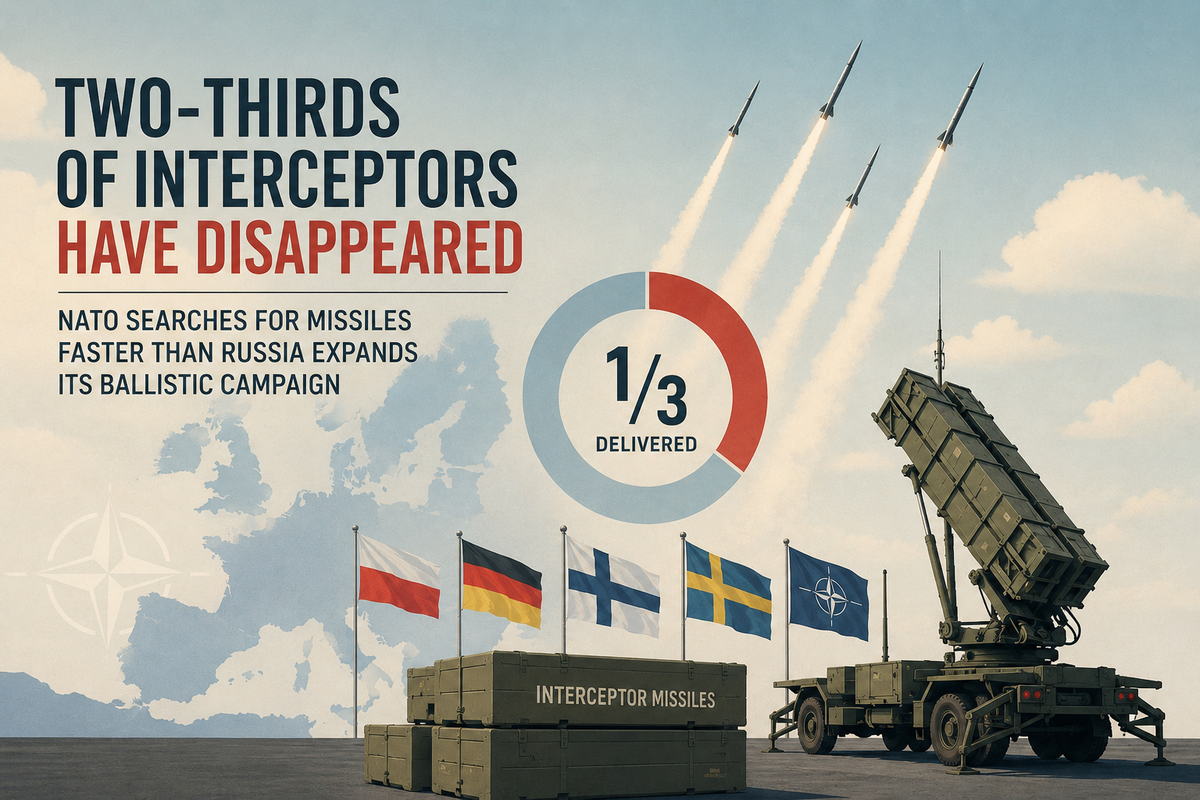
Two-Thirds of Interceptors Have Disappeared: NATO Is Searching for Missiles Faster Than Russia Expands Its Ballistic Campaign

Baltic Security Monitor | Geopolitical AnalysisBased on the Material OSINT Update, August 6, 2026, 08:00
The air defense war is entering a new phase. If the primary challenge for Ukraine was once the shortage of Patriot systems, the critical bottleneck has now become the interceptor missiles themselves. Even the world’s most capable air defense battery loses much of its value when its launchers run out of ammunition. That is why Kyiv and NATO are no longer talking primarily about future production—they are urgently searching for missiles that already exist in allied stockpiles.
What Changed
President Volodymyr Zelenskyy has, for the first time, quantified the scale of the supply shortfall. During the first half of 2026, Ukraine received only about one-third of the air defense missiles delivered by its partners during the same period in 2025.
The announcement came immediately after one of the most intense combined Russian missile attacks in recent months. During the strike of August 4–5, Ukrainian air defenses failed to intercept any of the 24 ballistic missiles or four Tsirkon hypersonic missiles launched by Russia.
Until now, discussions had largely focused on expanding Patriot production and establishing licensed manufacturing capacity. The emphasis has now shifted dramatically—from increasing future output to locating existing interceptor stocks that can be transferred within weeks rather than years.
Following talks between Zelenskyy and NATO Secretary General Mark Rutte, the Alliance has begun coordinating with member states that possess compatible interceptor inventories. Rutte publicly confirmed that he is consulting allies on emergency air defense deliveries, while Finnish President Alexander Stubb said Finland is prepared to explore practical ways of strengthening Ukraine’s defenses against ballistic missiles.
Why It Matters
This is no longer solely Ukraine’s problem.
Many NATO countries on the Alliance’s eastern flank rely on the same classes of interceptor missiles that Ukraine urgently needs. Any transfer of ammunition therefore requires a difficult balance between supporting Ukraine immediately and maintaining national readiness.
For the Baltic region, the issue is particularly significant.
Estonia, Latvia, and Lithuania possess limited long-range missile defense inventories, while Poland, Germany, Romania, and Sweden are simultaneously expanding their own air defense capabilities in response to the growing Russian threat.
The Alliance now faces a strategic choice:
Is it more effective to keep interceptor missiles in national stockpiles, or to use them now—destroying Russian ballistic missiles over Ukraine before Moscow gains even greater production capacity and operational experience?
Ballistic Missiles Remain the Hardest Threat
The latest attacks once again highlight the fundamental difference between defending against cruise missiles and ballistic missiles.
Most European medium-range air defense systems and fighter aircraft can effectively counter aircraft, drones, and many cruise missiles. Intercepting high-speed ballistic missiles during their terminal descent, however, requires a far smaller group of specialized systems.
This is why even ambitious European missile defense initiatives—including the FREYJA program—cannot solve the immediate problem.
Future capabilities may reshape Europe’s missile defense architecture later in the decade, but they will not compensate for today’s shortage of interceptor missiles during the coming autumn and winter.
Strategic Implications
The situation increasingly resembles a classic resource allocation problem.
As Russia accelerates ballistic missile production and continues combining ballistic missiles, cruise missiles, and drones in coordinated strike packages, NATO must determine where each individual interceptor missile will deliver the greatest strategic effect.
If additional supplies are not secured quickly, Ukraine will likely be forced to prioritize protection even more aggressively—concentrating its most capable interceptors around Kyiv, critical energy infrastructure, and major ports, while providing less coverage to lower-priority regions.
At the same time, long-range strikes against Russian launchers, storage facilities, and missile production sites become increasingly important. Reducing the number of missiles Russia can launch is becoming almost as valuable as delivering additional interceptors to Ukraine.
Conclusion
The shortage of Patriot launchers is no longer Ukraine’s primary air defense challenge.
The critical constraint is now interceptor ammunition.
As a result, NATO’s focus is shifting away from long-term industrial expansion toward the urgent redistribution of existing missile inventories among allied nations. How quickly those interceptors can be found and delivered may determine the effectiveness of Ukraine’s air defenses over the coming months—precisely when Russia is expected to exploit its current advantage before the winter campaign begins.