Three Refineries and One Ship: Ukraine Has Fused Fuel and Maritime Strikes Into a Single Campaign

Baltic Security Monitor | Material Update Snapshot: 2 August 2026, 08:00
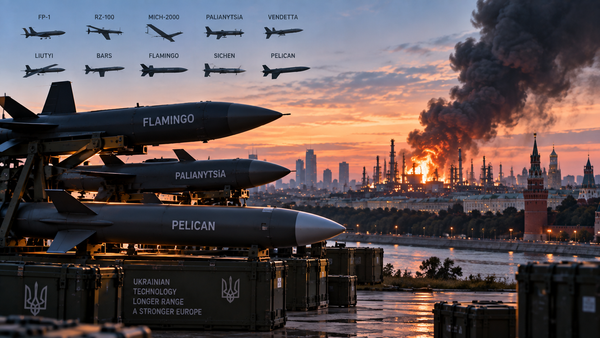
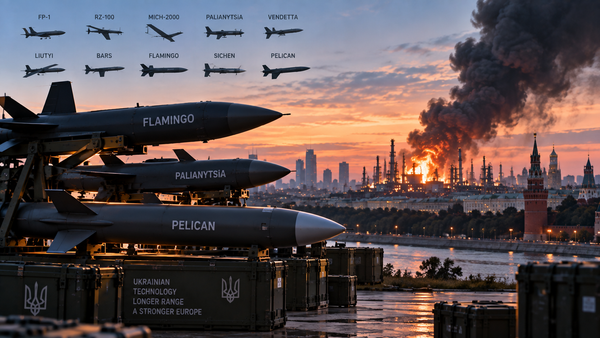
On the same night that 27 ballistic missiles flew at Kyiv, Ukrainian long-range drones were travelling the other way — 1,600 km to the Ufa refining cluster — while naval drones sank a sanctioned container ship in the Black Sea. The night of 1 August ran in both directions: Russia was testing the limit of Ukraine's air defence, Ukraine the limit of Russia's ability to protect its rear. The difference is that the Ukrainian operation reads not as a one-off strike but as three lines of effort stitched into one campaign.
What happened
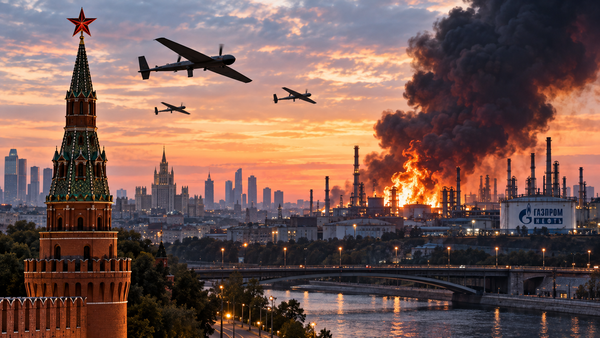
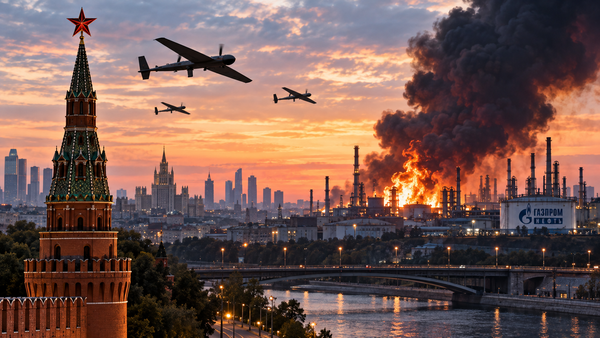
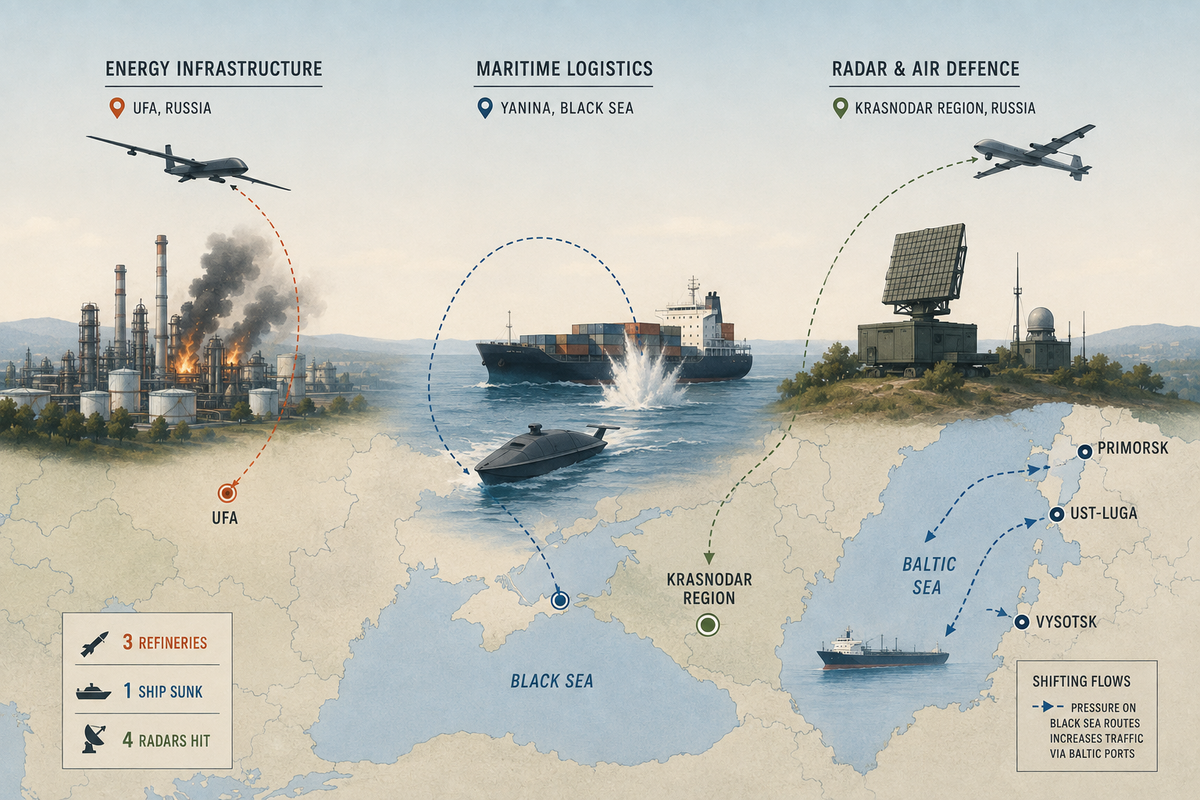
On the evening of 1 August, President Zelensky officially confirmed the series of deep operations. Ukraine's SBU struck infrastructure at three refineries in Ufa, Bashkortostan — Bashneft-Ufaneftekhim, Bashneft-Novoil and Bashneft-UNPZ — a single cluster with a combined capacity of more than 23 million tonnes of crude per year, roughly 1,600 km from Ukraine. Ground footage confirms fires at at least one facility; Bashkortostan's governor acknowledged the attack while attributing the smoke to "falling debris." The Ufa cluster is not a new target — previous strikes came in April, June and July — but hitting all three plants simultaneously is.
In parallel, two naval drones struck the container ship Yanina about 130 nautical miles from Novorossiysk; the vessel sank, and all 17 crew were rescued. The operator is FESCO, under Rosatom's control since 2023; Rosatom chief Alexey Likhachev called the attack "piracy" and insisted the cargo was purely civilian — frozen food and construction materials. There is no independent verification of the cargo; AFP noted no indication the vessel was tied to Rosatom's nuclear operations either. One discrepancy is worth flagging: Zelensky described the ship as having "a capacity of more than 100,000 tonnes," while open data lists the Yanina as a 142-metre, 962-TEU container ship — the claimed tonnage looks overstated and needs clarification.
The same night, per Ukrainian reporting, strikes hit four radar stations in Krasnodar Krai (three Podlet-K1 and one Kasta-2E2), the Black Sea Fleet's electronic-warfare centre at Cape Fiolent, and air-defence positions near Sevastopol. Russia's defence ministry called the scale of the attack unprecedented, claiming 274 drones intercepted across 16 regions.
What changed: from strikes to a campaign
Until now, Ukrainian deep operations read as a sequence of discrete episodes — a refinery one day, a tanker the next. The night of 1 August combined three lines in one time window: deep strikes on fuel processing + pressure on maritime logistics + suppression of the radar field and air defences along the approaches.
BSM analysis: hitting radars in Krasnodar Krai on the same night as Ufa and the Yanina is no longer a sum of episodes — it is operational design: blind the eyes first, then strike the targets. The strategy declared by the new defence-ministry leadership — expensive damage inflicted by cheap means — is now running as an integrated campaign rather than a political formula. The night's symmetry is telling: Russia is betting on the scarcity of Ukrainian interceptors; Ukraine is betting on the impossibility of covering a thousand kilometres of rear with air defence all at once.
The Baltic dimension
Striking three refineries simultaneously raises the likelihood that Russia will have to stretch its air defence and EW across far more oil facilities deep inside the country. 🟡 For the region, two consequences follow:
- Flows redirected to the Baltic. Pressure on Black Sea logistics — refining and maritime alike — pushes Russia to shift export and supply flows toward the Gulf of Finland and Baltic ports. The weight of Primorsk, Ust-Luga and the attendant shadow fleet in the Baltic Sea will grow. 🟡
- More EW in the northwest. Intensified electronic warfare around Russian ports, terminals and the routes of Ukrainian long-range drones raises the risk of navigation interference and of aircraft or drones straying toward Finnish and Baltic airspace. 🟡 GPS jamming in the eastern Baltic is already a standing regional complaint; a new EW wave could sharpen it.
There are, so far, no official signs of a new incident directly in Estonia, Latvia or Lithuania.
The twenty-third blackout: Zaporizhzhia loses external power again
On 1 August the Zaporizhzhia NPP lost all external power for nearly two hours — per the IAEA, the 23rd such episode since the full-scale war began. The reactors are shut down, but off-site electricity remains essential for cooling nuclear material; power was restored, and no immediate radiological threat was recorded.
The trendline of the series speaks for itself: the tenth loss of off-site power came in September 2025 (and lasted a record month, until repairs under an IAEA-brokered local ceasefire), the fifteenth in April 2026. The tempo is accelerating — thirteen blackouts in under a year, against ten in the first three and a half years of the war. The plant survives on a handful of vulnerable lines running through an active combat zone, and each new episode adds to the cumulative runtime of emergency diesel generators beyond their designed reserve role. 🟡 The October 2025 precedent — repairs under a local ceasefire — remains the most likely mechanism for future restorations as well.
Likely consequences
- Continued strikes on Russian refining and its logistics nodes — now, likely, in multi-facility series.
- Redistribution of Russian air defence and EW toward oil facilities, ports and industrial centres — at the cost of coverage density over individual military targets.
- Growing weight of Russia's Baltic ports as the fallback export route — with a corresponding load on shadow-fleet monitoring in the region. 🟡
- Added pressure on the IAEA over stable power supply to the ZNPP; possible new local ceasefire arrangements for line repairs. 🟡
Bottom line
The night of 1 August should be read as a single text with two authors. Russia wrote its part in ballistic missiles over the capital, nearly unopposed. Ukraine's reply was not symmetrical but systemic: three refineries, a ship, four radars — one design. The war of attrition is becoming a contest of logistics, and in that contest the Baltic is not a spectator: it is where Russia will carry the flows squeezed out of the Black Sea, and where its electronic warfare will hum in the background.
Baltic Security Monitor (osint-baltic.com) — an analytical publication on security along NATO's north-eastern flank. All OSINT coefficients are computed by an automated open-source indexing system.