Three Days Running: A Top-5 With Zero New Events

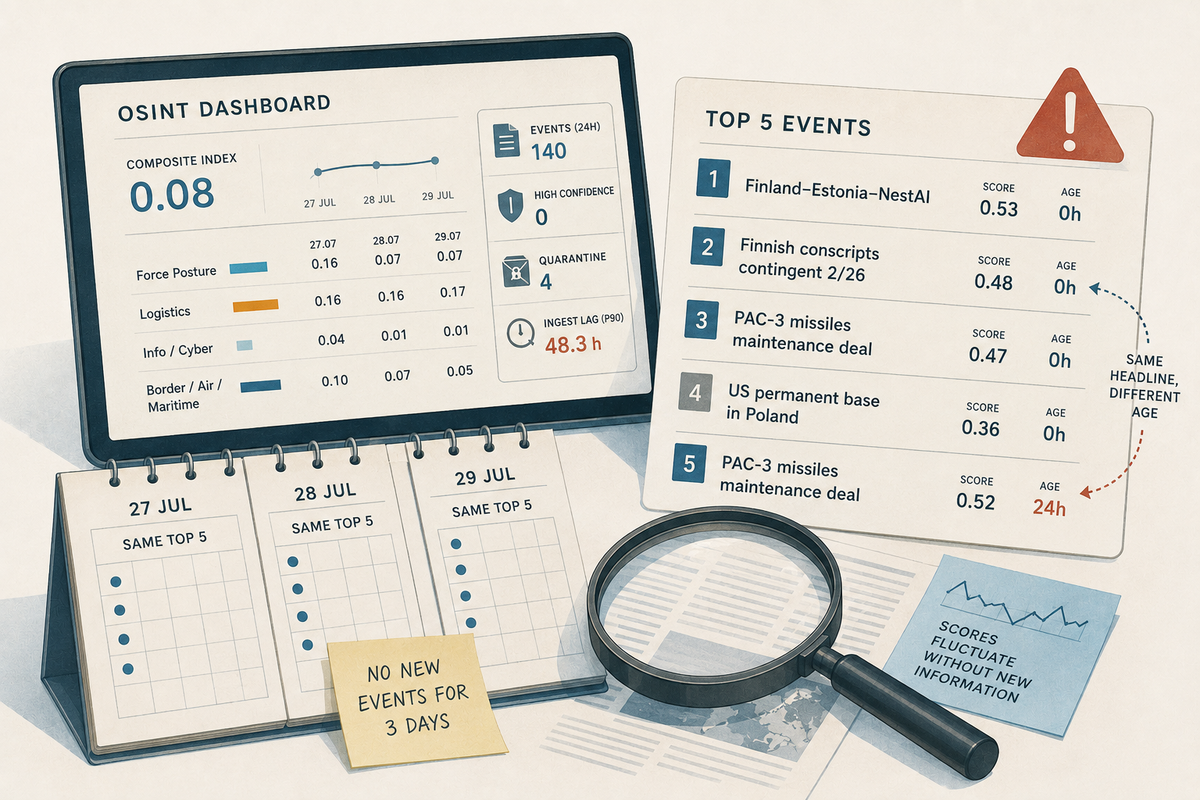
Baltic Security Monitor | Analytical Brief Snapshot: 2026-07-29T12:30:34Z
OSINT Indices
| Indicator | 27 Jul | 28 Jul | 29 Jul | Trend |
|---|---|---|---|---|
| Composite | 0.12 | 0.08 | 0.08 | second day at the cycle floor |
| Force Posture | 0.16 | 0.07 | 0.07 | flat at a low level |
| Logistics | 0.16 | 0.16 | 0.17 | the only sub-index drifting up |
| Info/Cyber | 0.04 | 0.01 | 0.01 | unchanged |
| Border/Air/Maritime | 0.10 | 0.07 | 0.05 | third straight day of decline |
Events (24h): 140 (yesterday 141 — volume holding steady) · High-confidence: 0 Quarantine: 4 (schema-mismatch: 2, low-information-density: 2) · Retry-eligible: 2 · Source failures: 0 Freshness: top-5 median age 0h, median ingest lag 6.9h (down from 16.5h) — an improvement, but p90 48.3h (down from 88.3h) — still critical
For a third consecutive day, BSM is recording the same fact: no new event has made the digest's top-5. All four unique stories in today's list are the same ones flagged on 27 and 28 July. But today's snapshot adds a new layer of evidence: the same unchanged text is getting sharply different scores from day to day, and the PAC-3 duplicate is once again showing the classic "double age" pattern — 0 hours and 24 hours for one headline in a single snapshot.
Top-5: The Same Four Stories, a Third Time
1. Finland–Estonia–NestAI
Score: 0.53 (28 Jul: 0.30 | 27 Jul: 0.43/0.41) — the highest score this story has received, despite the underlying 30 June agreement never being updated.
2. Finnish conscript contingent 2/26
Score: 0.48 (28 Jul: 0.43) — another score increase with no new information about the 6 July event.
3 and 5. PAC-3: the same age trick, a third time
Score: 0.47 (age 0h) and 0.52 (age 24h)
This is now the third documented case of the identical PAC-3 servicing-agreement headline (signed 7–8 July) appearing twice in the top-5 — once tagged "0 hours" and once with an honest real age. The pattern is consistent: the copy without "0h" always scores higher (0.52 vs 0.47), meaning the age-detection error is systematically affecting the score calculation too, not just the freshness field.
4. Permanent US base in Poland
Score: 0.36 (28 Jul: 0.40) — the same 18 June statement, a third straight day, its score drifting with no visible cause.
New Finding: Scoring Is Unstable Even Without New Input
Until now, BSM had mainly documented a problem with the "age" field. Today's snapshot adds a second, separate problem: scores for completely identical, unchanged text swing day to day — NestAI went 0.43 → 0.41 → 0.30 → 0.53 over three days without a single new source or detail. This means the pipeline's composite scoring depends on more than event content alone — possibly on some unstable processing context, the composition of the rest of that day's event pool, processing order, or a random component in the scoring itself. Either way, this is a second, independent flaw undermining confidence in the numbers driving the top-5.
One Bright Spot: Ingest Lag Temporarily Improved
Worth noting the one improvement across three days: median ingest lag dropped from 16.5 to 6.9 hours, and p90 from 88.3 to 48.3 hours — the first decline of the monitoring cycle. Given the top-5 is still entirely built from old news, though, this improvement most likely reflects processing of today's fresh event stream (140 events), not a fix to whatever mechanism keeps resurfacing stale records.
BSM Assessment
Three days running is no longer a snapshot anomaly — it's a persistent operating mode of the pipeline: no genuinely new event is making it into the top-5, the existing stale records keep circulating with shifting, non-reproducible scores, and duplicates of the same headline are systematically tagged with different ages. A composite of 0.08 for two days straight is no longer a signal of regional calm — it's a signal that the snapshot's ranking mechanism is stuck cycling the same dataset.
Conclusion
If the top-5 hasn't changed in three days, and scores for unchanged text keep swinging for no reason, trusting the ranking mechanism itself becomes risky. The logical next step isn't waiting for a fourth identical snapshot — it's verifying whether event deduplication and score calculation are functioning correctly at all before the composite index is used for any editorial conclusion about threat level.
Baltic Security Monitor (osint-baltic.com) — an analytical publication covering security on NATO's northeastern flank. All OSINT coefficients are calculated by an automated indexing system based on open sources.