Thirty Million Tonnes Without a Route: Russia’s Port Campaign Becomes a Systematic Blockade of Ukraine’s Exports

Baltic Security Monitor | Geopolitical AnalysisBased on the Material OSINT Update — 4 August 2026, 20:00
Modern maritime warfare is no longer fought primarily against ships. Increasingly, it is directed against logistics. If a nation cannot safely export its products, it gradually loses not only revenue but also economic resilience. Recent developments suggest that this is precisely what Russia is attempting to achieve in Ukraine.
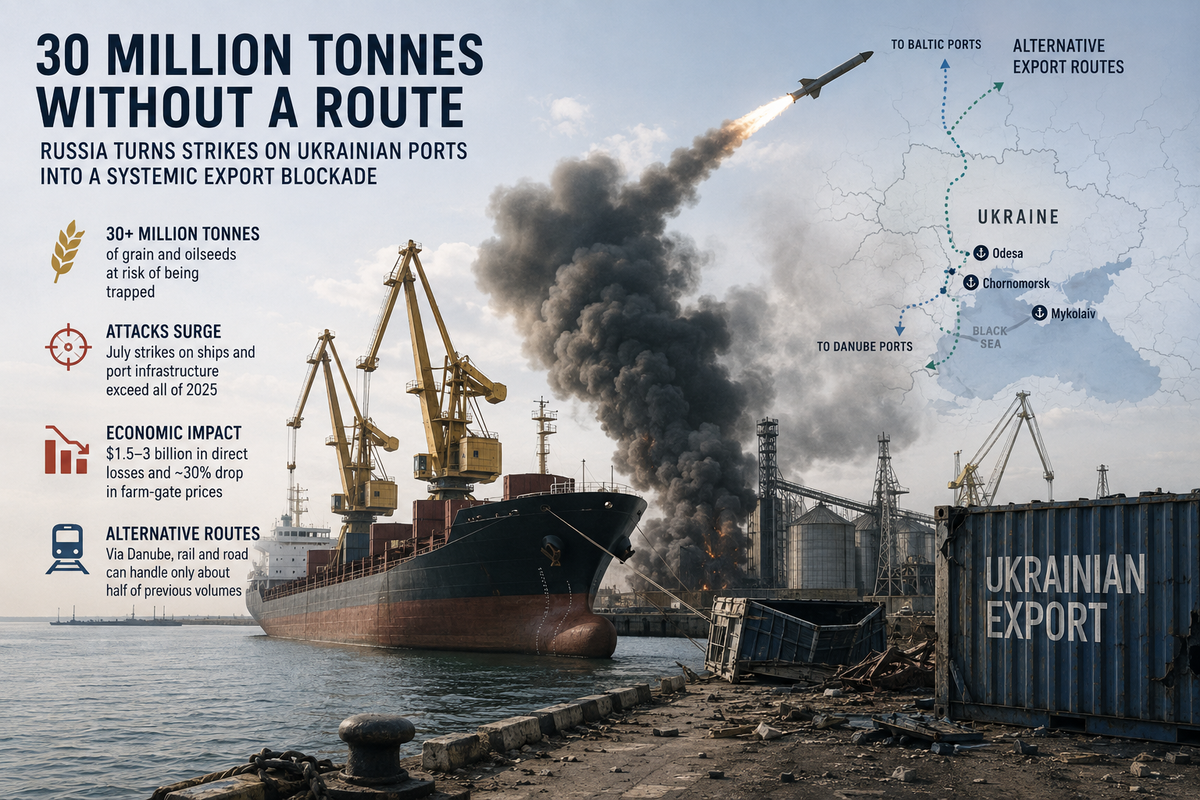
According to Ukraine’s Ministry of Agrarian Policy, more than 30 million tonnes of grain and oilseeds could lose reliable access to international markets as Russian strikes continue to target Black Sea ports and disrupt maritime operations.
If this assessment proves accurate, the campaign has moved beyond isolated attacks on port infrastructure. It is becoming a systematic effort to undermine the principal export mechanism of Ukraine’s economy.
What Has Changed
For much of the past year, Russian strikes against Odesa, Chornomorsk, Mykolaiv and other port facilities were viewed largely as individual military incidents.
The latest assessment by the Ukrainian government changes that perspective.
According to First Deputy Minister of Agrarian Policy Taras Vysotskyi, alternative export routes through the Danube, railways and road transport can currently absorb only around half of the cargo volumes previously handled by Black Sea ports. Even those routes are not expected to reach full capacity before the end of August.
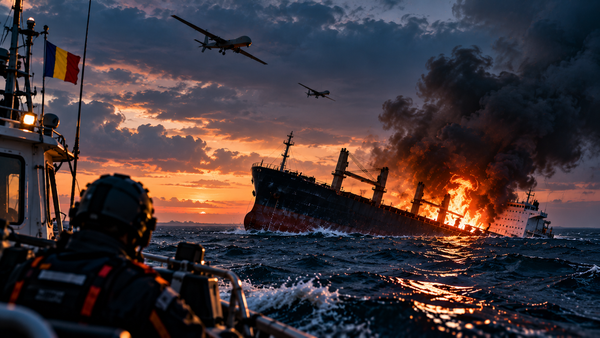
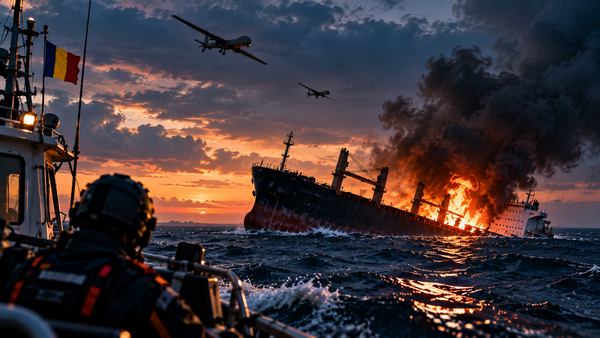
At the same time, the number of attacks against ships and port infrastructure during July has already exceeded the total recorded throughout 2025.
The implication is significant.
Russia appears to be shifting its focus from damaging individual facilities to degrading the entire system that enables Ukraine’s maritime trade.
Logistics Has Become a Battlefield
Ukraine remains one of the world’s largest exporters of wheat, corn and sunflower products.
Historically, the overwhelming majority of those exports have moved through Black Sea ports.
Unlike military cargo, agricultural exports require enormous transport capacity.
Tens of millions of tonnes cannot simply be redirected to trucks or railway wagons.
That makes maritime infrastructure strategically indispensable.
According to Ukrainian government estimates, direct losses to the agricultural sector already amount to between $1.5 billion and $3 billion, while domestic farm-gate prices have fallen by approximately 30 percent.
The consequences therefore extend well beyond damaged terminals.
Farmers receive lower prices, exporters lose access to global markets, and investment in future harvests becomes increasingly difficult.
Why the Baltic Cannot Replace the Black Sea
At first glance, shifting exports through Poland, Lithuania or Germany may appear to offer a straightforward solution.
In reality, the logistical challenge is far more complex.
Baltic ports already handle their own commercial traffic, while Ukrainian cargo must pass through several additional transport bottlenecks before reaching them.
The principal constraints include:
- the difference between Ukrainian and European railway gauges;
- limited border-crossing capacity;
- insufficient transshipment infrastructure;
- competition for port capacity with existing European trade flows.
For these reasons, even expanded use of Gdańsk, Gdynia, Klaipėda or German Baltic ports cannot rapidly replace the throughput once provided by the Black Sea.
The Baltic corridor can become an important supplement, but it cannot fully substitute Ukraine’s primary maritime export route.
Implications for Regional Security
For the Baltic region, the issue extends well beyond Ukrainian agriculture.
First, increased overland exports place additional pressure on Poland’s transport network and on NATO’s eastern logistics corridors.
Second, if a growing share of Ukrainian exports moves through Baltic ports, those facilities become increasingly integrated into Ukraine’s economic infrastructure.
That, in turn, increases their strategic importance.
Third, continued attacks on Black Sea shipping are once again raising questions about whether an international mechanism for protecting commercial navigation will eventually be required.
Since the collapse of the Black Sea Grain Initiative, the security of civilian shipping has depended increasingly on political and military decisions rather than internationally guaranteed arrangements.
Economic Pressure as a Strategy of War
In modern conflict, economic disruption can be as strategically significant as military destruction.
Restricting Ukraine’s maritime exports affects multiple layers of national resilience:
- reduced foreign currency earnings;
- lower government tax revenues;
- weakening of the agricultural sector;
- greater pressure on the state budget;
- rising insurance costs for commercial shipping;
- fewer international operators willing to enter Ukrainian ports.
In other words, the effects of each strike accumulate over time.
Every new attack damages not only a specific facility but also confidence in the entire logistics network.
What Comes Next
Over the coming months, Ukraine and its partners are likely to concentrate on several parallel efforts.
The first will be further expansion of Danube shipping and land transport corridors through Poland and Romania.
The second will involve renewed discussion of an international mechanism to protect commercial navigation in the Black Sea.
The third will focus on strengthening air and missile defence around critical port infrastructure.
This is where the story of Ukraine’s exports intersects with the story of FREYJA.
If Europe intends to secure ports, power plants, logistics hubs and industrial facilities against sustained missile attacks, it will require more than a limited inventory of Patriot batteries.
It will also need a larger, more affordable layer of missile defence capable of protecting critical infrastructure on a sustained basis.
Conclusion
Russia’s campaign against Ukraine’s ports increasingly resembles not a series of isolated strikes but a systematic attempt to make the country’s primary export route economically and physically unreliable.
For Ukraine, this is a battle for one of the foundations of its economic resilience.
For Europe, it is a reminder that continental security depends not only on tanks, aircraft and missile systems, but also on the ability to protect maritime logistics, commercial shipping and critical infrastructure.
The attacks on Ukraine’s Black Sea ports have therefore ceased to be solely a Ukrainian problem.
They are becoming an increasingly important test of Europe’s wider economic and strategic security architecture.