The Missile Didn't Turn Back: What the Kh-101 Crash in Poland Changes for NATO Air Defense

Baltic Security Monitor | Geopolitical Commentary Based on a Material OSINT Update, 30 July 2026, 14:00
This morning it was only a precaution: Polish and allied aircraft scrambled preemptively during a strike on western Ukraine. By midday, the situation had changed in kind — a physical crash site was found on Polish territory, and the prime minister of a NATO member publicly identified it as a likely Russian cruise missile. This is no longer a risk of an airspace violation. It's a confirmed one, with a crater in Polish soil to show for it.
What Happened
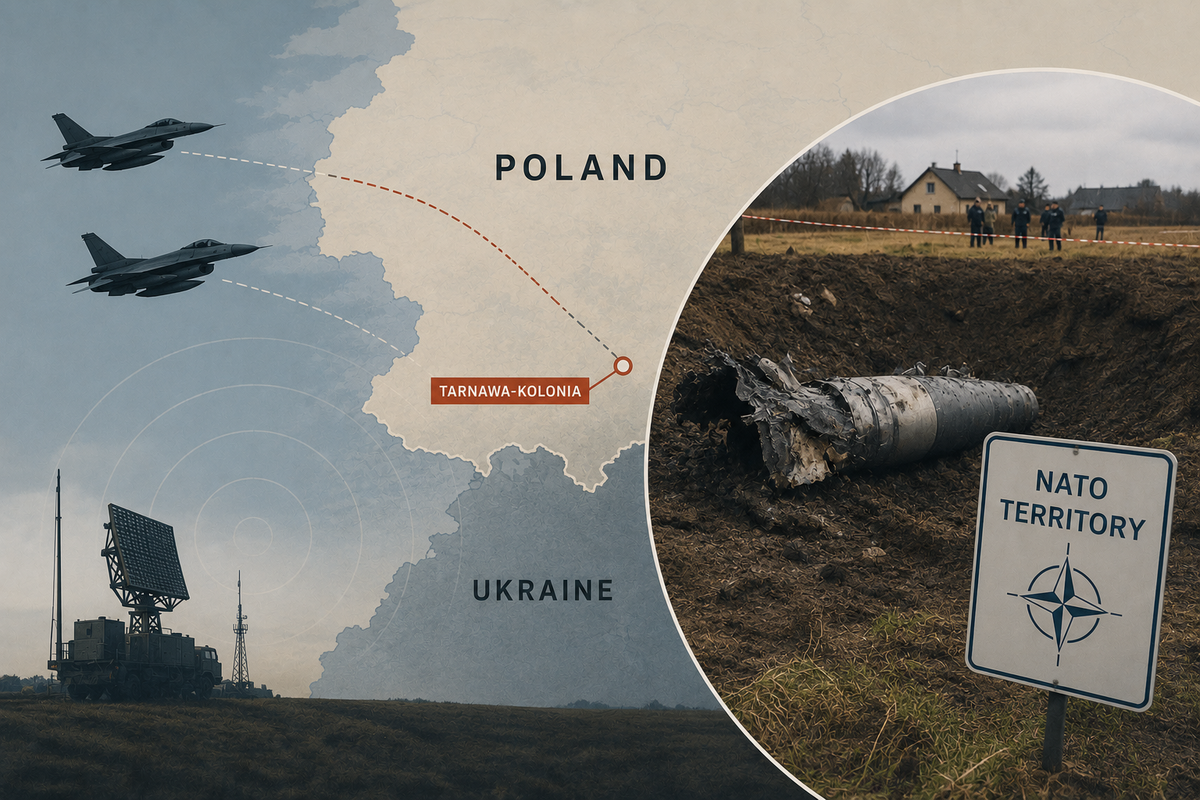
Poland's Armed Forces Operational Command (DORSZ) detected an unidentified object in Polish airspace at 03:40 local time overnight into 30 July, during a mass Russian strike on western Ukraine. An F-16 was scrambled to intercept, but the object disappeared from radar at 03:46. Its likely crash site was later found near Tarnawa-Kolonia in Lublin province — roughly 80–100 km from the Ukrainian border and about 2 km from the nearest buildings — leaving a crater roughly 10 meters wide and 5 meters deep, with debris scattered across an area of about 200 meters. There were no casualties.
Prime Minister Donald Tusk, convening a coordination group with Deputy PM and Defense Minister Władysław Kosiniak-Kamysz and Interior Minister Marcin Kierwiński, said "all indications are that it was a Russian Kh-101 missile," while stressing the need for 100% certainty on the missile type and who launched it. Ukraine's acting Foreign Minister Andrii Sybiha had already identified the object as a Kh-101 — a strategic, air-launched cruise missile with a range exceeding 4,000 km that Russia regularly uses against Ukrainian civilian infrastructure.
What Changed Since the Morning Report
This morning's picture was limited to a preemptive scramble of Polish and allied aircraft during Russia's strike on western Ukraine. Now a physical crash site has been found on NATO territory, backed by the Polish prime minister's preliminary assessment that it was a Russian missile. That moves the episode from the category of an airspace-violation risk into the category of a likely actual incursion and fall of a Russian munition on Polish soil — considerably more serious than a brief incursion followed by a return to Ukrainian airspace.
A Historical Parallel
This isn't the first time a Russian munition has fallen on Polish territory during the war: in November 2022, two missiles struck the village of Przewodów, also in Lublin province, killing two civilians. Today's incident, in the same Polish region, caused no casualties, but confirms that the risk of such falls on Polish soil remains a systemic possibility rather than a one-off from four years ago.
Why It Matters for the Region
The incident highlights an existing gap in the eastern flank's air defense: detecting and tracking a target does not guarantee its destruction, particularly with a low-altitude flight path, a short reaction window, and trajectory uncertainty. Polish forces tracked the object for only about six minutes before it vanished from radar — and it crashed before it could be intercepted.
For the Baltic states, the practical relevance is direct: comparable decisions will need to be made in the event of missile or drone incursions from Russia — whether there's enough data for immediate engagement, which assets to use, and who makes the call when populated areas are at risk. Romania's four-day drone incursion series, which BSM covered this week, and today's Polish incident together outline the same dilemma playing out in different corners of the eastern flank: having the technical ability to shoot down a target doesn't mean every target gets destroyed, and the decision window is sometimes measured in minutes.
Likely Consequences
- Poland may request consultations and further clarification within NATO, though there are no signs yet of an Article 4 process being triggered;
- Pressure will grow on the Alliance to deploy more short- and medium-range ground-based systems along the Polish-Ukrainian border;
- Poland's interception rules may be revised toward earlier engagement of targets with a confirmed Russian trajectory;
- The incident will become an additional argument for accelerating integration of Polish air defense with Ukrainian early-warning data;
- Russia will likely deny the object was theirs or demand that forensic analysis be completed first.
Conclusion
The difference between "a missile entered and turned back" and "a missile fell on NATO territory" isn't rhetorical — it's operational: the first remains an airspace incident, the second is now a confirmed strike on Alliance territory by an adversary's munition, even without casualties. The six-minute window between detection and the target vanishing from radar is the parameter that will determine how seriously Poland and its neighbors revise their own rules of engagement in the weeks ahead.
Baltic Security Monitor (osint-baltic.com) — an analytical publication covering security on NATO's northeastern flank.