The Freshness That Wasn't: OSINT Digest — 27 July 2026

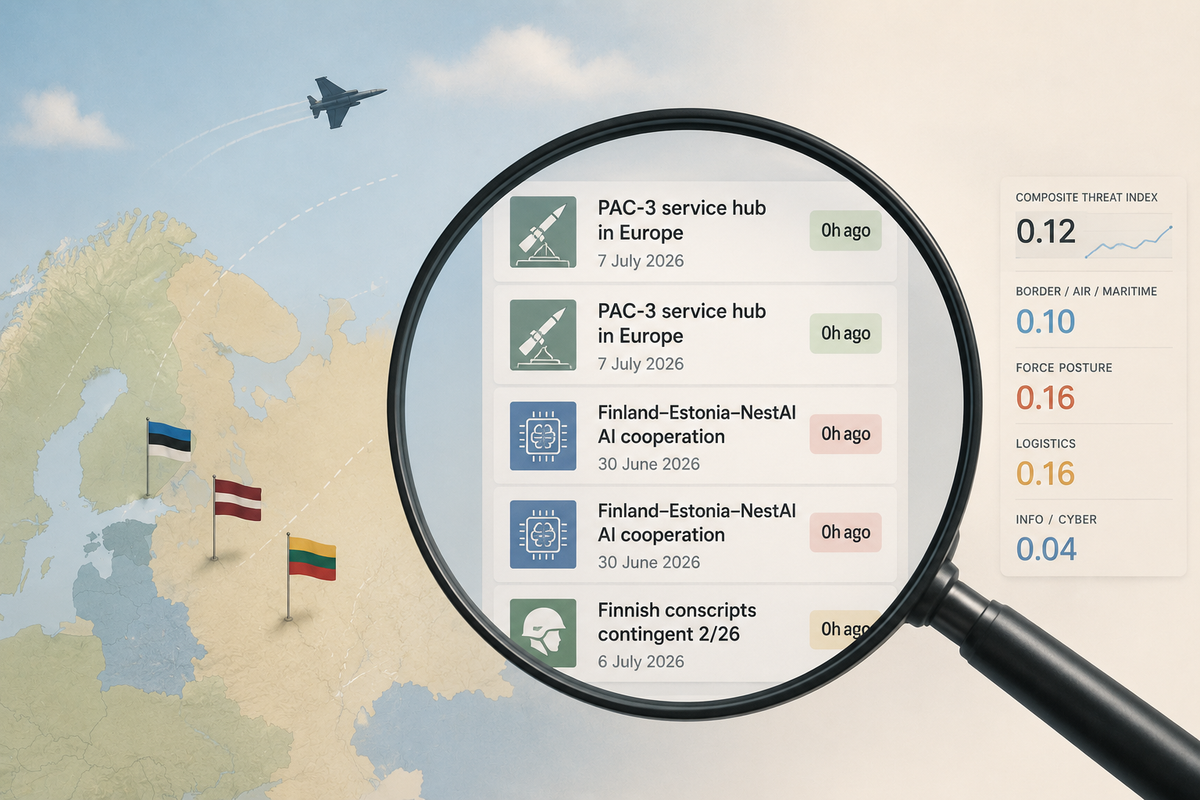
Baltic Security Monitor | Analytical Brief Snapshot: 2026-07-27T10:55:15Z
OSINT Indices
| Indicator | Value | Note |
|---|---|---|
| Composite Threat Index | 0.12 | Δ 6h: 0.00 / Δ 24h: 0.00 |
| Force Posture | 0.16 | now above Border/Air/Maritime — a rare inversion |
| Logistics | 0.16 | tied with Force Posture |
| Info/Cyber | 0.04 | trace signal |
| Border/Air/Maritime | 0.10 | lowest reading of the entire monitoring cycle |
Events logged (24h): 24 (roughly double the typical volume) · High-confidence: 0 Quarantine: 8 (schema-mismatch: 6, low-information-density: 2) · Retry-eligible: 6 · Source failures: 0 Freshness: top-5 median age 0h, but median ingest lag 13.8h, p90 64.4h
A composite of 0.12 reads, at first glance, like another quiet day — close to the cycle's historical floor. But this is the first snapshot in the entire monitoring period where Border/Air/Maritime has dropped below both Force Posture and Logistics, which now sit tied at 0.16 — a structural inversion of the pattern that has held since May. The more consequential finding sits elsewhere: at least four of today's five top entries are three-week-to-month-old news, each stamped by the system as "0 hours" old. This isn't a spike in activity. It's a freshness failure dressed up as a new day.
Top-Five Structure: A Reality Check
1–2. PAC-3: an agreement that is three weeks old
OSINT score: 0.47 (both entries, duplicated) — WATCH
The digest lists the same event twice under adjacent rankings: the agreement to build a European maintenance center for PAC-3 interceptor missiles for Patriot systems, involving the US, Poland, Germany, the Netherlands, and Sweden. The deal was signed on 7–8 July 2026, while Poland's Deputy Prime Minister and Minister of National Defence Władysław Kosiniak-Kamysz was in Ankara for the NATO Summit. In other words, this is not today's news — it is 20 days old and has already been covered by dozens of defense outlets.
BSM Assessment: duplicating a single event across two top-5 positions, each carrying an identical 0.47 score, points to a pipeline fault — either double-indexing the same source or conflating two mirrored publications of the same story. Labeling something "0 hours old" when it is 20 days old goes beyond the digest's own stated ingest-lag ceiling (a p90 of 64.4 hours) — this looks less like lag and more like a reprocessing or timestamp error.
3–4. Finland–Estonia–NestAI: an agreement with a broken date
OSINT score: 0.43 and 0.41 — WATCH (two entries, identical text, different scores)
The Finnish Ministry of Defence, the Estonian Defence Forces, and the European AI lab for Defence NestAI signed a Letter of Intent on 30 June 2026 to advance the development of artificial intelligence capabilities. The digest's own event text carries the date "30.5.2026" — directly contradicting the "30 June 2026" stated one sentence later. This is the second corrupted date in today's top-5.
BSM Assessment: beyond the bad date, the two duplicate entries received different scores (0.43 vs 0.41) for identical text — a sign the scoring model is inconsistent on near-duplicate input rather than deduplicating it. The underlying event itself is not escalatory: a non-binding framework agreement signed nearly a month ago.
5. Finnish conscript contingent 2/26
OSINT score: 0.41 — WATCH
This entry reports conscripts starting service on 6 July 2026 — three weeks before today's snapshot. A routine rotational item, not an escalation signal by any reading.
(Today's top-5 is, in substance, three unique stories stretched across five slots via duplication; the newest of them is 20 days old.)
The Signal the Digest Missed
While the top-5 recycles July's NATO Ankara Summit, the actual regional story of the past week is elsewhere — and it did not make it into the digest. On 20 July, Lithuanian Defence Minister Robertas Kaunas said the Kremlin needs a new victory and that Moscow's attention is turned toward the Baltic states and Poland — a continuation of the wave of presidential provocation warnings BSM has tracked since early July. That same day, NATO fighters carried out three separate interceptions of Russian aircraft over the Baltic Sea, while air-raid sirens sounded across Poland as part of a drill. None of that appears in today's top-5, and Info/Cyber and Border/Air/Maritime are both at their cycle lows. This time the gap between the pipeline and the open-source record isn't about threat assessment — it's about what the pipeline considers "today's news" in the first place.
Regional Context
The provocation narrative BSM first flagged on 6 July (anonymous Telegraph and Guardian leaks) through 15–16 July (public confirmation by the Lithuanian and Latvian presidents) continued to develop after BSM's last documented digest on 16 July. Germany, Poland, and the Baltic states now lead European NATO members on defense spending, preparing to absorb a first wave of possible Russian aggression on their own, without guaranteed US backing. The undocumented gap in BSM's digest archive between 17 and 26 July coincides precisely with this period of intensifying public debate — which makes today's "quiet" snapshot a sharper contrast than the numbers alone suggest.
Conclusion
Today's digest is not a story about low threat levels — a composite of 0.12 is, on its own, close to the cycle's historical floor and not news. It is a story about data integrity: event volume has doubled (24 vs. a typical 10), the digest logged its first documented quarantine batch (8 entries, mostly schema-mismatch), and the entire top-5 is built from month-old republished news tagged "0 hours old." When an automated indexing system starts confusing publication date with processing date, the composite index stops measuring threat and starts measuring the health of the pipeline itself.
Baltic Security Monitor (osint-baltic.com) — an analytical publication covering security on NATO's northeastern flank. All OSINT coefficients are calculated by an automated indexing system based on open sources.