The Cluster That "Isn't There": OSINT Digest, July 16

Baltic Security Monitor | Analytical Briefing Snapshot: 2026-07-16T12:55:15Z
Today's OSINT indices
| Indicator | Value | Movement |
|---|---|---|
| Composite threat index | 0.07 | Δ6h 0.00 · Δ24h 0.00 — flat for an eighth straight snapshot |
| Force Posture | 0.00 | zero |
| Logistics | 0.00 | zero |
| Info/Cyber | 0.00 | zero |
| Border/Air/Maritime | 0.30 | second day at the WATCH threshold, a slight dip from 0.31 |
Events logged in 24h: 10 · High-confidence: 0 Quarantined: 0 · Source failures: 0
Three of the four sub-indices sit at exactly zero today. That means the composite score is almost entirely determined by a single number — Border/Air/Maritime (0.30) — divided by four (0.30 ÷ 4 = 0.075 ≈ 0.07 as reported). For the first time, the composite formula is visible with total clarity: today's "overall threat level" is, in effect, one sub-index, not a composite of several.
Top five: a sixth straight snapshot with no new entries
The same list as July 6, 7, 10, 13 and 15: the SNMG2 command handover (0.44), NATO's training-opportunities catalogue (0.35), Maven Smart System (0.28), Task Force X-Central Mediterranean (0.28), and the NISRF Exercise ACE wrap-up (0.28). No new entries.
BSM analysis: Six days of an identical top five confirm an established finding: the system's source base is limited to official NATO publications, and the northeastern flank remains structurally underrepresented within it. That makes it especially worthwhile to look beyond the top five — and that's exactly where this week's most important development sits.
The signal of the day: a cluster that "supposedly isn't there"
Recent automated pipeline reports have noted the absence of a "high-confidence multi-source cluster" around the topic of provocations against the region. That claim is worth checking independently — and it doesn't hold up against open-source reporting.
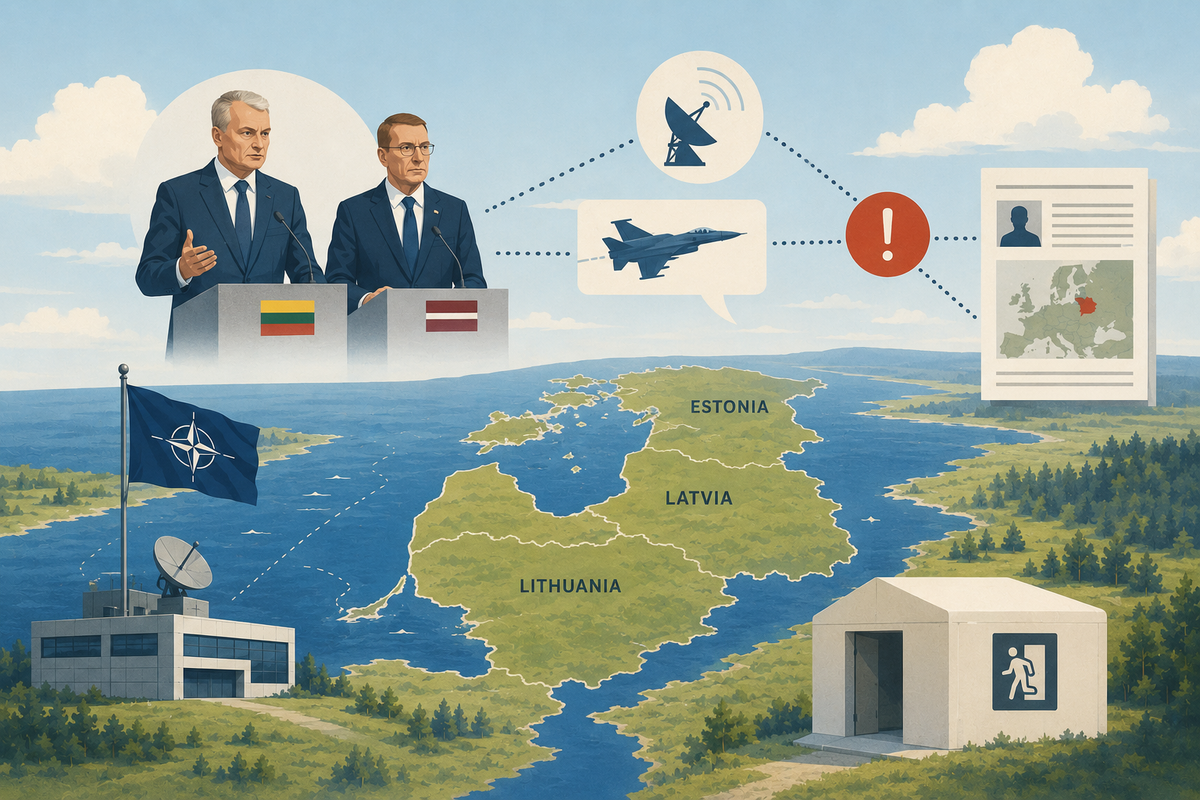
On July 15, Lithuanian President Gitanas Nausėda and Latvian President Edgars Rinkēvičs, at a joint press conference in Vilnius, publicly confirmed intelligence assessments about Russia preparing limited kinetic attacks on critical infrastructure in the Baltic region. Nausėda said: "I cannot deny that we have such information and that it concerns limited kinetic operations likely targeting critical infrastructure." Rinkēvičs added that even without a total Ukrainian victory, Russia might indirectly test Article 5 and NATO/EU response mechanisms, calling the next 12 months crucial for Baltic security.
In parallel, Polish Foreign Minister Radosław Sikorski warned of a possible false-flag scenario involving Ukrainian drones, and Poland intercepted Russian aircraft over the Baltic Sea on Tuesday and Wednesday (July 14–15) that, according to the Polish government, were surveilling Poland's air-defence systems while staying outside territorial waters. In response, Kremlin spokesman Dmitry Peskov dismissed the Lithuanian warning as "a fresh batch of bugaboos" meant to justify NATO's military buildup in the Baltics.
On July 16, Ukraine's Center for Countering Disinformation published its own assessment aligning with the Lithuanian and Latvian statements: that Russia is preparing hybrid operations and provocations against NATO countries, specifically citing Sikorski's and Nausėda's warnings.
BSM analysis: This is exactly the kind of cluster the automated reports say "isn't there": two sitting presidents on the record, corroboration from a third country's foreign minister, a documented aircraft-interception incident, an official Kremlin response, and an independent assessment from a Ukrainian state body — all published within a 24–48 hour window. None of these sources belongs to the NATO.int-adjacent set the pipeline indexes, so the cluster stays invisible to the system despite being real and well-documented in the open-source record.
Worth noting, too, is a third, more cautious voice: according to LRT/Delfi, some Baltic security officials say no concrete plan, date or organizer has been identified — the risk remains a probabilistic assessment rather than confirmed intelligence about a specific operation.
Regional context: a story BSM has tracked since early July
This is now the third wave of the same signal BSM flagged on July 6 and July 13 — back then it was anonymous leaks to the Telegraph and the Guardian; now it's direct public statements from two presidents. The escalation in how the story is delivered — from "sources say" to "the president confirmed in an interview with the national news agency" — is itself a meaningful signal, independent of whether any provocation actually occurs.
Conclusion
Today's composite index is, in effect, a single number — the Border/Air/Maritime sub-index, diluted by three zeros. The top five hasn't changed for a sixth straight snapshot. And the cluster of events that should explain the region's elevated tension exists, is documented, and is tightly clustered in time — just not in the sources the pipeline can see.
Baltic Security Monitor (osint-baltic.com) — an analytical publication covering security on NATO's northeastern flank. All OSINT coefficients are calculated by an automated indexing system based on open sources.