The Carpathian Eight Shows Its Hand: Ukraine Gets a Fuel Rear Guard on Two Fronts

Baltic Security Monitor | Material Update
21 September 2026, 14:00 (Europe/Tallinn)
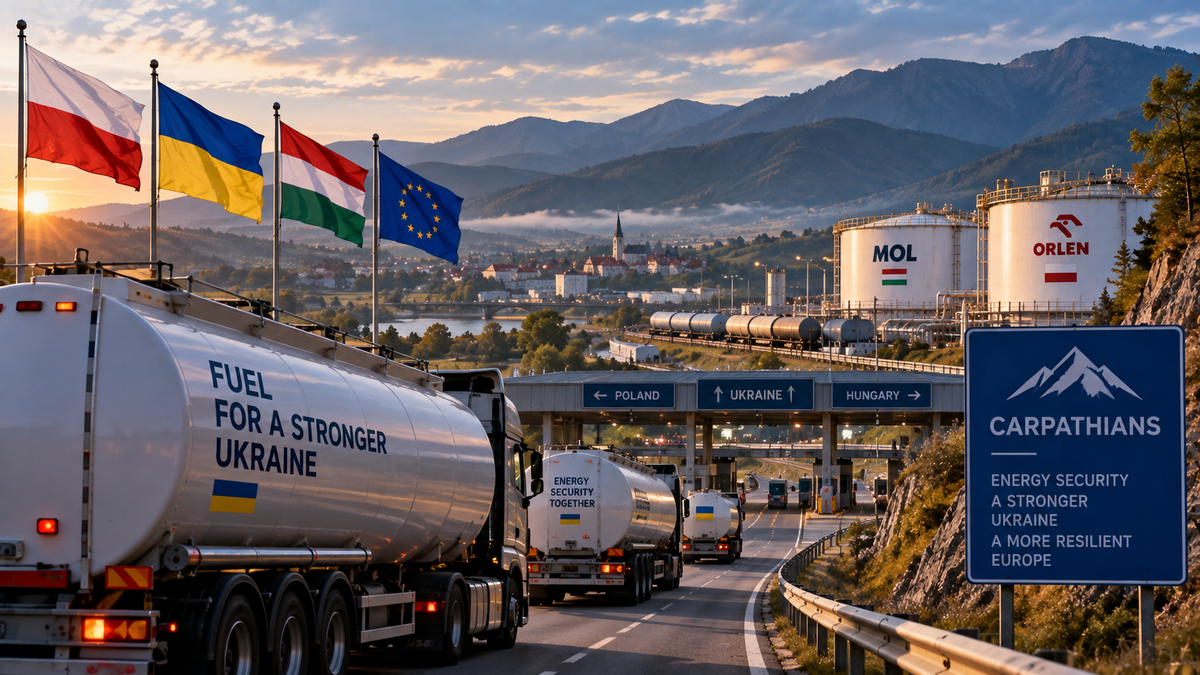
Within days of each other at the Carpathian Eight summit, Kyiv signed two separate fuel memoranda — one with Poland, one with Hungary. Together they sketch the contour Ukraine has lacked since Russian strikes took out much of its domestic refining capacity: reserve infrastructure on both flanks of the Carpathians at once.
ORLEN–Naftogaz: fuel worth up to $500 million, LNG, and refining
On 21 September, during the Carpathian Eight summit, Poland's ORLEN and Ukraine's Naftogaz signed two memoranda. The first, with Ukrnafta, covers petroleum-product supplies to the Ukrainian market worth up to $500 million, and opens work on sending Ukrainian crude to Central European refineries plus a possible transfer of used fuel tankers to Ukrnafta. The second, per Naftogaz, provides for three LNG cargoes in the first quarter of 2027, meant to help cover peak winter demand.
Reuters independently confirmed both figures — three LNG cargoes and the fuel package worth up to $500 million. The distinction matters: this is a signed framework, not completed delivery. ORLEN describes the LNG cargoes as potential supplies still to be explored, while Naftogaz frames them as available "if required."
BSM analysis: The refining component outweighs the dollar figure. Ukraine's own refineries have been severely degraded or destroyed by Russian strikes, so the ability to send domestically extracted crude to Central European refineries is not just an import channel — it's a separate resilience mechanism that partially restores a production link Ukraine has lost.
MOL–Naftogaz: border storage, out of strike range
The summit's second track is the Hungarian deal. On 20 September, at the Carpathian Economic Forum held as part of the same C8 format, Naftogaz and Hungary's MOL signed a memorandum to build petroleum-product storage facilities in Hungary, near the Ukrainian border. Acting Naftogaz CEO Serhiy Fedorenko said diversifying supply routes and building capacity outside the strike zone is a matter of stability for the entire market.
Details remain thin: a memorandum is not a construction decision, and there is no confirmed launch date, investment figure, or planned storage capacity yet disclosed. The agreement concerns refined petroleum products, not natural gas.
BSM analysis: Russian forces had already destroyed most of Ukraine's large oil depots and fuel-storage facilities early in the full-scale war, forcing a restructuring of supply logistics. Moving part of the reserve outside the reach of Russian strikes is a direct answer to that experience, and, per Hungarian Conservative, one of the first tangible Hungarian projects tied to the C8 format launched on 18 September. It is also notable that Budapest — which kept Kyiv at arm's length for years — is moving on this now, following the political shift after Orbán's departure as prime minister.
Regional context: the summit as a fuel umbrella
The C8 format brings together Ukraine, Hungary, Poland, Slovakia, Romania, Czechia, Austria, and Serbia; per Reuters, more than 50 agreements worth over €1 billion were signed around the summit, more than half of them energy-related. At YES 2026 in Kyiv, Prime Minister Serhiy Koretskyi acknowledged that defending every individual asset is unfeasible, so the government's focus is on decentralizing critical energy, heating, and water networks so strikes on individual nodes don't trigger systemic collapse. He noted Ukraine had already reached its baseline winter gas-storage target a month ahead of schedule.
Bottom line
Two memoranda in two days of the same summit is not a coincidence — it signals that Ukraine's fuel resilience is now being built as a network of external reserves on both flanks of the Carpathians, rather than a single vulnerable point on the map. The next material deltas to watch: conversion of the Hungarian memorandum into a binding contract with a defined storage capacity, first deliveries under the Polish fuel line, and confirmation that Ukrainian crude is actually being processed at Central European refineries.
Baltic Security Monitor (osint-baltic.com) — an analytical publication on security along NATO's northeastern flank.
Compiled from official ORLEN and Naftogaz statements and independently verified through open sources.
Sources
- ORLEN, official statement, 21 September 2026
- Naftogaz, official statement, 21 September 2026
- Reuters — ORLEN to supply Ukraine with LNG and fuel
- Kyiv Post — Naftogaz, MOL Make Pact for Border Fuel Storage in Hungary
- Euromaidan Press — Ukraine and Hungary agree to build fuel storage beyond Russia's reach
- Hungarian Conservative — Hungary Plans 'Safe Haven' for Ukrainian Fuel