The Calm Before Ankara: OSINT Digest, July 6

Baltic Security Monitor | Analytical Briefing Snapshot: 2026-07-06T08:18:16Z
Today's OSINT indices
| Indicator | Value | Movement |
|---|---|---|
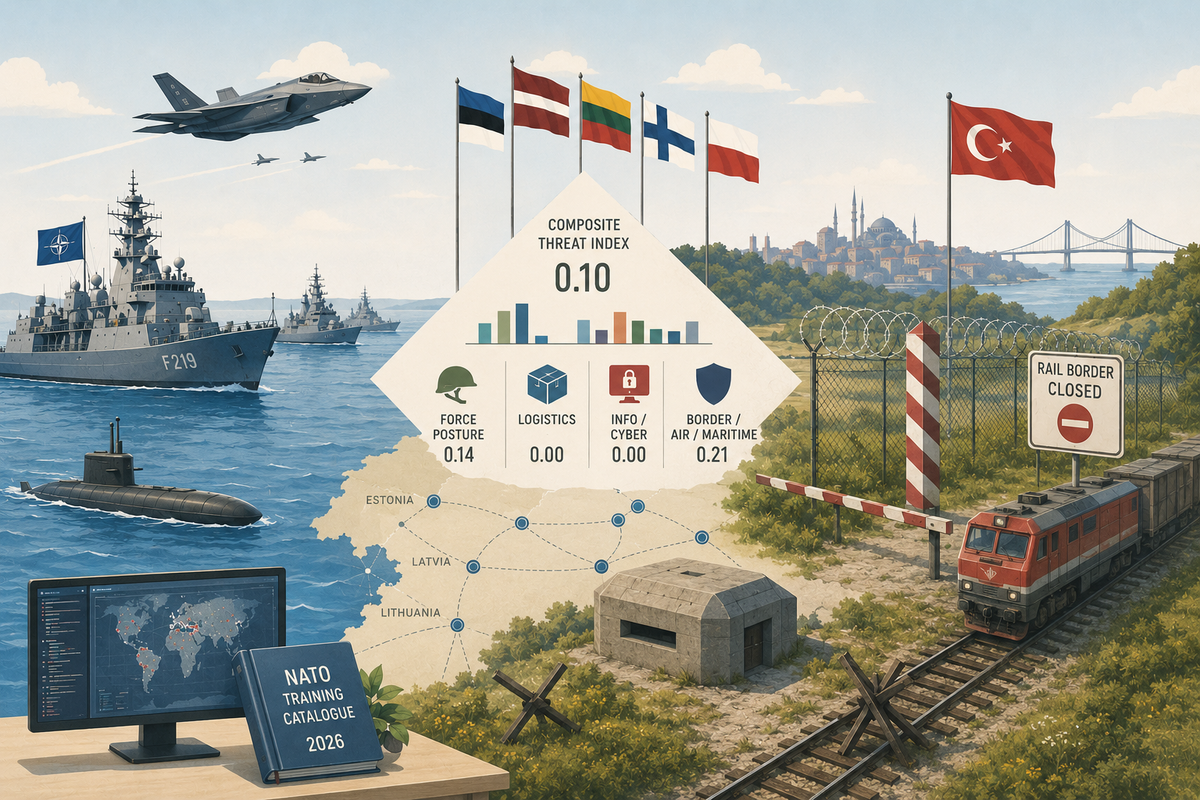
| Composite threat index | 0.10 | Δ6h 0.00 · Δ24h 0.00 — flat on both horizons |
| Force Posture | 0.14 | — |
| Logistics | 0.00 | — |
| Info/Cyber | 0.00 | — |
| Border/Air/Maritime | 0.21 | highest of the four sub-indices |
Events logged in 24h: 10 · High-confidence: 0 Quarantined: 0 · Source failures: 0
The composite index hasn't moved in either the 6-hour or 24-hour window — a rare state of total stillness. But that stillness is deceptive: none of today's top-five entries concern the northeastern flank. They're about the Mediterranean, a NATO training catalogue, and a technology milestone reached two weeks ago. Meanwhile the region's actual tension — Russia quietly shutting rail crossings with Finland, Estonia and Latvia, and a US warning to Poland about a possible provocation — sits entirely outside the digest. The system is reading administration. The region is living a different agenda.
Top five digest entries
🔵 1. Italy hands over NATO maritime task group command to Greece
OSINT score: 0.44 — WATCH
The Italian Navy concluded its six-month command of Standing NATO Maritime Group Two (SNMG2), transferring authority to the Hellenic Navy at an official ceremony aboard ITS Virginio Fasan at Taranto Naval Base. Rear Admiral Cristian Nardone formally handed command to Commodore Georgios Kypriotis, with Greece now leading SNMG2 for its next operational cycle.
BSM analysis: This is the day's highest-scoring event, but geographically it belongs to the Mediterranean and NATO's southern flank — not the Baltic or the north. Its position at the top of the list illustrates a structural quirk of the indexing system: routine change-of-command ceremonies reliably score high regardless of region, while genuine northeastern-flank developments (see below) haven't yet been picked up.
🔵 2. UK Carrier Strike Group joins Ramstein Flag 2026
OSINT score: 0.39 — WATCH
HMS Prince of Wales took part in Exercise Ramstein Flag 2026, held June 8–19, contributing fifth-generation air power to NATO's largest air exercise in Europe. The exercise spanned 20 locations from Norway to Spain and Finland, with up to 150 NATO aircraft from 18 nations flying roughly 150 sorties a day over 11 days.
BSM analysis: This is a retrospective entry — the exercise itself ended on June 19, and its appearance in today's snapshot reflects delayed source processing rather than a fresh signal. Notably, the carrier group's F-35Bs refuelled on Finnish highways during the drill, underscoring how deeply Finland is now woven into NATO's forward air infrastructure.
🔵 3. Chair of the NATO Military Committee visits Ramstein Flag 2026
OSINT score: 0.36 — WATCH
A second delayed entry from the same exercise cycle. (Context above, entry #2.)
🟣 4. NATO Education and Training Opportunities Catalogue (ETOC)
OSINT score: 0.35 — WATCH
An administrative-educational record: an update to NATO's training-programme catalogue. A purely bureaucratic entry whose presence in the top five reflects source activity rather than operational significance.
BSM analysis: A textbook example of index "noise" — a formal OSINT score (0.35, above the WATCH threshold) attached to an entry with no bearing on threat dynamics. A day when a quarter of the top five is a training catalogue is either a genuinely quiet day, or a sign that indexing hasn't caught up with reality yet.
🟠 5. NATO Maven Smart System reaches full technical operational capability
OSINT score: 0.28 — WATCH
NATO's Maven Smart System (MSS) achieved full technical operational capability on June 22, marking a major milestone in the Alliance's digital transformation. NATO's Security Accreditation Board granted the system full accreditation to operate on the Alliance's classified network, giving, in the words of Task Force Maven's director, "full authorization to operate NATO MSS for everything, including exercises, missions, and activities."
BSM analysis: This is the week's most consequential entry that the composite index effectively ignores — today's Info/Cyber sub-index sits at zero, despite a full-scale AI command-and-control rollout across NATO. Meanwhile, Spain has begun blacklisting Palantir Technologies, MSS's developer, from state contracts over concerns about feeding classified national-security data into the platform. The gap between a formal zero in Info/Cyber and this event's actual weight is further evidence that today's composite score undercounts the information-technology dimension of security.
The signal the digest missed
While the top five logs ceremonies and technology milestones, the two developments that matter most for the northeastern flank this week never made it into the digest.
First, starting July 1, Russia temporarily closed several railway border crossings with Finland, Estonia and Latvia, with a government decree ordering a halt to "the movement of persons, vehicles, goods, and freight" at seven crossings. Five of the shuttered checkpoints sit on the Finnish border, while Estonia and Latvia each lose one crossing; Estonia's Ivangorod crossing and Latvia's Sebezh crossing remain open. The closures leave Finland with no open rail link to Russia at all, which normally exports fertiliser to Finland by rail. Moscow gave no reason for the decision.
Second, The Telegraph reported that the United States has warned Poland that Russia is preparing an armed "provocation" on Polish territory, potentially launched from Kaliningrad — where Russian nuclear weapons are stationed — or from Belarus. Scenarios reportedly range from drone or missile strikes on critical infrastructure and simulated air raids designed to force Poland to activate its air-defence systems, to a small-scale ground incursion by Russian or Belarusian forces. Polish security sources believe the goal is to escalate pressure on the West to halt aid to Ukraine.
BSM analysis: Both developments carry far more weight for regional risk than anything in today's official top five. That neither registered in the composite index isn't a system failure so much as a demonstration of its nature: it indexes published NATO sources and structured news events, while fast-moving intelligence and diplomatic signals — unexplained government decrees, intelligence warnings — take longer to work through the pipeline.
Regional context
Estonia and Latvia have launched a joint tender for 600 concrete bunkers to be installed along the Baltic Defence Line — a joint initiative of the three Baltic states announced in January 2024, costed at roughly €60 million, with completion targeted for the end of 2027. Elements of the first 28 bunkers have already been delivered to Estonia, with nine installed in the country's southeast.
On the Polish side, Poland is on track to double its armed forces to 250,000 troops in 2026, with a longer-term goal of 500,000 by 2039, while moving toward 5% of GDP in defence spending that same year. In January 2026 the presidents of Poland and Lithuania agreed to build a joint cross-border training area in the Suwałki Corridor — the most vulnerable stretch of NATO's eastern flank, pinched between Kaliningrad and Belarus.
On the eve of Ankara
The 36th NATO Summit will be held in Ankara on 7–8 July 2026 — the second time Türkiye has hosted, after Istanbul in 2004. Turkish authorities have already deployed roughly 70,000 police and gendarmerie for the two-day event. Zelensky will attend Ankara for an official dinner hosted by President Erdoğan and will address the Defence Industry Forum, with a NATO-Ukraine Council meeting also scheduled.
Today's frozen composite index and administratively-heavy top five should be read against that backdrop. This isn't de-escalation — it's a pause before summit rhetoric meets the facts on the ground.
Conclusion
Today's snapshot exposes the gap between what the automated indexing system sees and what's actually happening in the region. The composite index is stuck at 0.10, and the top five is filled with change-of-command ceremonies, a training catalogue, and a two-week-old technology milestone — while, off the record, Russia quietly shuts rail crossings with three regional states and Washington warns Warsaw of a possible armed provocation. One day remains before NATO leaders gather in Ankara.
Baltic Security Monitor (osint-baltic.com) — an analytical publication covering security on NATO's northeastern flank. All OSINT coefficients are calculated by an automated indexing system based on open sources.