The Algorithm Goes Quiet, the Border Doesn't: OSINT Digest, August 11

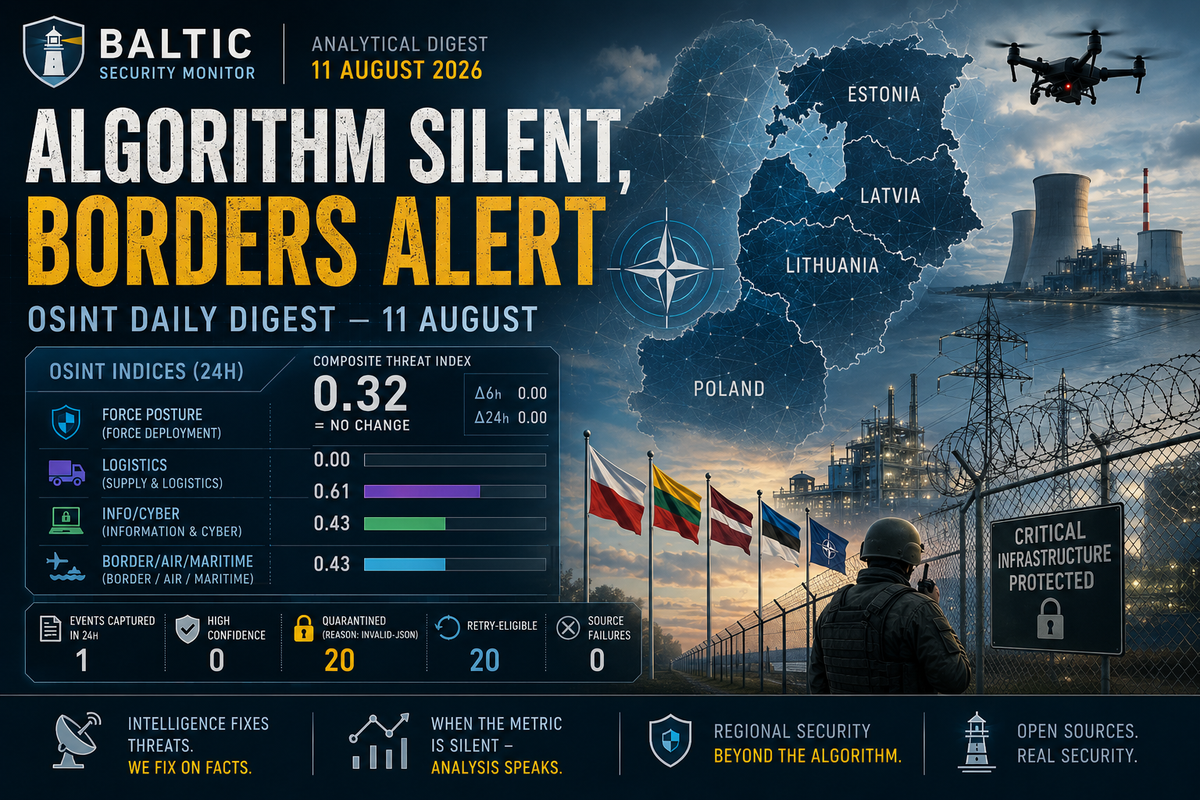
Baltic Security Monitor | Analytical Review Snapshot: 2026-08-11T14:09:32.921Z
OSINT Indices of the Day
| Indicator | Value | 24h Trend |
|---|---|---|
| Composite threat index | 0.32 | = unchanged (Δ6h 0.00, Δ24h 0.00) |
| Force Posture | 0.00 | flat zero — an unusual full absence of signal in this category |
| Logistics | 0.61 | highest subindex of the day |
| Info/Cyber | 0.43 | moderately elevated |
| Border/Air/Maritime | 0.43 | moderately elevated |
Events recorded in 24h: 1 · High-confidence: 0 Quarantined: 20 (cause: invalid-json) · Retry-eligible: 20 · Source failures: 0
This dataset needs a caveat. The composite index is flat today, with zero movement on both the 6-hour and 24-hour deltas, and Force Posture has dropped to an outright zero. The digest's own event counter reads "1," yet the top-events list contains three entries — an internal inconsistency BSM flags rather than papers over. Meanwhile, independent of the automated system, Reuters published an exclusive today on a significant hardening of critical-infrastructure security across Poland and the Baltic states — a story the digest missed entirely.
Top Digest Events (nominally five, actually three, one relevant)
🔵 1. Sweden Dismantles Russian Spy Network
OSINT score: 0.32 — WATCH (new entry)
Sweden's security service (SÄPO) said it shut down an espionage network directed by Russia's SVR foreign intelligence service, operating under the cover of diplomatic immunity. According to SÄPO, the network involved at least three individuals — an agent embedded in a foreign diplomatic mission in Stockholm, and two handling officers. SÄPO's deputy chief of operations, Christoffer Wedelin, said the agency had comprehensively mapped the network before intervening, tracking covert meetings at restaurants and parks across Stockholm. The operation had reportedly been planned and directed by the SVR for some time, aiming to influence Swedish decision-making and discredit Sweden, NATO and the EU. Diplomatic immunity ruled out prosecution, so SÄPO's response was limited to severing the network's communication channels; all three individuals subsequently left Sweden.
BSM analysis: The case fits SÄPO's previously documented pattern of using diplomatic cover to place intelligence personnel in the Nordic region. Notably, the agency did not pursue arrests — immunity made prosecution impossible, leaving disruption as the only available tool. This is the third publicly disclosed case of its kind in Sweden in recent years, and a signal that monitoring of diplomatic missions across Northern Europe is intensifying in step with NATO's expansion on the northern flank.
The Signal the Digest Missed
While the automated system showed zero Force Posture and a static composite, Reuters published an analysis noting that Poland and the three Baltic states — all bordering Russia and having already found Ukrainian drones on their territory — are taking no chances. Poland, Lithuania, Latvia and Estonia are strengthening security around critical infrastructure over fears that Moscow could stage a "false-flag" attack using captured Ukrainian drones.
Last month Lithuania deployed troops to help riot police guard its LNG import terminal, an oil products terminal, a key power link with Poland, and the Kruonis pumped-storage plant. Reuters reported on August 10, citing intelligence officials from all four countries, that they are tightening security around dams, power stations and gas infrastructure. Lithuania's Defence Minister Robertas Kaunas told Reuters directly: "We are not naive, we see the information, we read between the lines and we are doing our homework." Latvia's Prime Minister Andris Kulbergs confirmed heightened security at the Daugava dam near Riga and the Inčukalns underground gas storage facility, saying "a potential hybrid threat is more likely than it was before."
BSM analysis: This is precisely the kind of development that structurally explains today's elevated Border/Air/Maritime reading (0.43) — even without a corresponding entry in the top-list. Simultaneous infrastructure-hardening across four countries, backed by on-record statements from a defence minister and a prime minister, is not an isolated incident but a coordinated defensive posture against a possible provocation. The fact that BSM's automated pipeline missed this story entirely — it doesn't even register within the digest's "1 event in 24h" — is itself a signal about the system's source coverage limits, not about a lack of regional activity.
Pipeline Health: 20 Quarantined Events in 24 Hours
This cycle recorded 20 quarantined events over 24 hours, all attributed to invalid-json, all flagged retry-eligible. At the same time, the system logged only one "accepted" event and a Force Posture reading of exactly 0.00. BSM publishes these figures without smoothing them over: when roughly a quarter of the potential event stream is being dropped to parsing errors, and the accepted minimum includes two irrelevant articles, a composite of 0.32 should be read as a floor estimate, not a definitive measure of regional activity.
Regional Context
Defence spending remains highest, within Europe, precisely among the states now hardening infrastructure security: Lithuania at 5.38% of GDP, Latvia at 4.9%, both continuing to outpace the NATO European average. In parallel, the Swedish espionage case is a reminder that the threat isn't confined to frontline states — SVR diplomatic-cover operations are surfacing in Nordic countries well removed from the immediate line of contact.
Conclusion
Today illustrates a gap between what the automated metric shows and what is actually happening in the region. The composite sat frozen at 0.32, Force Posture dropped to zero, and a third of the top-list turned out to be noise — while Reuters independently confirmed a coordinated hardening of critical-infrastructure defences across four countries, against intelligence warnings of a possible false-flag provocation. BSM records this gap openly: when the pipeline goes quiet, that doesn't mean the region does.
Baltic Security Monitor (osint-baltic.com) — an analytical publication on security along NATO's northeastern flank. All OSINT coefficients are calculated by an automated indexing system based on open sources.