From Test Range to Battlefield in Eight Months: Ukraine Fires Its First FP-7 Ballistic Missile in Combat

Baltic Security Monitor | Analytical Brief Snapshot: 2 October 2026, 08:00 (Europe/Tallinn) · Material OSINT Update
"Thank you for the result. Next: production." That's how Zelenskyy described the first combat use of the FP-7 in a short video. Two sentences that mark a transition — from test range to battlefield, from a promise of independence from foreign missiles to an actual first launch.
What happened
Late on October 1, President Zelenskyy released a short video and wrote on Telegram and X: "Ukrainian tactical ballistic missile FP-7. First combat use. Thank you for the result. Next: production." He did not disclose the target, location or outcome of the strike. Reuters independently confirmed the announcement.
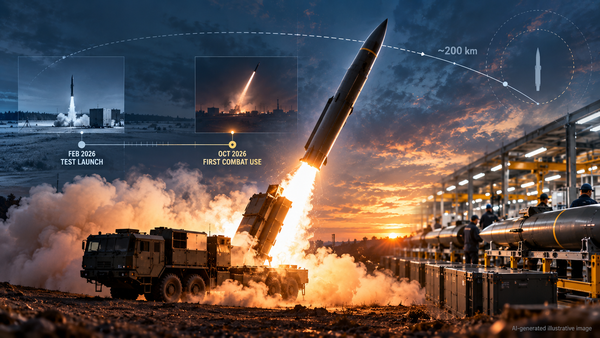
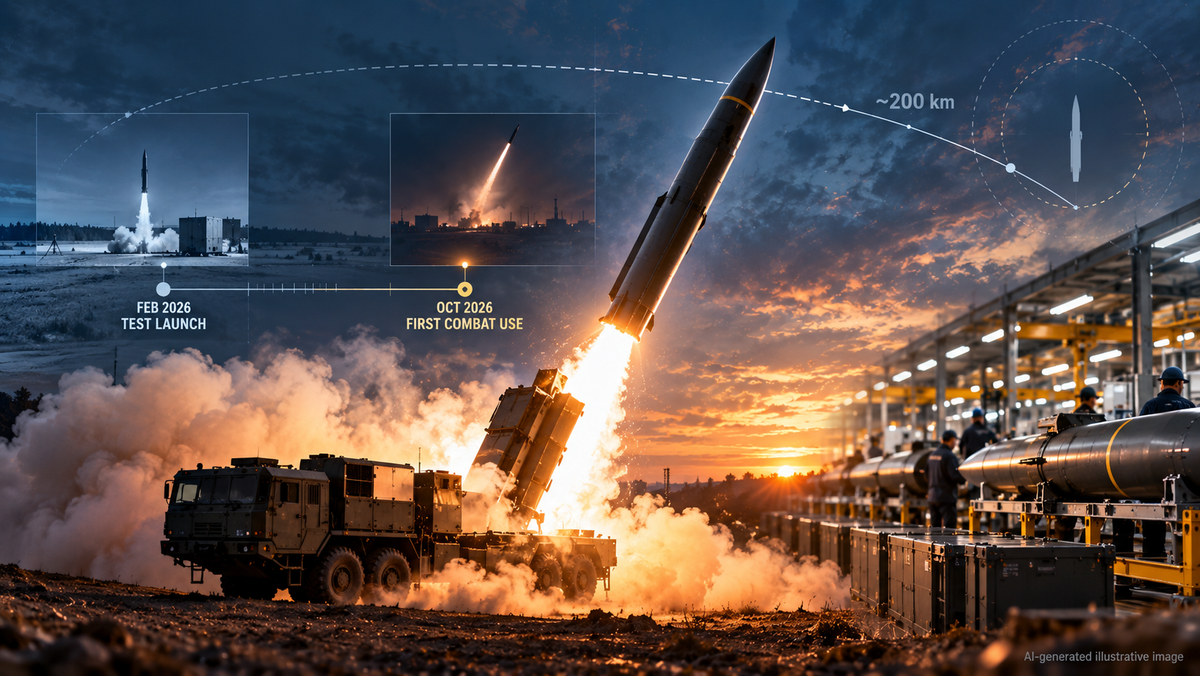
The missile's manufacturer is Fire Point, the same company behind the FP-1 strike drone and the FP-5 "Flamingo" cruise missile. FP-7's range is estimated at roughly 200 km — for comparison, the US-supplied ATACMS, which Ukraine has mainly relied on for ballistic strikes, flies up to roughly 300 km. Fire Point's founder and chief designer, Denys Shtilerman, has compared FP-7 to ATACMS, saying the Ukrainian missile costs roughly half as much.
Programme timeline
Development of FP-7 and the longer-range FP-9 was officially announced in September 2025. FP-7's first test launch took place in February 2026. In August, Zelenskyy said Ukraine's first domestically produced ballistic missile could see combat use this fall. According to Fire Point, the missile completed ground/laboratory and flight-testing stages in September before entering military trials. The October 1 launch is no longer another testing milestone — it's a concrete capability threshold.
Confirmed versus outstanding
| Claim | Status |
|---|---|
| First combat use of FP-7 occurred October 1 | ✅ Official Zelenskyy statement, confirmed by Reuters, video released |
| Manufacturer is Fire Point | ✅ Confirmed |
| FP-7 range roughly 200 km | ✅ Per available reporting (Ukrainian military analysts' estimate) |
| FP-7 is also being developed as part of the European Freyja missile-defence programme | ✅ Confirmed by Fire Point and Reuters |
| Target, strike location, number of missiles launched | 🟡 Not disclosed by Ukraine |
| Strike outcome (combat effectiveness) | 🟡 Not independently confirmed — this is an official Ukrainian claim backed by launch footage, not by evidence of target damage |
BSM analysis: why "first use" matters more than it might seem
Two separate facts here are easy to conflate. The first is the fact of combat use itself: officially confirmed, backed by launch footage, independently reported by Reuters. The second is the claimed outcome of the strike: purely a Ukrainian claim at this point, with no independent evidence of damage. BSM treats the first as a confirmed event and the second as unconfirmed.
The context explains why this matters now. Ukraine has for years relied largely on foreign-supplied precision missiles — chiefly ATACMS — while Russia retains a substantially larger ballistic-missile arsenal it regularly uses against Ukrainian targets. An indigenous tactical ballistic capability gives Kyiv a potential route to reducing dependence on foreign inventories and the political restrictions attached to their use (ATACMS, notably, has been employed under restrictions on targets inside Russia).
BSM analysis: A roughly 200 km range puts Russian command posts, logistics hubs, airfields, ammunition facilities and other tactical-rear targets within reach — without consuming scarce Western missiles. But one launch, on its own, changes nothing strategically. The key indicator isn't today's launch but whether the programme moves to serial production at volumes with military relevance. That's exactly why Zelenskyy's "next: production" line matters more than the launch itself — it signals where the programme's focus is now pointed.
The European dimension: Freyja
Fire Point says FP-7 technology is also being developed as a ballistic interceptor within Freyja, a European missile-defence programme launched this year. Davyd Aloian, deputy secretary of Ukraine's National Security and Defence Council, said in July that Ukraine wants a prototype for the Freyja European anti-ballistic system ready in the first half of 2027.
That connection shouldn't be overstated: yesterday's announced combat use was of FP-7 specifically as a tactical ballistic missile. There is no public evidence yet of an operational FP-7-derived anti-ballistic capability.
Checking other items from today
Overnight Russian strikes on Kyiv were also reviewed: on the morning of October 2, Russia struck the Southern Bridge for the second time in as many days, following a hit the previous day; traffic disruptions and other damage were reported. This is operationally significant locally but, on information available at this snapshot, does not constitute a new regional-security capability or escalation delta sufficient for a separate material update.
The earlier WATCH item on Garry Kasparov remains unresolved: Reuters confirmed he says US and Lithuanian security services warned him of an assassination threat, but public authorities have still not identified him as the intended target in the alleged plot.
Estonia's ban on Russian/Belarusian grain transit has taken effect but remains below the materiality threshold, since such transit through Estonia had previously been virtually nonexistent.
What it means for Ukraine and the region
For Ukraine, the signal is direct: if the FP-7 programme reaches serial production at meaningful volumes, it shifts the dependency balance on foreign precision-weapons supply — exactly the kind of dependency that has previously constrained the pace and geography of long-range strikes.
For the wider region, the significance is indirect for now, through the Freyja connection: if Ukrainian ballistic technology genuinely becomes the basis for a European interceptor, it adds another channel through which lessons from the war in Ukraine directly shape NATO's future air-defence architecture.
Conclusion
The first launch confirms the programme has crossed the threshold from testing to combat use. Whether that becomes strategically significant depends entirely on production volume — not on the fact of the first launch itself.
Next checks: confirmed serial-production rates; repeat combat launches; identified targets and damage evidence; formal acceptance by Ukraine's armed forces; disclosed accuracy/reliability data; deployment across multiple units.
Baltic Security Monitor (osint-baltic.com) — an analytical publication on security on NATO's northeastern flank. All OSINT assessments are produced by an automated monitoring system using open sources.