Summit Day, Yesterday's List: OSINT Digest, July 7

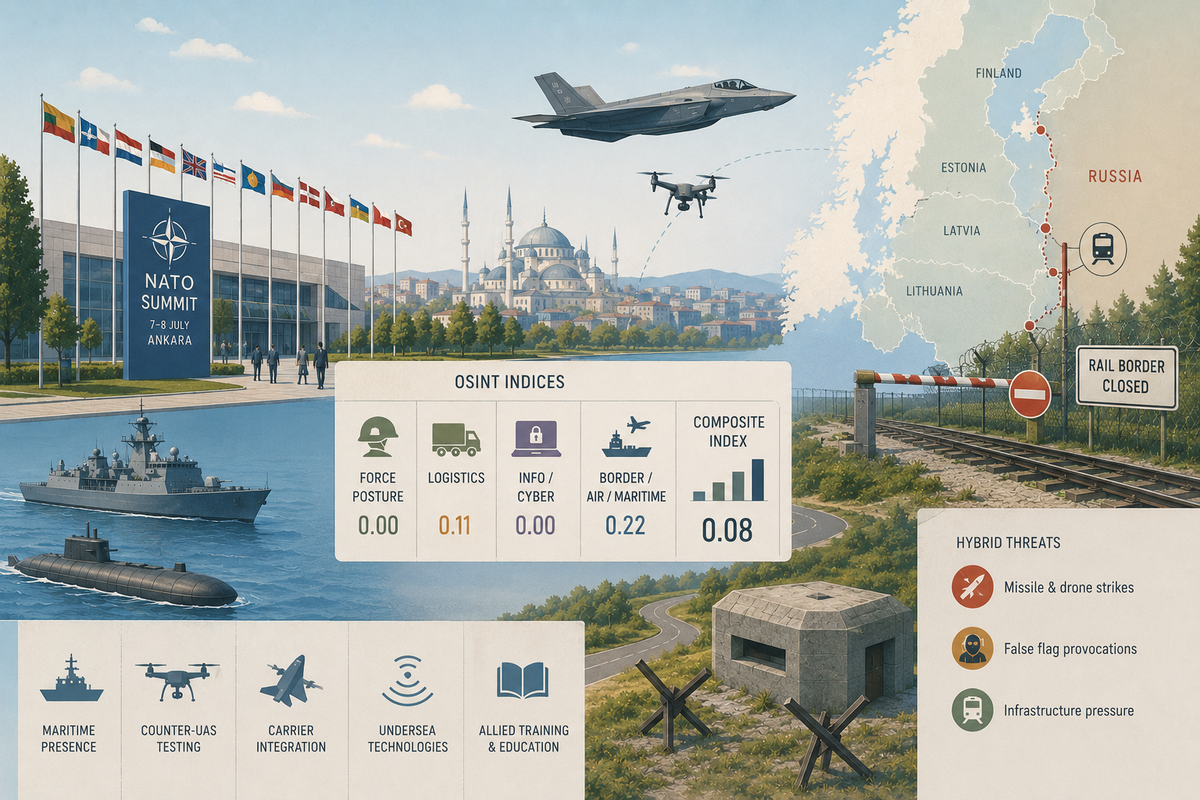
Baltic Security Monitor | Analytical Briefing Snapshot: 2026-07-07T10:18:02Z
Today's OSINT indices
| Indicator | Value | Movement |
|---|---|---|
| Composite threat index | 0.08 | Δ6h 0.00 · Δ24h 0.00 — motionless again |
| Force Posture | 0.00 | down from 0.14 yesterday |
| Logistics | 0.11 | appeared from zero yesterday |
| Info/Cyber | 0.00 | unchanged |
| Border/Air/Maritime | 0.22 | highest sub-index, stable for a second day |
Events logged in 24h: 10 · High-confidence: 0 Quarantined: 0 · Source failures: 0
Today's real headline isn't any of the five top entries — it's that the list is identical to yesterday's. Same five events, same scores (0.44 / 0.39 / 0.36 / 0.35 / 0.28), same order. And this happens on the very day NATO's 36th summit opened in Ankara — the alliance's biggest political event of the year.
Top five: unchanged for a second day
All five entries — Italy handing SNMG2 command to Greece, the UK Carrier Strike Group's role in Exercise Ramstein Flag 2026, the NATO Military Committee chair's visit to the same exercise, NATO's training-opportunities catalogue, and the Maven Smart System reaching full operational capability — repeat yesterday's snapshot verbatim, scores included.
BSM analysis: This isn't an indexing error so much as a demonstration of the system's ceiling. The sources it draws from — mostly official NATO pages — simply published nothing new in the last 24 hours, so the same entries resurface as the most current available. Tellingly, this coincides with the summit's opening day: the fact of the summit itself hasn't yet worked its way into the index, while lower-stakes but already-published material continues to occupy the top slots. It's a clean illustration that the composite index tracks publication speed on official sources, not real-world event weight.
The sub-indices beneath the frozen top five did shift: Force Posture dropped to zero, while Logistics appeared for the first time in two days at 0.11 — a technical signal rather than a substantive one, since no logistics-specific event actually made the top five.
The signal the digest missed
While the automated system holds yesterday's list, the region saw something overnight that speaks directly to BSM's coverage area.
Russia carried out another massive strike on Kyiv the night of July 6. Ukraine convened an emergency UN Security Council session; NATO's Secretary General stressed the strike was designed specifically to harm civilians. Against that backdrop, the Kremlin dismissed Western media reports of preparations for provocations against Poland as "Western propaganda" — to which Poland's Foreign Ministry responded pointedly: "They said the same thing a few weeks before the invasion of Ukraine." Polish Foreign Minister Radosław Sikorski framed the assessment in terms that track BSM's July 6 analysis: Russia is exhausted by the war in Ukraine, and that's precisely why it's preparing a provocation against NATO.
BSM analysis: The Kremlin's direct denial is an expected but substantive detail — it moves anonymous intelligence leaks into a formal diplomatic dispute, and Warsaw's response explicitly invokes the 2022 parallel. None of this made today's OSINT top five, further evidence that the composite index is running behind the region's actual diplomatic and security agenda.
Regional context: day one in Ankara
The summit opened today with the Defence Industry Forum, where NATO Secretary General Mark Rutte announced three new multilateral defence initiatives. One is a new Multilateral Defence Financing Mechanism (MDM) being built by the UK, the Netherlands, Finland and Poland to strengthen defence capabilities and improve allied spending efficiency. In parallel, Germany's government approved its 2027 draft budget with higher defence spending, while Spanish Prime Minister Pedro Sánchez, according to EFE, is expected to defend at the summit his position that Madrid's current spending level already meets its alliance commitments.
Beyond the summit itself, Politico reported on July 5 that NATO's eastern-flank states — Finland, Poland and the Baltic states — are actively preparing for a scenario in which they would have to absorb a first strike without guaranteed backing from Washington. Lithuania, Latvia and Estonia, constrained by geography, are focusing on the Baltic Defence Line and the deployment of a permanent German brigade of up to 5,000 troops meant to guarantee immediate European reinforcement in the event of a breakthrough attempt near the Suwałki Corridor.
Conclusion
For a second day running, the composite index sits nearly motionless and the digest's top five repeats yesterday's list word for word — on the exact day NATO's most consequential summit of the year opened in Ankara with concrete new defence-financing announcements. Meanwhile the Kremlin publicly denied preparing a provocation against Poland, and Warsaw answered with a direct historical parallel to 2022. The gap between what the system indexes and what's actually happening is wider today than it's been in days.
Baltic Security Monitor (osint-baltic.com) — an analytical publication covering security on NATO's northeastern flank. All OSINT coefficients are calculated by an automated indexing system based on open sources.