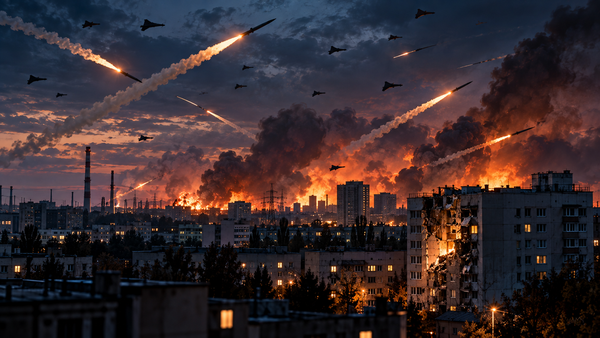
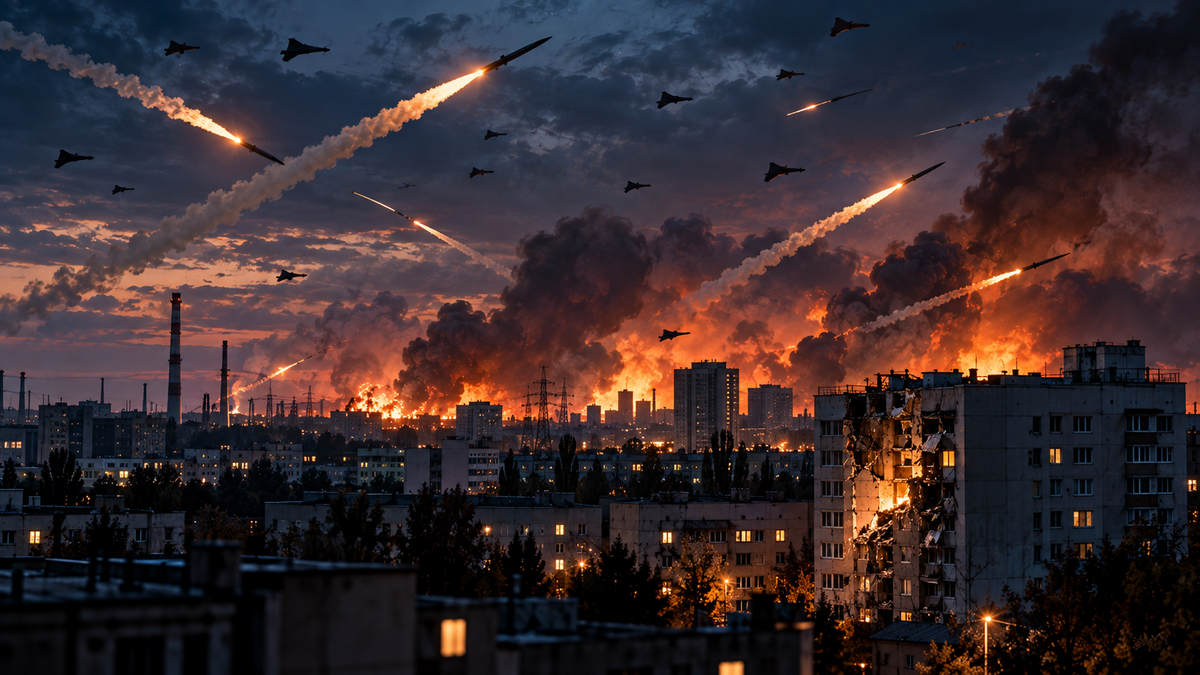
Seventy Missiles in One Night: A Mass Strike on Energy Again Shows What Ukraine Lacks

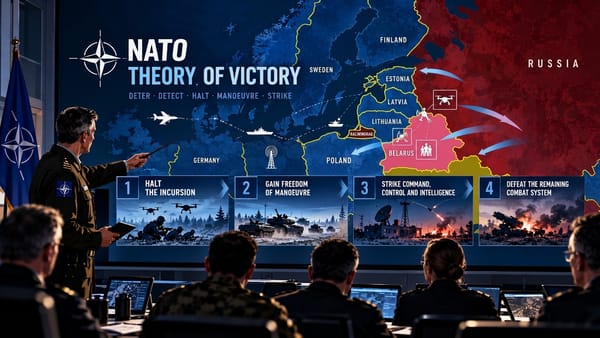
Baltic Security Monitor | Analytical Brief Snapshot: 7 October 2026, 14:00 (Europe/Tallinn) · Material OSINT Update
Kyiv warned about this strike a day ahead: intelligence had seen the preparations. It did not prevent casualties. The headline is not that Russia struck, but the composition: 70 missiles, many of them ballistic, plus a wave of drones that included jet-powered ones. That mix is exactly what Ukraine intercepts worst.
Assessment
| Indicator | Value |
|---|---|
| BSM assessment | MATERIAL UPDATE |
| Category | Ukraine war / strategic air campaign / energy / spillover onto NATO's eastern flank |
| Materiality | High |
| Uncertainty flags | 🟡 4 · 🔴 0 |
| Delta type | Scale, composition and energy focus of the strike |
What happened
Overnight into 7 October Russia launched one of its largest combined strikes on Ukraine. According to Zelenskyy, 70 missiles were fired, "many of them ballistic," plus Shahed-type drones. He named Ukraine's energy infrastructure as one of the key targets and said the Russians wanted to strike "painfully and demonstratively." Strikes hit at least 12 regions.
According to Ukraine's Air Force preliminary figures, 130 drones and 48 cruise missiles were used, along with ballistic missiles. 🟡 The digest adds that 46 of the drones were jet-powered, that 161 aerial targets were destroyed or suppressed by 09:00 and that impacts were recorded at 18 locations. These are Ukrainian official figures that may be revised, and I found no full confirmation of those details.
In Pryluky, in the Chernihiv region, a missile destroyed an ordinary five-storey apartment block: five killed, 26 injured, including five children. At the time of the snapshot the nationwide toll was at least 11. 🟡 After 14:00 Reuters reported at least 15 dead, and Ukraine's energy ministry announced partial emergency power cuts in five regions. Those figures post-date the cutoff, and BSM presents them only as an update.
Russia's Defence Ministry acknowledged a "massive strike" and said it targeted military-industrial facilities, including production and storage of missiles and drones. According to the digest, it also hit port and ship-repair infrastructure in the Odesa region. These are Russian claims and do not confirm what was actually hit.
Confirmed versus outstanding
| Claim | Status |
|---|---|
| 70 missiles, many ballistic, plus drones | ✅ Zelenskyy, Reuters, ABC |
| Energy among key targets, strikes in at least 12 regions | ✅ Zelenskyy, ABC |
| Pryluky: 5 dead, 26 injured, including 5 children | ✅ Zelenskyy (ABC) |
| At least 11 dead at the time of the snapshot | ✅ Ukrainian officials, Reuters |
| 130 drones, 48 cruise missiles | ✅ Air Force, as relayed by Reuters |
| 46 jet-powered drones, 161 targets downed, 18 impact sites | 🟡 Ukrainian preliminary data only, single source |
| Russian claims of military-industrial targets | 🟡 Russian MoD statement, not independently confirmed |
| Precautionary Polish activity with no violation of its airspace | 🟡 As reported; I did not verify independently |
BSM analysis: why this is material and not "just another strike"
Russia attacks Ukraine every night, and BSM does not log every strike. The material delta here is the combination: 70 missiles in one coordinated strike with a large drone wave, with ballistics that Kyiv again named as the hardest for air defence. France24 notes that the deaths and damage illustrate Ukraine's difficulty countering ballistic missiles and the new jet-powered drones.
The second element: this was not a surprise. Zelenskyy had warned a day earlier that intelligence saw preparation for a massive strike. Foreknowledge did not save lives, because knowing a strike is coming is not the same as being able to stop it.
BSM analysis: On 5 October Russia announced stepped-up strikes after Zelenskyy's remarks on attacks against Russian refineries. BSM assessed that then as rhetoric that does not clear the threshold without implementation. Implementation came within two days. It is a case for waiting for action rather than reacting to words. The energy war also runs both ways: Zelenskyy said Ukraine hit two oil facilities and a training ground in the Perm, Samara and Astrakhan regions, and told Reuters Ukraine would answer with strikes on Russian energy.
What it means for the Baltic states and Ukraine
The strike came right after the German-Ukrainian defence-production package (BSM, 4 October) and Sweden's decision to deploy Patriot to Poland to protect the aid hub for Ukraine (6 October). The picture is increasingly about two tasks: replenishing Ukrainian air defence and protecting the logistics that feed it.
For NATO's eastern flank the significance is the size of the mixed missile and drone package that regional systems must be able to detect, classify and, if needed, intercept. Poland scrambled aircraft and activated ground-based air defence and radar during the strike, showing that large Russian strikes on Ukraine create real-time requirements for NATO neighbours.
Checking other items today
🟡 Lithuania, permanent US base. On 5 October Trump said he would "certainly look at" Lithuania's request for a permanent base. On 6 October Prime Minister Sinkevičius said Lithuania is ready to cover the costs if Washington makes the political decision. The US has kept an armoured battalion of almost 1,000 troops in Lithuania since 2019 on rotations. There is no Washington decision, basing agreement or force package, so this remains WATCH. Context: the Pentagon is conducting a six-month review of its posture in Europe.
🟡 Lithuania, constitutional amendment on nuclear weapons and foreign bases. The first vote has taken place; the second is needed after the required waiting period. No decision on nuclear deployment exists.
🟡 Attacks on civilian shipping in the Black Sea. No sufficiently strong new attribution evidence found. Remains WATCH.
Conclusion
The strike confirms what BSM has been recording for weeks: the bottleneck is not the number of drones but missiles, especially ballistic ones, and the ability to intercept them. Ukrainian requests for Patriot interceptors are likely to intensify.
Next checks: updated casualty figures and effect on the power system; confirmation of the jet-drone count; whether a new Russian weapon, changed launch geography or a confirmed incursion into NATO airspace appears; Washington's decision on Lithuania.
Baltic Security Monitor (osint-baltic.com) — an analytical publication on security on NATO's northeastern flank. All OSINT assessments are produced by an automated monitoring system using open sources.