Patriot Moves into the Industrial Phase as U.S. and Ukraine Explore European Production Options

Baltic Security Monitor | Material OSINT Update5 August 2026, 14:00 UTC
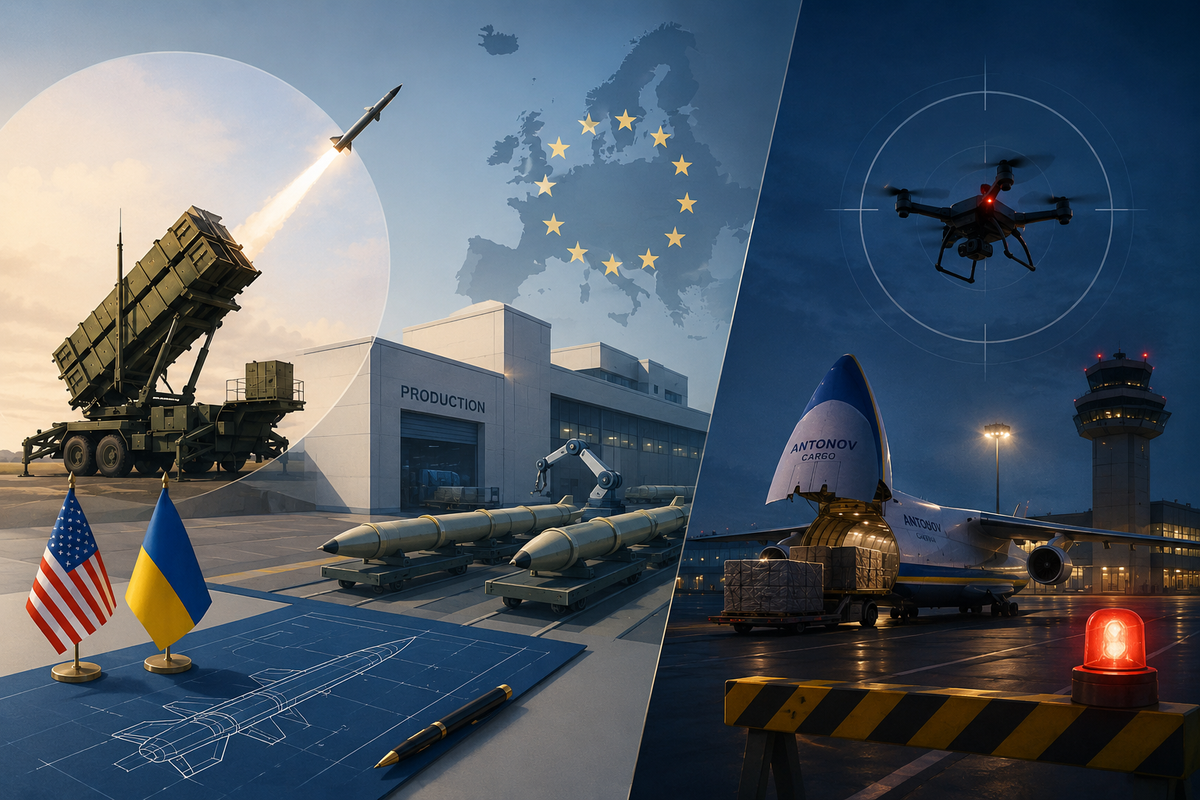
The debate over local production of Patriot interceptors has moved beyond political rhetoric. Despite Donald Trump’s reservations about transferring sensitive technology, Washington, Kyiv, and the defence industry continue to develop concrete licensing and manufacturing options. No final decision has been made—but the industrial planning is clearly underway.
What happened
Reuters, citing U.S., Ukrainian and industry sources, reports that negotiations on localising Patriot interceptor production remain active.
Several industrial models are under consideration, including:
- Ukrainian participation in a joint U.S.–European production programme;
- assembly of components in Europe;
- development of a lower-cost PAC-3 variant;
- multiple technology licensing arrangements.
The talks involve the U.S. administration, Lockheed Martin, and U.S. Ambassador to NATO Matthew Whitaker.
No political approval has yet been granted. President Donald Trump has reportedly expressed concerns about transferring sensitive missile technology, while establishing new production capacity would require several years.
What changed
Following political signals in July suggesting possible joint production, it remained uncertain whether the initiative would survive internal debate in Washington.
Reuters now confirms that negotiations have not only continued but have progressed into discussions of concrete industrial and licensing models.
The programme has therefore entered an intermediate stage:
- political approval remains pending;
- industrial planning is already in progress.
This indicates that localisation is now being treated as a practical defence-industrial project rather than merely a political concept.
Why it matters
Ukraine remains heavily dependent on Patriot systems for defence against Russian ballistic missile attacks.
At the same time, NATO’s eastern flank countries rely on the same supply chains and compete for the same limited stock of PAC-3 interceptors.
If an agreement is reached, European production could:
- expand overall PAC-3 output for both Ukraine and NATO;
- reduce dependence on the single U.S. production line;
- establish an additional European industrial hub for missile components;
- improve long-term interoperability between Ukraine’s future missile-defence architecture and the systems operated by Poland, Germany, Romania and other allies.
A second strategic track is emerging in parallel.
While Patriot remains the high-end missile-defence system, the European-Ukrainian FREYJA programme aims to provide a more affordable complementary interception layer rather than replacing Patriot.
🟡 Even under the most favourable political scenario, licensing, certification and factory preparation would take years and will not resolve the immediate shortage of interceptors.
Likely implications
- Ukraine will continue seeking both immediate deliveries of ready-made PAC-3 interceptors and long-term production rights.
- 🟡 Germany could emerge as the principal European location for final assembly or component manufacturing.
- The U.S. administration and Lockheed Martin are likely to pursue a licensing model that preserves control over critical technologies.
- FREYJA is increasingly likely to be positioned as a complementary lower-cost layer rather than a competitor to Patriot.
- 🟡 Failure to approve localisation would leave Europe even more dependent on limited American production capacity.
Related Signal
Suspicious drone temporarily disrupts operations at Germany’s key cargo airport
German authorities confirmed that a drone and a suspicious object were detected overnight at Leipzig/Halle Airport on 5 August.
Airport operations were temporarily restricted while one runway was closed for inspection by explosive ordnance specialists.
Leipzig/Halle serves as one of Europe’s major cargo hubs and is regularly used by Ukrainian Antonov transport aircraft.
🟡 Reports claiming that the drone operated near a Ukrainian aircraft and may have carried an explosive device currently rely on security sources and have not been fully confirmed by investigators.
Neither the operator, origin nor motive has been established.
For now, the incident should be monitored as a potentially important signal affecting European logistics supporting Ukraine, but available evidence does not justify attributing it to Russian sabotage at this stage.
Assessment
The Patriot localisation initiative has moved beyond political signalling into practical industrial planning.
Even though actual production remains years away, the negotiations suggest that Washington and its allies are beginning to shape the long-term industrial architecture required to sustain both Ukraine’s missile defence and NATO’s eastern flank.