One Hundred and Twenty Missiles and Their Own Crews: North Korea Moves from Arms Supplier to Missile Operator in Russia

Baltic Security Monitor | Geopolitical AnalysisBased on the Material OSINT Update, 5 August 2026, 08:00
North Korea has long ceased to be merely a supplier of artillery ammunition to Russia. If Ukrainian intelligence is correct, the relationship is entering a far more consequential phase: from exporting weapons to maintaining an operational missile presence on Russian territory. That would mean Moscow is gaining not only additional missiles, but an additional strike capability operating alongside its own forces.
What Has Changed
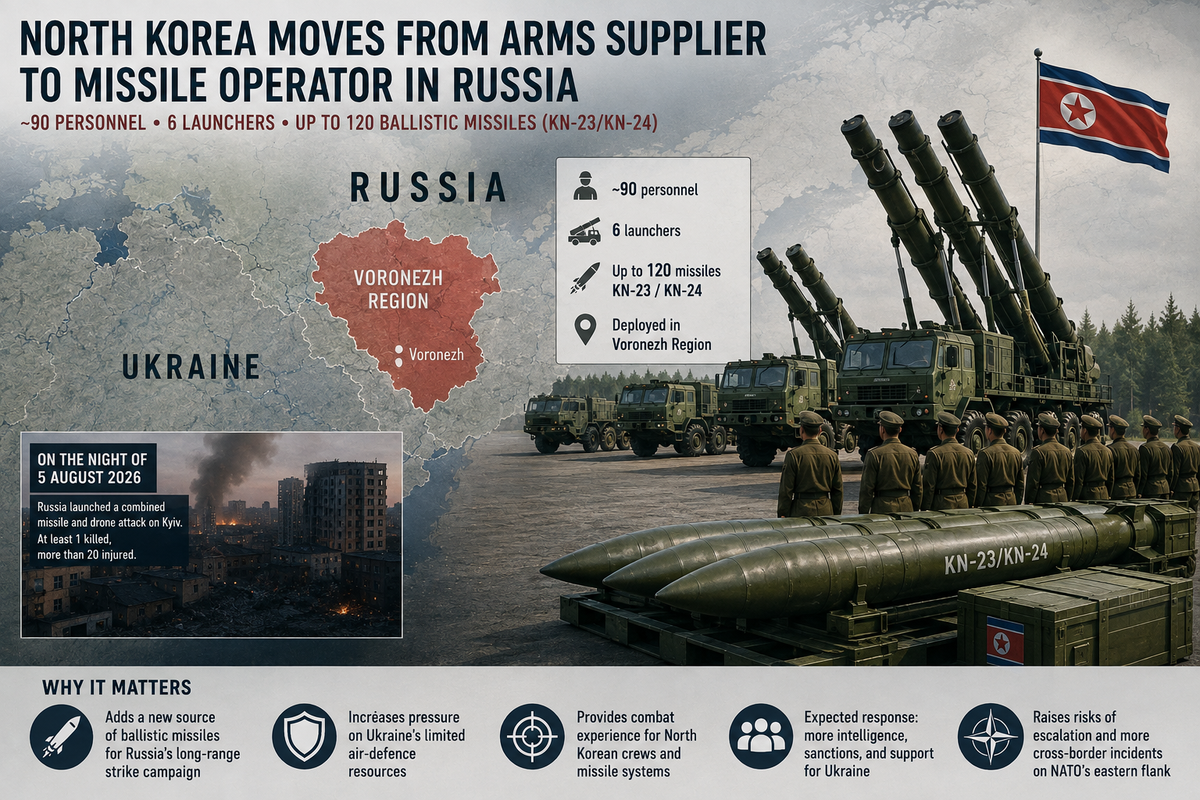
According to Ukrainian intelligence, cited by Reuters, North Korea is deploying a dedicated missile unit to Russia’s Voronezh region. The reported force consists of approximately 90 personnel, six transporter-erector-launchers (TELs), and a stockpile of up to 120 KN-23/KN-24 short-range ballistic missiles.
These figures have not been independently confirmed by Moscow, Pyongyang, or Western governments. 🟡
However, North Korean ballistic missiles are no longer a matter of speculation. Their use by Russia has previously been confirmed through forensic analysis of missile debris, and on 30 July Russia reportedly resumed employing this class of missile after a prolonged pause.
The significance of the latest report therefore lies less in the missiles themselves than in the apparent evolution of military cooperation.
Until now, cooperation between Moscow and Pyongyang largely followed a supplier-customer model: North Korea delivered artillery ammunition, missiles, and personnel, while North Korean troops were primarily associated with operations in Russia’s Kursk region.
The reported deployment suggests a different model:
- dedicated North Korean missile crews;
- their own launchers;
- a substantial missile stockpile;
- permanent basing inside western Russia.
If confirmed, this would represent a transition from military supply to elements of a shared strike infrastructure.
Why It Matters
The number itself—120 missiles—is not the most important aspect.
More significant is what such a deployment would enable operationally.
A permanently based missile unit would provide Russia with an additional reserve of ballistic strike capability that is not directly constrained by the production rate of its own Iskander missiles.
This would allow Russia to:
- increase the total number of ballistic targets in combined strike packages;
- distribute strike missions across different missile systems;
- sustain a higher operational tempo over an extended period;
- combine KN-23/KN-24 launches with Iskander missiles and drones to place additional pressure on Ukraine’s air-defence network.
For Ukraine, this translates into greater demand for scarce Patriot PAC-3 interceptors, which are already one of the most limited resources in defending against large-scale ballistic attacks.
Implications for NATO’s Eastern Flank
For Poland and the Baltic states, the implications are indirect but strategically significant.
The more independent sources of ballistic missiles Russia can draw upon, the longer it can sustain large-scale strike campaigns against Ukraine.
Recent months have repeatedly shown that major missile attacks trigger heightened military activity along NATO’s eastern flank, including the scrambling of Polish fighter aircraft and increased regional air surveillance.
An additional missile reserve increases the likelihood of similar cross-border security episodes in the future.
Equally important, North Korean personnel would gain practical combat experience in employing their own missile systems under wartime conditions.
The operational lessons learned could later contribute to improvements in the accuracy, tactics, and survivability of KN-23 and KN-24 systems beyond the European theatre. 🟡
Why Voronezh?
If the intelligence proves accurate, the choice of Voronezh region is also notable.
Its location provides operational access to Ukrainian targets while allowing Russia to avoid formally deploying North Korean military personnel onto occupied Ukrainian territory. 🟡
This creates a politically more manageable arrangement: foreign personnel operate from internationally recognised Russian territory while remaining integrated into Russia’s military infrastructure.
The Kyiv Strike Provides the Operational Context
During the night of 5 August, Russia launched another combined attack against Kyiv using ballistic missiles and drones.
At least one person was killed and more than twenty others were injured, while damage was reported across several districts of the capital.
There is no evidence that the newly reported North Korean missile unit played any role in this attack.
Nevertheless, the timing underscores an important point: reports of the deployment emerge not during a lull in the conflict, but amid Russia’s continuing long-range strike campaign against Ukraine.
What Comes Next
Should the reported deployment be confirmed, several developments are likely over the coming months:
- Russia may increase the proportion of North Korean missiles within combined strike packages while conserving its own Iskander inventory.
- Ukraine is likely to intensify requests for Patriot PAC-3 interceptors and other ballistic missile defence capabilities.
- The United States, NATO, and South Korea may expand intelligence collection focused on missile and personnel transfers between North Korea and Russia. 🟡
- Additional sanctions may target shipping, rail networks, and defence organisations supporting North Korean military deliveries.
- Combat experience gained by North Korean missile crews could accelerate improvements to the KN-23/KN-24 missile family. 🟡
Bottom Line
Until now, Russia primarily received military resources from North Korea.
If it is now receiving a dedicated operational missile unit as well, the relationship is evolving into something considerably deeper.
For Ukraine, this means additional pressure on an already strained ballistic missile defence network.
For NATO, it is another indication that Russia’s war effort increasingly relies not only on its domestic defence industry, but also on the integration of military capabilities from heavily sanctioned partner states.