One Fresh Signal in an Ageing Feed: The UK Track Moves to the Top of the OSINT Digest

Baltic Security Monitor | Analytical ReviewSnapshot: 2026-08-08T18:30:35.154Z
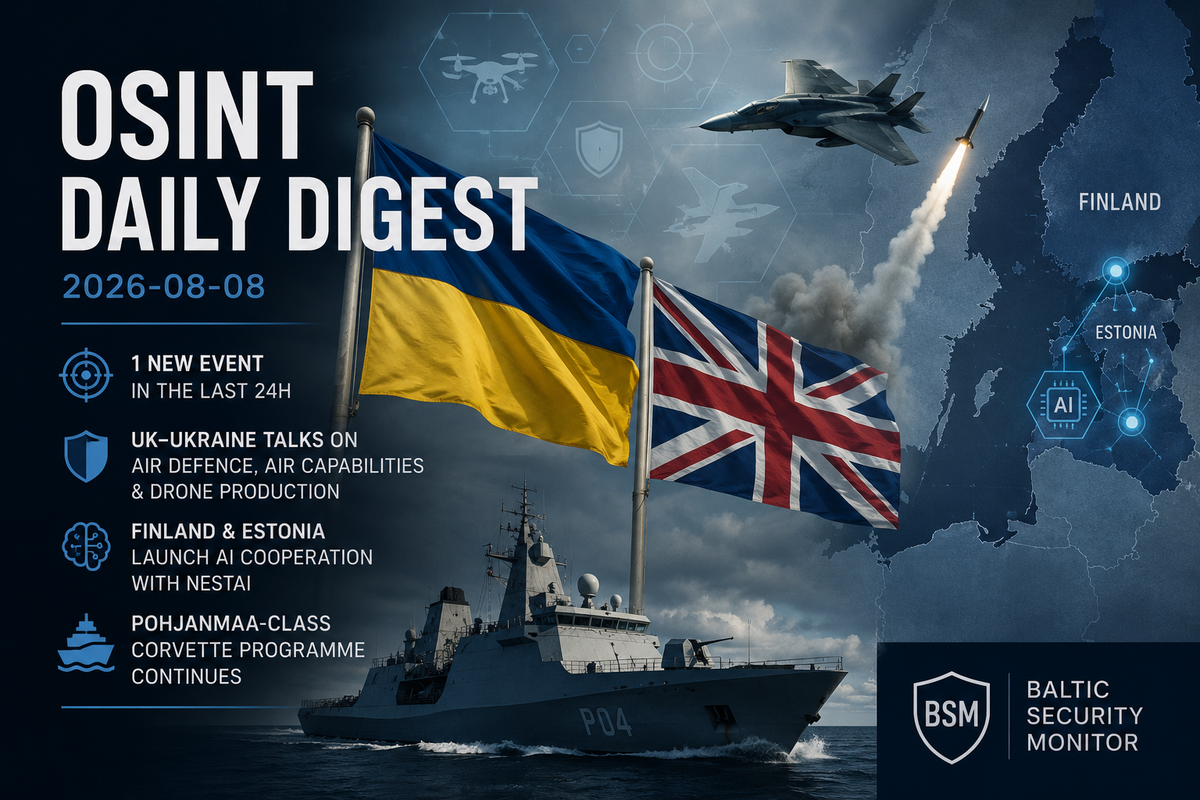
The evening OSINT digest for 8 August shows no sign of a new concentration of events: the system identified only one event over the past 24 hours, while four of the five most significant entries are between 56 and 108 hours old. The main relatively fresh signal is the continuing Ukraine–UK dialogue on strengthening air defence, air capabilities and drone production.
The composition of the top five is notable less for the individual headlines than for its structure. Finnish-Estonian cooperation on military AI appears twice, while construction of the Pohjanmaa-class corvettes and Finland’s participation in a military parade have remained background items for several days. The digest does not identify a new regional episode comparable to recent airspace incidents or shifts in military logistics.
What Is Actually New
The leading item is a Ukrainian Ministry of Defence report on talks with the United Kingdom — WATCH, score 0.41, approximately 32 hours old at the time of the snapshot.
Three interconnected areas are at the centre of the discussions: air defence, development of air capabilities and production of unmanned systems.
The talks do not, by themselves, constitute an announcement of a new weapons delivery or an additional air-defence system. The digest provides no figures for equipment, delivery schedules or new financial commitments. The significance of the event therefore lies more in the continuation of the industrial and defence relationship between Kyiv and London than in any immediate change in Ukraine’s battlefield capabilities.
BSM assesses this signal as part of a broader shift from a model of “supplying weapons to Ukraine” towards one of jointly expanding production capacity. The United Kingdom increasingly treats unmanned systems as an area in which supporting Ukraine can also contribute to the development of its own defence-industrial base.
For Ukraine, such a model is particularly important in areas where wartime consumption can no longer be sustained through occasional deliveries and instead requires a continuous industrial flow — above all in drones and air-defence systems.
Finland and Estonia: An Important Signal That Has Already Become Background
The most substantial Baltic-related item in the top five is Finland and Estonia’s cooperation with defence AI company NestAI. It appears twice in the digest, with WARNING scores of 0.68 and 0.70, but both entries are more than 100 hours old.
Treating it again as a new event would therefore be misleading.
On 30 June, Finland’s Ministry of Defence, the Estonian Defence Forces and NestAI signed a Letter of Intent on cooperation in developing military AI capabilities. The document does not create financial commitments, but establishes a framework for joint research, training and technical cooperation. Initial areas include adaptive AI, support for command-and-control systems, and autonomous and unmanned systems.
Particularly significant is the emphasis on an open and modular architecture capable of integrating solutions from different countries without dependence on a single supplier. This potentially makes the initiative broader than a bilateral Finnish-Estonian project: its stated long-term direction allows other countries and defence companies to participate.
For BSM, this remains a structurally important development, but today’s digest provides no evidence that it has moved into a new phase.
The Remaining Items Are Mostly Feed Inertia
The participation of Finnish military personnel in ceremonial events and construction of the fourth Pohjanmaa-class corvette remain in the top five, but neither creates a new analytical storyline.
The Pohjanmaa programme is significant in its own right: the four multi-role corvettes are a central component of Finland’s Squadron 2020 programme and its future capabilities in the Baltic Sea. Construction of the fourth vessel, however, is part of an established production cycle rather than a sudden change in the regional naval balance.
The same applies to ceremonial activity involving the Finnish Defence Forces. Such events may enter an automated monitoring stream because of the military nature of the source and participants, but they are not in themselves indicators of changes in readiness or force deployment.
A mechanical reading of today’s top five could therefore create an impression of greater activity than is actually present in the feed.
The Main Signal of the Day Is Not Escalation, but the Absence of a New Cluster
The digest registered one event over the past 24 hours, with none classified as high-confidence. The median age of the five leading events reached 56 hours.
At the same time, the collection pipeline appears technically stable: quarantine — 0, there are no retry-eligible events, and source failures — 0. Median ingest lag stands at 8.7 hours, while p90 is 58.6 hours.
This allows two different pictures to be separated.
The first is the event picture: there are few fresh, significant signals.
The second is the technical picture: there is no indication that the lack of new events is being caused by widespread source failures or an accumulation of material in quarantine.
The high p90 ingest lag and the age of the top five nevertheless call for caution. An absence of new events in the current sample cannot automatically be interpreted as an absence of developments in the real-world environment.
What This Means for the Region
The evening snapshot of 8 August instead brings attention back to two longer-term processes.
The first is the gradual transformation of support for Ukraine into shared defence-industrial infrastructure. Kyiv-London discussions on air defence, air capabilities and drones fit this trajectory: the resilience of production is becoming as important as individual aid packages.
The second is the emergence of a northern European technological network within NATO. The Finnish-Estonian military AI project illustrates how countries on the Alliance’s north-eastern flank are attempting to establish interoperable architectures for autonomous systems, C2 and data processing in advance, rather than integrating them only after finished systems have been procured.
These are different processes, but they follow a common logic: European defence is increasingly being built around the ability to jointly produce, adapt and scale technologies, rather than simply around the number of platforms already in service.
Conclusion
The OSINT feed on the evening of 8 August is relatively sparse. The only comparatively fresh signal is the Ukraine–UK discussion on air defence, air capabilities and drone production. Most of the other leading entries represent already known or recurring developments.
Today’s digest therefore provides no basis for describing a new wave of military activity on NATO’s north-eastern flank. Its more interesting implication lies elsewhere: Ukraine’s industrial integration with the United Kingdom and Finland’s technological integration with Estonia are gradually becoming persistent elements of the European security architecture.
The key question for subsequent updates will not be whether these stories remain in the top five, but whether they produce a next step: concrete production decisions on the Ukraine–UK track or a transition of the Finnish-Estonian AI initiative from a framework agreement to pilot systems.
Baltic Security Monitor (osint-baltic.com) — analytical coverage of security on NATO’s north-eastern flank.
This article is based on automated OSINT monitoring and analysis of open sources.