Not a Shipment, a Technology: Britain Hands Ukraine Control Over Stone Cloak Production

Baltic Security Monitor | Geopolitical Commentary Based on a Material OSINT Update, 28 July 2026, 08:00
The difference between giving someone a fish and teaching them to fish is literal here. Britain has spent years supplying Ukraine with finished Stone Cloak electronic-warfare modules — now it's handing over the technology itself, the right to produce and modify it independently. And it's a brand-new prime minister, one week into the job, who is doing it, choosing Zelenskyy as his first foreign guest — a decision that is a message in itself.
What Happened
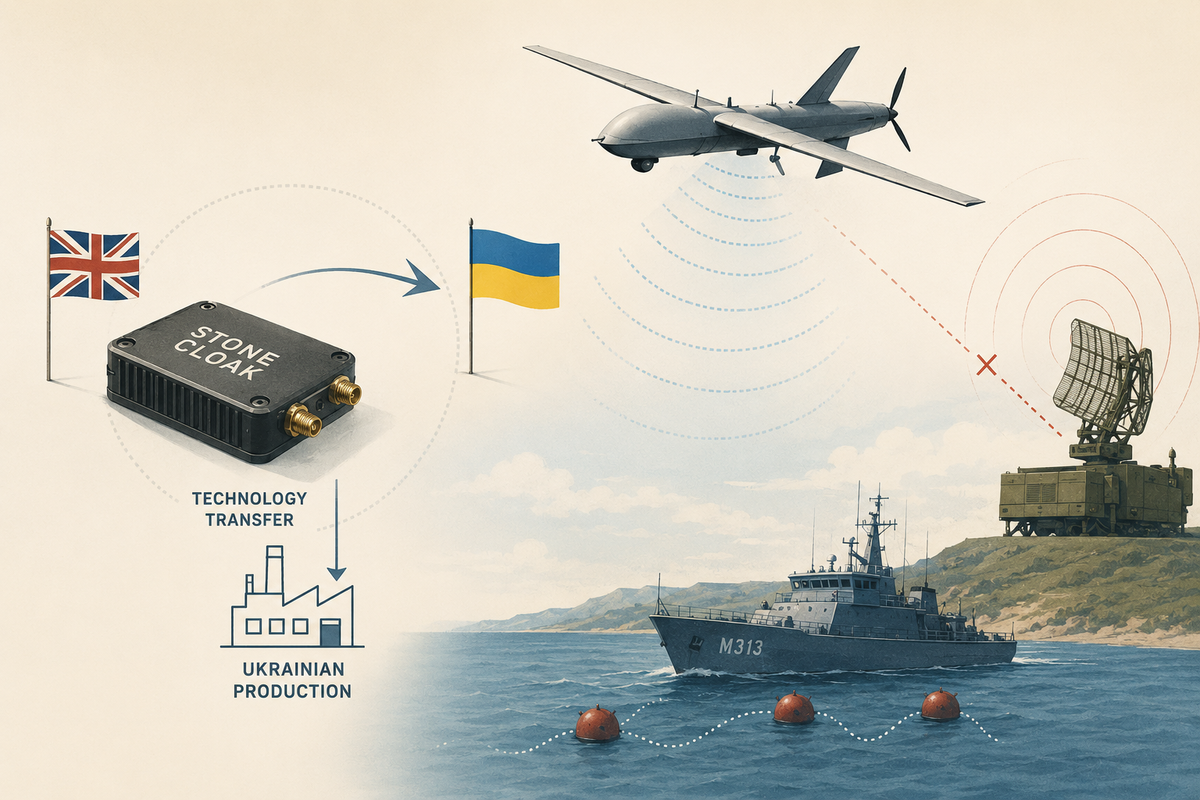
Following a meeting between Volodymyr Zelenskyy and new UK Prime Minister Andy Burnham, London officially announced the transfer of intellectual property for its Stone Cloak electronic-warfare system to Ukraine — a tablet-sized module fitted to long-range drones that jams Russian air-defense detection and tracking. The UK Ministry of Defence has already supplied several thousand finished units to Ukraine; Kyiv now gains the right to manufacture the devices itself, at scale, without depending on the pace of British factory output.
Burnham, who took office on 20 July and had been in post exactly one week at the time of the meeting, chose Zelenskyy as the first foreign leader he received. The announcement came during a visit to a Royal Navy base.
Why This Isn't a Routine Delivery
The analytical distinction here is real: this is not another batch of equipment but a transfer of technological control to the Ukrainian side. It reinforces a model of joint defense production in which Ukraine gets not just finished products but the ability to scale and modify the technology itself as Russian radar and electronic-warfare countermeasures evolve — an adaptation cycle that previously depended on the pace of British shipments and now runs directly on Ukrainian production lines.
The technology is also set to be integrated into Britain's own long-range strike systems, including the low-cost Brakestop cruise missile (a range of at least 600 km and a 200–300 kg warhead) — meaning the battlefield lessons flow both ways: a system proven in Ukraine's deep strikes on Russian logistics and energy infrastructure is becoming part of Britain's next generation of weapons.
Relevance for the Baltic Region
Ukrainian combat experience is being transferred directly into British, and likely future European, long-range systems — accelerating the formation of a shared NATO technological base in drones, electronic warfare, and air-defense penetration. For the northeastern flank, this means combat-tested solutions, already proven against real Russian air defense, will reach regional deterrence systems faster than NATO's traditional procurement and testing cycle would normally allow.
The Related Maritime Signal: Sea Breeze as a Future Foundation
During the same meeting, the two leaders met more than 200 Ukrainian service members and sailors who had just completed a three-week phase of Exercise Sea Breeze in the UK — a 15-nation maritime security and mine-countermeasure exercise. BSM reads this as a continuation of preparing Ukraine to independently lead mine-countermeasure operations in the Black Sea: the format is gradually shifting from pure training toward the foundation of a future shipping-security architecture — the very gap our previous coverage flagged as missing after the Golden Leo sinking.
BSM Assessment
This update's materiality rests not on the size of the aid but on the type of decision: transferring IP reduces Ukraine's dependence on someone else's production pace and turns Kyiv from a recipient of technology into a real-time co-developer of it. Likely consequences include rapid scale-up of Ukrainian Stone Cloak production, greater survivability for long-range strike and reconnaissance drones, a faster electronic-warfare adaptation cycle against Russian air-defense upgrades, and — most relevant for the region BSM covers — deeper convergence of Ukrainian and European defense industry, potentially down to shared production lines.
Conclusion
The symbolism operates on two levels at once: a prime minister one week into office chooses Zelenskyy as his first guest, and his first major foreign-policy act isn't an aid package but a transfer of technological control. For the Baltics, this signals a broader trend — defense support for Ukraine is increasingly converting from one-off deliveries into a shared industrial base that will remain a permanent part of Europe's defense architecture once the war ends.
Baltic Security Monitor (osint-baltic.com) — an analytical publication covering security on NATO's northeastern flank.