Nine Miles From the Kremlin, Moscow Loses Its Own Refinery

Baltic Security Monitor | Material Update 22 September 2026, 08:00 (Europe/Tallinn)
Gazprom Neft's Moscow Oil Refinery has stopped crude processing after a 20 September drone strike — both of its primary units went down at once. This is no longer just facility damage; it's a confirmed production shutdown at a plant that supplies 40% of Moscow's fuel market and 70% of petrol and aviation-gas demand in the surrounding region.
What happened
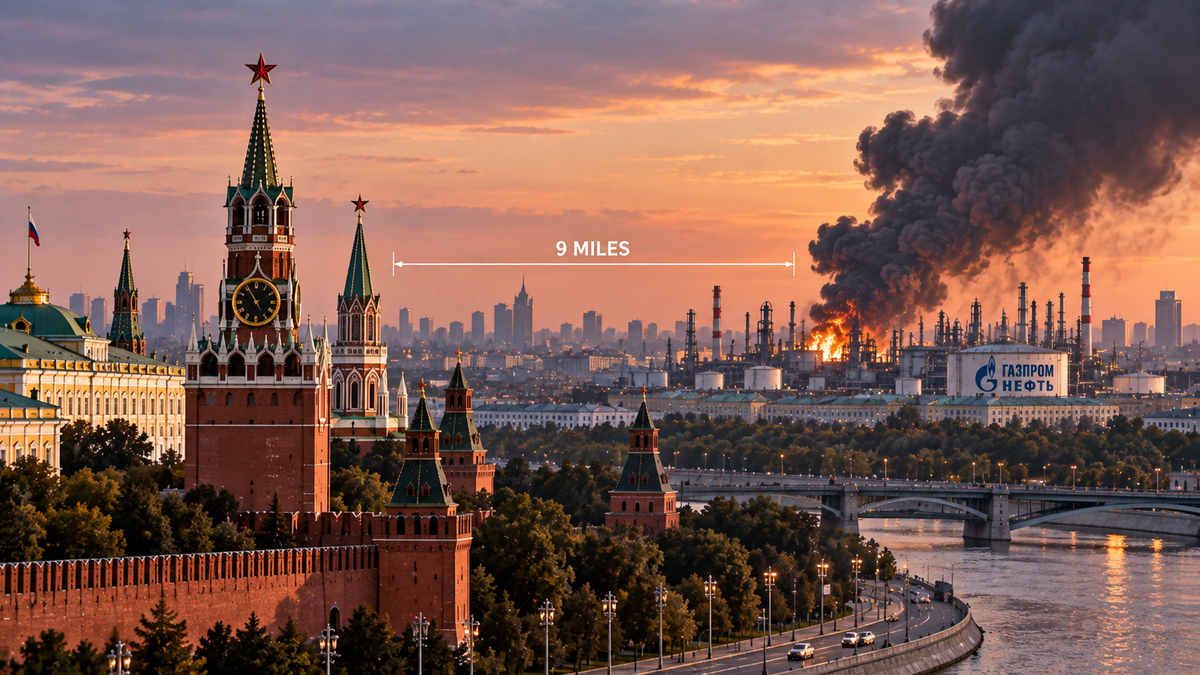
Reuters reported late on 21 September, citing three industry sources, that the Moscow Oil Refinery — located in the Kapotnya district, roughly 15 kilometers (9 miles) from the Kremlin — has fully suspended crude processing. Both primary units caught fire: AVT-6, with a capacity of about 21,400 tonnes per day (53% of the plant's capacity), and EURO+, with about 18,800 tonnes per day (47%). Sources estimate repairs will take several weeks.
The market impact is already visible: since 21 September, the refinery has stopped offering fuel on the St. Petersburg International Mercantile Exchange. Gazprom Neft has not commented officially. Moscow Mayor Sergei Sobyanin confirmed only that an "industrial facility" was damaged during the strike, without specifying the scale.
For reference, the refinery processed 11.6 million tonnes of crude in 2024 (roughly 230,000 barrels per day), producing 2.9 million tonnes of petrol, 3.2 million tonnes of diesel, and 1.3 million tonnes of bitumen.
BSM analysis: The key shift from the previous snapshot (20 September, when BSM logged the strike itself) is the move from "confirmed damage" to "confirmed production outage." That's not a rhetorical distinction — a damaged unit can still run at reduced output, but two fully halted primary units mean the plant isn't processing crude at all, not simply operating less efficiently.
The General Staff's 45% figure — with a caveat
Ukraine's General Staff separately said on 21 September that the strike hit AVT-6, an integrated processing unit, and an isomerization unit, and assessed that more than 45% of Russia's designed refining capacity is now disabled. That figure is a Ukrainian military assessment, not independently validated at the same level as Reuters' reporting, so it shouldn't be treated as an established national outage number yet.
BSM analysis: The trajectory matters more than any single number here. In July, the General Staff cited 42.74%; Ukrainian energy analyst Mykhailo Honchar estimated roughly half of primary capacity offline by late June; and the IEA and Reuters-cited industry sources put the range at 33–40% through June. A rise to 45% by late September sits within that same band of estimates — but the fact that the latest confirmed outage is the plant closest to the Kremlin of any hit so far adds political weight beyond the economic one.
Wider context: one more plant, not the first
On 15 September, Reuters reported that three of Russia's six largest diesel-producing refineries — Kirishi, Volgograd, and NORSI — had already halted or sharply cut output after drone strikes; together those six plants account for roughly half of the country's diesel production. The Moscow refinery now joins that list as a plant with a confirmed full processing halt, not just reduced output.
BSM analysis: The refinery campaign has clearly become cumulative rather than episodic — drones have hit a Russian refinery on average once every three days over the first eight months of 2026, per the IEA, and each new facility lands on an already-damaged network rather than acting in isolation. For the Baltic region and NATO's eastern flank, the effect is indirect but structural: the longer Russia's domestic refining stays disrupted, the higher the economic and logistical cost of the war becomes for Moscow — while the value of air-defence, electronic-warfare, and counter-UAS assets protecting strategic infrastructure deep inside Russian territory, including near the capital, only grows.
What to watch
The next material deltas: a confirmed restart date, signs that repairs extend beyond the current multi-week estimate, quantified throughput losses, and an independently validated national refining-outage figure to replace the General Staff's still-unverified 45%.
Baltic Security Monitor (osint-baltic.com) — an analytical publication on security along NATO's northeastern flank. Compiled from independent Reuters reporting and official statements from Ukraine's General Staff.
Sources
- Reuters — Moscow refinery output halted after drone attack, 21 September 2026
- Interfax-Ukraine — General Staff assessment, 21 September 2026
- Reuters — half of Russia's top diesel refineries cut output, 15 September 2026
- Kyiv Post — Moscow Oil Refinery Halts Processing After Ukrainian Drone Strike
- Euromaidan Press — background on the refining campaign (July 2026)