Money Against Missiles: The EU Funds Ukraine's Own Weapons and Targets Russia's Ballistic Supply Chain on the Same Day

Baltic Security Monitor | Analytical Brief Snapshot: 8 October 2026, 08:00 (Europe/Tallinn) · Material OSINT Update (late capture of 7 October events)
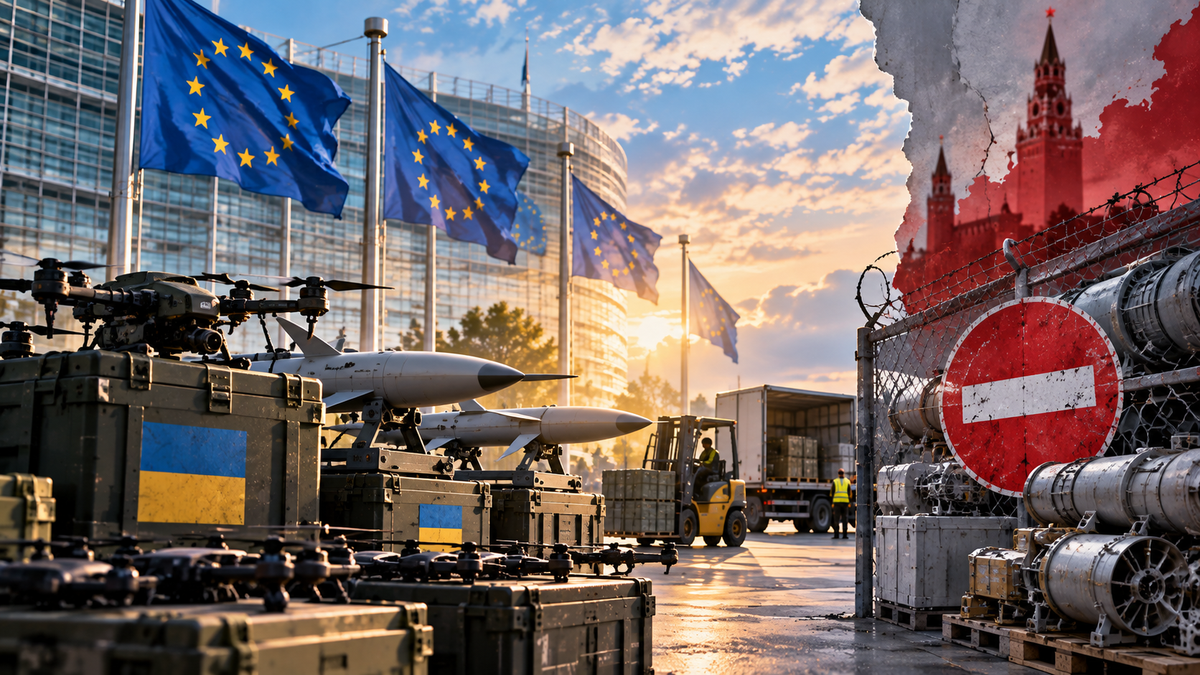
After the mass strike of 7 October, Brussels answered with two decisions in a single day. One is done: €1.24 billion has been paid out for Ukrainian drones, interceptors and missiles. The other is still on paper: 1,646 new sanctions listings, more than half aimed at Russia's ballistic-missile supply chain. The logic is straightforward: build more on Ukraine's side, constrain what Russia can build. But both decisions work with a lag, and neither closes the gap the front keeps exposing: too few interceptors for ballistic missiles.
Assessment
| Indicator | Value |
|---|---|
| BSM assessment | MATERIAL UPDATE (two stories, both from 7 October) |
| Category | Defence financing / sanctions / defence industry / Ukraine's sustainability |
| Materiality | High |
| Uncertainty flags | 🟡 6 · 🔴 0 |
| Delta type | Financing: pledge → payment. Sanctions: proposal → ambassador approval, not yet legally in force |
1. €1.24 billion paid out: from pledges to a transfer
On 7 October the European Commission confirmed it had disbursed €1.24 billion to Ukraine under the defence component of the €90 billion Ukraine Support Loan. The money is for Ukrainian-made weapons: drones, drone interceptors, drone ammunition and missiles. This is a completed payment, not another pledge.
The loan's structure is an indicative €60 billion for defence and €30 billion for budget support over 2026–2027, with €28.3 billion of defence-industrial support planned for 2026. By the Commission's count this is the fifth defence payment, with more expected "in the coming weeks." Defence Commissioner Andrius Kubilius: "Every euro we sent to Ukraine today is turned into drones, interceptors and missiles."
BSM analysis: What matters is the direction more than the size: the money goes to Ukrainian producers rather than to buying finished systems abroad. That shortens the chain between decision and production. But three things must stay separate: money transferred, weapons ordered, weapons delivered. The Commission has reported only the first.
This is separate from the German-Ukrainian production agreements BSM covered on 4 October.
2. Sanctions: 1,646 listings, but not yet law
On 7 October, EU ambassadors approved 1,646 new sanctions designations. According to Reuters (three diplomats), most target Russia's military-industrial complex, and more than half relate to the ballistic-missile production chain, including the 9M723 Iskander-M. The list covers missile testing and research bodies, solid-fuel and rocket-engine makers, suppliers of specialised textiles and carbon fibres, drone producers and shipyards that service submarines. It also includes 77 Russians who ran for Duma seats in occupied Ukrainian territory and seven North Korean individuals and entities.
By RFE/RL's count, cited by Kyiv Post, the military-industrial block comprises 743 individuals and 826 entities (about 1,570 per Reuters). It is the largest single set of listings since February 2022. For scale, the EU already sanctions nearly 3,000 individuals and entities linked to the invasion.
But this is not final adoption. EU foreign ministers are expected to approve the listings formally on 12 October. Until then the sanctions are not legally in force.
BSM analysis: These sanctions aim less at assembly plants than at what feeds them: fuel, engines, fibres and test infrastructure. That is logical, since no components means no missiles. But the effect depends on enforcement and on whether Russia can obtain restricted inputs through other channels. For now this is a signal, not a result.
Confirmed versus outstanding
| Claim | Status |
|---|---|
| EU disbursed €1.24 billion under the loan's defence component | ✅ European Commission/EEAS, 7 October |
| Funds go to Ukrainian drones, interceptors, drone ammunition and missiles | ✅ European Commission |
| Split by category, production volumes, delivery dates | 🟡 Not disclosed |
| EU ambassadors approved 1,646 listings; over half on ballistic missiles | ✅ Reuters (three diplomats) |
| Final adoption | 🟡 Expected 12 October |
| "Largest package since 2022" | 🟡 Media characterisation; exact figures differ slightly (1,646 vs 1,650 in headlines) |
What it means for the Baltic states and Ukraine
For Ukraine, it means more predictable financing for domestic production at a moment when Russia shows every night what is missing: the 7 October strike was again about ballistic missiles. Ukrainian interceptors help against drones, but they do not by themselves solve the problem of expensive interceptors for ballistic targets.
For the Baltic states the wider logic matters. Russia's missile-making capacity feeds the threat to NATO's eastern flank, so hitting that chain, if it is enforced, touches regional security too. And Ukraine's production experience, above all in cheap counter-drone tools, increasingly shapes European procurement priorities.
WATCH
🟡 Black Sea: the EU is supplying satellite imagery to Romania and Bulgaria. After attacks on commercial ships in their exclusive economic zones (5 October: a Turkish-owned grain carrier off Romania, two dead; 6 October: a ship sunk about 130 km off Bulgaria's coast), both countries asked for imagery, and Commission spokesperson Christian Wigand confirmed it is being provided. The European Maritime Safety Agency has also offered support. This is a verified operational response, not attribution. Bulgarian Prime Minister Rumen Radev assigned no blame and an investigation is under way. Zelenskyy says Russian drones attacked the Romanian vessel; I found no independent confirmation. Bulgaria has suspended the search for missing crew of the Alfa Watan (sources say 12 people; other headlines say 10; the discrepancy is unresolved).
🟡 Lithuania: permanent US base and constitutional amendment. No new US basing agreement or permanent force commitment verified. The 6 October vote advanced repeal of Article 137 of the Constitution, which bans weapons of mass destruction and foreign military bases. The next vote is expected on 12 January 2027. No nuclear deployment has been authorised.
🟡 NATO, Theory of Victory. No formal adoption or implementation decision beyond the previously reported planning document. SACEUR Gen. Alexus Grynkewich is expected to present the concept in Poland on 12 October.
Closed: the 3 October Vilnius alert (cancelled after about 50 minutes, no confirmed air threat) is closed as stale. The Kasparov threat reporting stays under routine monitoring.
Other items checked
The 7 October mass strike is covered in BSM's 14:00 update. Denmark's assessment that Russian sabotage against its defence industry has moved to execution was covered at 20:00 on 7 October; no new independently verified incident was found. A fresh Russian drone wave over Kyiv and western Ukraine early on 8 October did not establish a new capability or a confirmed NATO-airspace violation.
Conclusion
Two decisions, one day, one aim: narrow the gap between what Ukraine can produce and what Russia can launch. The first is already in force, but its effect will show only in deliveries. The second still has to clear 12 October and then prove it is enforced.
Next checks: final sanctions adoption on 12 October; contracts, production volumes and deliveries behind the €1.24 billion; forensic attribution of the Black Sea ship attacks; US decisions on a base in Lithuania.
Baltic Security Monitor (osint-baltic.com) — an analytical publication on security on NATO's northeastern flank. All OSINT assessments are produced by an automated monitoring system using open sources.