From "Unidentified Object" to Russian Kh-101: Why NATO's Confirmation Matters More Than the Crater

Baltic Security Monitor | Geopolitical Commentary Based on a Material OSINT Update, 30 July 2026, 20:00
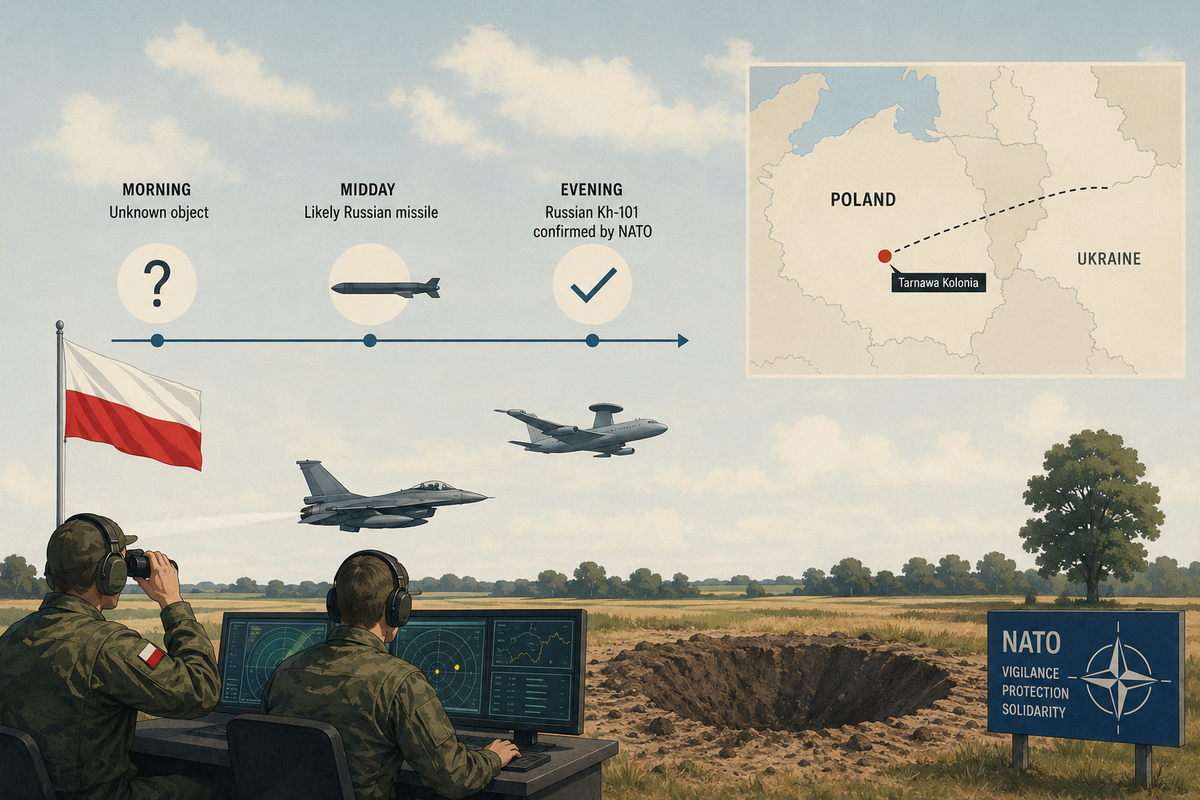
This morning it was an "unidentified object." By midday, it was "likely a Russian missile." By evening, the wording converged: the Polish government, the military command, and NATO itself are now saying the same thing — it was a Russian Kh-101. The gap between those three stages matters more than the crash itself, because it's what determines how the Alliance officially responds.
What Changed Over the Day
The main shift since the evening check is that the language has become significantly more definite. Polish Prime Minister Donald Tusk and Defense Minister Władysław Kosiniak-Kamysz said the object that fell near Tarnawa-Kolonia is highly likely a Russian air-launched Kh-101 cruise missile — "from the analysis of most of the traces, the recovered fragments point to a Russian Kh-101 missile," Tusk said at the crash site. NATO publicly linked the violation of Polish airspace to Russia's strike on Ukraine. Colonel Martin O'Donnell, spokesperson for NATO's Supreme Headquarters Allied Powers Europe (SHAPE), confirmed that Poland and NATO scrambled two Polish F-16s, a NATO A330 aerial-refueling aircraft, a Polish Saab 340 AEW&C aircraft, and a Mi-24 helicopter in response to the violation; NATO's Supreme Allied Commander Europe, General Alexus Grynkewich, stressed that the Alliance "will continue to take all necessary measures to defend NATO territory."
According to updated details, the missile entered Polish airspace around 03:40, left a roughly ten-meter-wide crater in a field, and came down about 80–100 km from the Ukrainian border. Polish authorities said they were prepared to destroy the missile had it continued flying deeper into the country. Defense Minister Kosiniak-Kamysz said roughly 20 objects were observed near Polish airspace that night, while Ukraine's air force reported 61 Kh-101 missiles were launched as part of the broader barrage.
Why It Matters: A Unified Attribution, a Restrained Response Threshold
Earlier in the day, the object's type and origin were officially described as preliminary. There is now a converged public assessment from the Polish government, its military leadership, and NATO: a Russian Kh-101 crossed the airspace of an Alliance member and completed its flight on Polish territory. At the same time, Warsaw does not yet believe Poland was a deliberate target and has not announced a request for Article 4 consultations under the North Atlantic Treaty — keeping the response below the threshold of formal escalation.
The incident points to a more serious vulnerability than a brief border crossing: a low-flying cruise missile was detected but not destroyed, and traveled a significant distance over NATO territory. For Poland and the Baltic states, this raises a practical question about interception rules. The current approach — waiting for confirmation of trajectory and threat — reduces the risk of a mistaken engagement, but may leave too little time to intercept a cruise missile heading toward a populated area or critical infrastructure.
A Baltic Precedent
This isn't the first test of NATO's rules for responding to unattributed aerial objects on the northeastern flank this year: in May, drones entered Estonian and Latvian airspace from Russia, and the dispute over how to respond to such incidents contributed to the collapse of the government in Riga. Romania recorded drone incursions for four straight days this week and used weapons in only three of the four cases. Today's Polish incident adds another entry to the same list: having the technical ability to intercept a target doesn't guarantee its destruction, and the decision window remains critically short.
BSM Assessment
NATO's official response so far remains political and coordinative: the Alliance says it will take necessary measures to defend its territory, but there's been no announcement of a new operation, additional force deployment, or a change to rules of engagement. A formal procedure like Article 4 will likely not be triggered without evidence of deliberate targeting of Poland or a recurrence of similar episodes. That's precisely why the confirmed attribution matters more than the crater itself: it establishes the fact for the record and for public pressure, but doesn't, for now, change the operational rules of the game.
Likely Consequences
- Poland will revisit the time thresholds and authority for opening fire on Russian missiles entering from Ukraine;
- Demand will grow for continuous airborne radar patrols and additional short-range air-defense assets along the eastern border;
- The incident will become an argument for real-time exchange of Polish and Ukrainian early-warning data;
- The Baltic states may push for unified NATO criteria for intercepting missiles and drones rather than separate national decisions;
- A formal NATO procedure will likely not be triggered absent evidence of deliberate targeting of Poland or a repeat of similar episodes.
Conclusion
The three stages of a single day — "unidentified object" → "likely a Russian missile" → converged NATO attribution — show just how slowly even a confirmed incident translates into a change in the rules. The crater in the field near Tarnawa-Kolonia is now documented and agreed upon by all parties. The question that remains open, for Poland and the Baltics alike, is how many more episodes like this it will take before the threshold for opening fire actually changes.
Baltic Security Monitor (osint-baltic.com) — an analytical publication covering security on NATO's northeastern flank.