From Refineries to Engels: Ukraine Has Assembled Fuel, Strategic Aviation and Shaheds Into One Target System

Baltic Security Monitor | Material Update (revised 20:00) Snapshot: 2 August 2026, 20:00
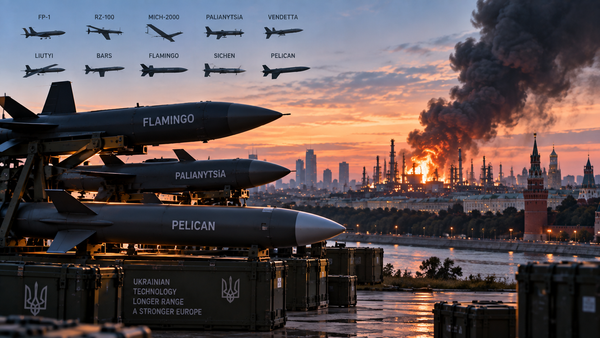
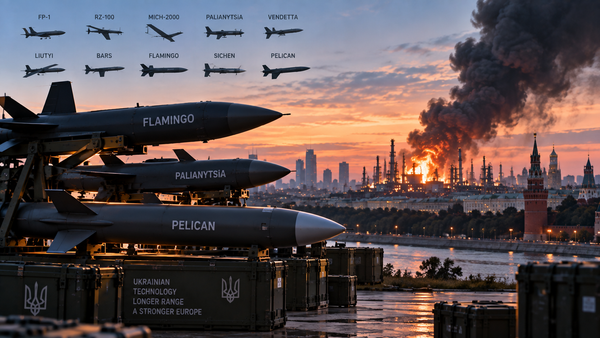
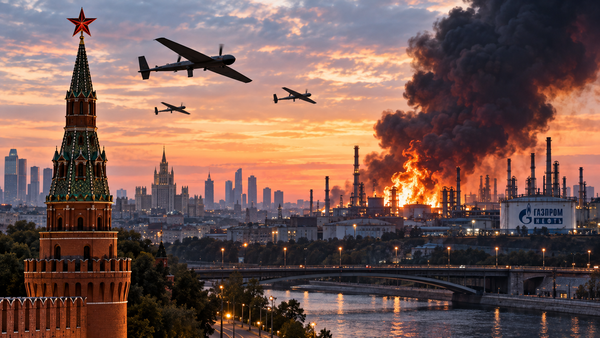
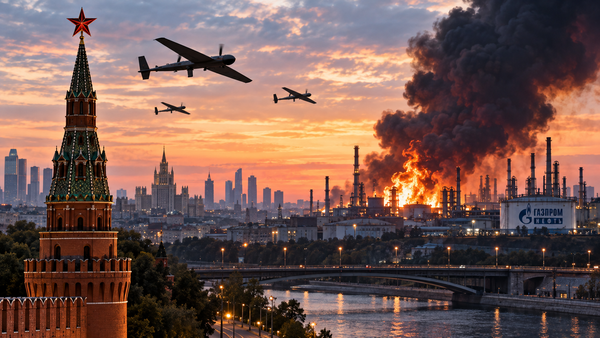
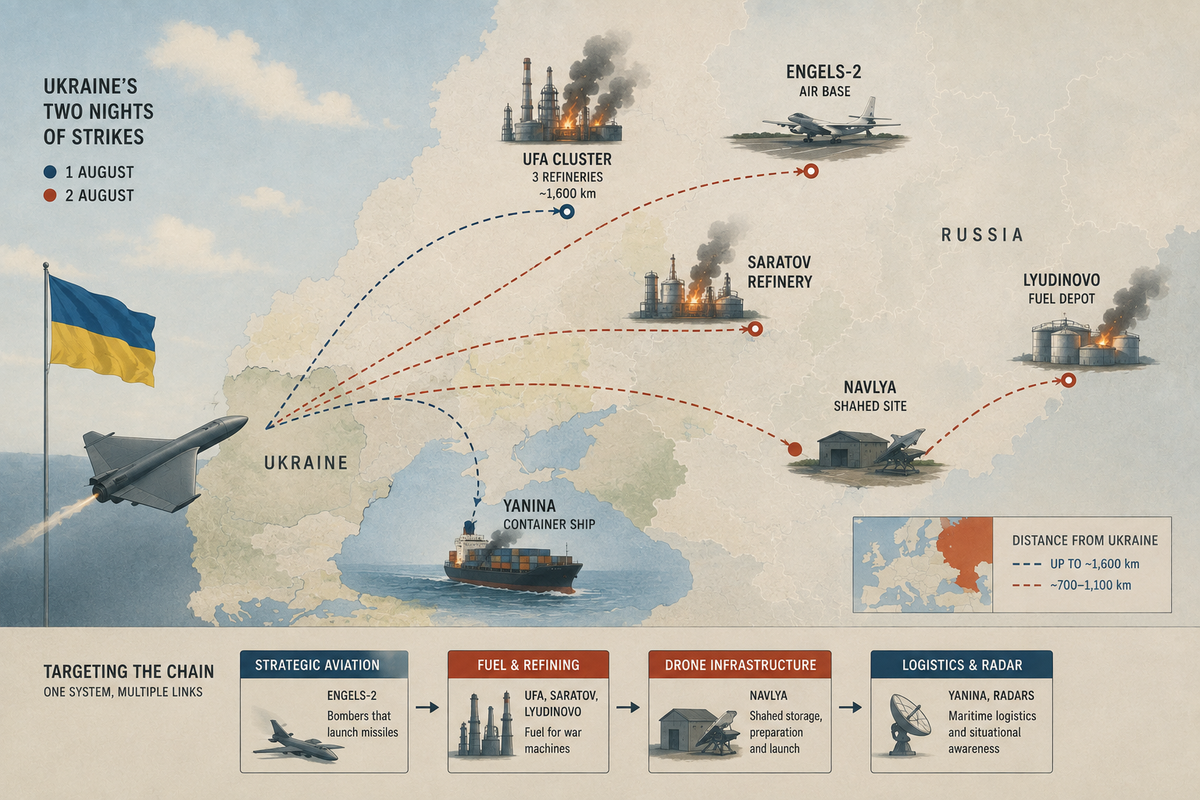
Over two consecutive nights, Ukrainian long-range weapons worked through every link of Russia's strike chain: on the night of 1 August — three Ufa refineries, a sanctioned container ship, and the radar field along the approaches; on the night of 2 August — the Engels-2 strategic aviation base, the Saratov refinery, a military fuel depot in Lyudinovo, and a Shahed launch site near Navlya. For two weeks Russia has been demonstrating its 48-hour rhythm of ballistic salvos. Ukraine has answered with a 48-hour rhythm of its own — except its targets are not residential districts but the carrier aircraft, the fuel that feeds them, and the drones that fly in behind the missiles.
What is confirmed
Night of 2 August (official, Ukraine's General Staff):
- Engels-2 — one of Russia's principal strategic aviation bases, home to the Tu-95MS and Tu-160 bombers that launch missiles at Ukraine. A hit and a fire were recorded at the airfield; the General Staff did not specify what was struck.
- The Saratov refinery (Rosneft, ~7 million tonnes/year, one of Russia's oldest) — a confirmed hit and a large fire. Per Dnipro OSINT analysis, the strike damaged, among other things, the ELOU-AVT-6 primary distillation unit with a 6-million-tonne annual capacity. This is at least the fifteenth attack on the plant of the war; the 8 July strike had already halted its operations. The geometry is telling: the refinery and Engels-2 are 17 km apart — fuel and carriers struck in a single sortie.
- The Lyudinovo oil depot (Kaluga Oblast) — storage and supply of fuel and lubricants for the Russian military.
- A storage, preparation and launch site for attack drones near Navlya (Bryansk Oblast) — a direct attack on Shahed infrastructure.
- Plus ground drone-control stations in Kursk Oblast and in occupied parts of Donetsk, Dnipropetrovsk and Zaporizhzhia oblasts (1 August strikes).
Russian regional authorities confirmed fires and damage in Saratov and Samara oblasts and Udmurtia; Saratov's governor reported two people killed. In Novosemeykino near Samara, a large Wildberries logistics centre caught fire after a strike, and the region's airspace was closed. Russia's defence ministry claimed 635 Ukrainian drones intercepted overnight — a figure that remains a one-sided assertion without independent verification. 🟡
Night of 1 August (recap): three Ufa refineries 1,600 km out (a >23-million-tonne cluster; on 2 August Bashneft-UNPZ was hit again — the second night running), the sinking of the Rosatom/FESCO container ship Yanina 130 miles off Novorossiysk, four radar stations in Krasnodar Krai, and the Black Sea Fleet's EW centre at Cape Fiolent.
What changed: a target system, not a target list
In the morning, the operation looked primarily like a continuation of the refining-and-shipping campaign. The General Staff's evening confirmation reveals a more complex structure: strategic aviation + fuel + Shahed storage and launch + distribution logistics — simultaneous pressure on several links of the strike chain rather than a series of unrelated hits.
BSM analysis: the chain logic is simple. Tu-95s and Tu-160s carry the missiles; refineries and depots give them kerosene; the Navlya sites dispatch the Shaheds that fly in the same salvos as the ballistic missiles aimed at Kyiv. Russia can compensate for a strike on any single link; simultaneous pressure on all of them forces choices about what to defend. Even without confirmed aircraft losses, recurring attacks on Engels-2 carry a cost: dispersal of the bomber fleet, hardened airfield defence, and scarce air-defence assets expended hundreds of kilometres from the front. By the Financial Times' assessment, Ukrainian strikes had knocked out more than 30% of Russia's operational refining capacity (45% of nominal) by late July — the campaign has a measurable cumulative result, and this night added to it.
The Baltic dimension
The regional consequences are indirect but significant, and they reduce to one question: where does Russia move its air defence and EW next.
- Option 1: inward. Pulling additional air-defence and EW systems from the northwestern axis to protect airfields, refineries and industrial centres — thinning coverage around St Petersburg and Kaliningrad for a time. 🟡
- Option 2: to the perimeter. The opposite — reinforcing air defence around St Petersburg, the Gulf of Finland ports and Kaliningrad in anticipation of a widening Ukrainian strike geography. 🟡
- Either way — more EW. Increased long-range electronic-warfare activity can intensify the GPS interference already present over the Baltic Sea and neighbouring states. 🟡
- Baltic ports as the rear gate. Pressure on refining and Black Sea logistics raises the weight of Ust-Luga, Primorsk and other Baltic terminals — and the load on shadow-fleet monitoring. 🟡
No newly confirmed violations of Estonian, Latvian or Lithuanian airspace have been identified since the morning check.
Likely consequences
- Russia will intensify dispersal of its strategic bombers and munitions across multiple airfields.
- Defending refineries, fuel depots and Shahed sites will compete for the same mobile air-defence assets — the shortage becomes structural.
- Ukraine will likely keep combining fuel strikes with attacks on aviation and drone infrastructure. 🟡
- Russia may widen restrictions on mobile connectivity, navigation and civil aviation in regions along long-range drone routes. 🟡
Bottom line
For two weeks, the war's defining number seemed to be the 48 hours between Russian salvos. This weekend produced its mirror image: 48 hours between Ukrainian waves — Ufa and the Yanina, then Engels and Saratov. The difference is not the rhythm but the architecture: Russia strikes the city; Ukraine strikes the system that produces the strikes. Which side fails to sustain its own tempo first is a question now measured not only in Patriot interceptors, but in kilometres of burning distillation units.
Baltic Security Monitor (osint-baltic.com) — an analytical publication on security along NATO's north-eastern flank. All OSINT coefficients are computed by an automated open-source indexing system.