From 30,000 to 50,000: North Korea’s Growing Role Remains the Main Signal to Watch

Baltic Security Monitor | Security Watch10 August 2026, 14:00
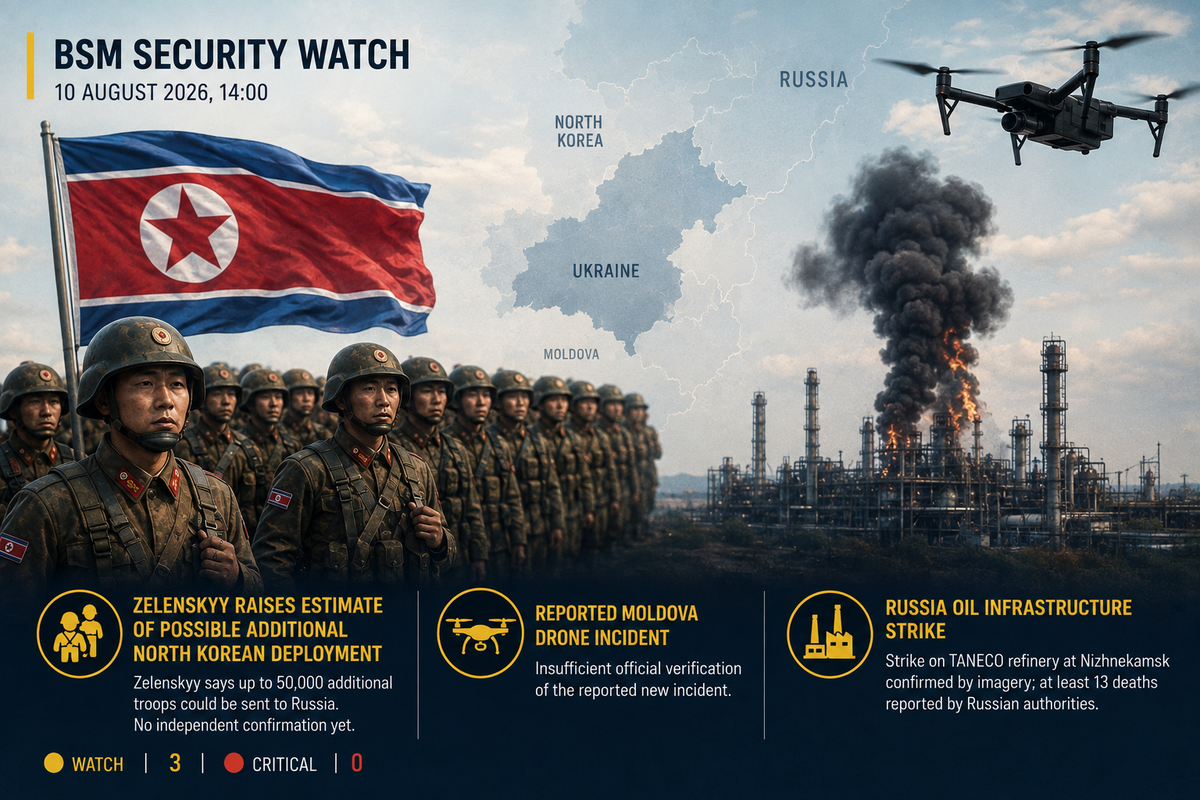
No new development crossed the BSM materiality threshold during the latest monitoring cycle. The most important signal remains the possible expansion of North Korea’s military presence in Russia — but the new figure of up to 50,000 additional troops still lacks independent confirmation.
Zelenskyy Raises the Estimate
President Volodymyr Zelenskyy said on 9 August that Russia could receive up to 50,000 additional North Korean troops.
The figure is significantly higher than the previous Ukrainian estimate of up to 30,000 additional personnel reported earlier in August. Reuters confirmed Zelenskyy’s statement, but the estimate itself remains based on Ukrainian information and has not been independently verified.
That distinction matters.
The underlying trend — deepening military cooperation between Moscow and Pyongyang — is no longer hypothetical. Approximately 14,000 North Korean personnel had previously been deployed to Russia, while Ukrainian intelligence has recently reported the movement of a separate North Korean missile unit to Russia’s Voronezh region.
According to that assessment, the unit includes around 90 personnel, six launchers and potentially as many as 120 KN-23/KN-24 ballistic missiles.
The new 50,000 figure, however, represents a different level of potential involvement.
Why 50,000 Would Matter
If independently confirmed, such a deployment would indicate that North Korean participation is moving beyond limited expeditionary support toward a much larger and potentially more institutionalised military commitment.
An additional force of this size would not necessarily translate directly into 50,000 frontline troops. Personnel could perform combat, logistics, engineering, training, security and other functions.
But even in that case, the effect could be significant.
North Korean personnel assigned to rear-area or supporting roles could release Russian troops for other missions. Combined with missile deployments and continuing ammunition cooperation, this would deepen Pyongyang’s role as a direct contributor to Russia’s war effort.
For Ukraine, the significance is therefore not simply the headline number. The more important question is whether Russia and North Korea are constructing a sustainable mechanism for rotating and expanding North Korean forces inside Russia.
At present, there is not enough public evidence to answer that question.
No corresponding confirmation of the new 50,000 estimate from South Korean intelligence, the United States, NATO or another independent intelligence authority was identified during this monitoring cycle.
Moldova: Another Drone Report, but Still No Confirmation
A second potentially relevant development concerns reports of another war-related drone incident involving Moldova.
The incident remains insufficiently verified.
Fresh checks of Moldova’s Interior Ministry and Border Police sources did not identify a new official statement confirming the specific episode described in secondary reporting.
Moldova has documented previous drone incursions and recovered debris connected to Russia’s war against Ukraine. Those precedents demonstrate that the risk is real, but they cannot be used as evidence that a new incident occurred.
This distinction is particularly important for Baltic Security Monitor because isolated drone reports around NATO’s eastern neighbourhood can quickly acquire strategic significance before the underlying facts are established.
A confirmed penetration accompanied by wreckage, interception, damage or an operational military response would warrant reassessment — especially if evidence connected it with a wider sequence of incidents affecting Romanian or Bulgarian airspace.
For now, that threshold has not been reached.
The TANECO Strike Does Not Yet Change the Regional Picture
Ukraine also struck the TANECO oil refinery at Nizhnekamsk in Russia on 10 August.
Russian authorities reported at least 13 deaths, while Reuters verified imagery showing smoke rising from the refinery.
The attack is operationally significant, but from the perspective of the BSM monitoring framework it currently fits an already established pattern: Ukraine’s long-range campaign against Russian oil and energy infrastructure.
That means the strike does not, by itself, represent a new strategic delta for the Baltic or NATO eastern flank.
This assessment could change if the campaign produces a broader shift — for example, a substantial Russian redeployment of air-defence assets, changes in force protection affecting the north-western military direction, or retaliation directly affecting NATO territory.
None of those developments has been established in the current monitoring cycle.
What to Watch Next
The most important variable is therefore not whether the 50,000 figure receives another media citation, but whether evidence begins to appear behind it.
South Korean intelligence or defence assessments would provide an important independent reference point. U.S. or NATO confirmation would substantially increase confidence. Observable transport movements, identifiable deployment areas or evidence that new North Korean units have actually arrived would be stronger still.
For Moldova, the threshold is similarly straightforward: an official incident report, recovered wreckage, confirmed flight path, interception or attribution.
Until such evidence appears, both developments remain signals to monitor rather than confirmed changes in the regional security picture.
BSM Assessment
The absence of a material update does not mean the underlying security environment is static.
North Korea’s military involvement in Russia continues to deepen, but the latest and most consequential figure — up to 50,000 additional troops — remains a Ukrainian estimate rather than an independently established deployment.
That makes it important, but not yet sufficient, evidence of a new phase.
The distinction between a warning of what may happen and evidence that it is happening remains the central analytical line.