FREYJA Gets a Deadline: Europe's Missile Shield Is Outpacing the Defense of Its Own Trade Routes

Baltic Security Monitor | Geopolitical Commentary Based on a Material OSINT Update, 27 July 2026, 14:00
Two stories from the same day aren't about the same thing, but they trace the same gap. One shows how fast Europe can build shared defense architecture when the political will exists: two weeks after its Paris launch, the FREYJA coalition already has a deadline, a steering committee, and an industrial division of labor. The other shows how slowly that same Europe still responds to a threat that has existed for years: a cargo ship sinks a week after being hit, and the response amounts to a statement about violated maritime law.
Level One: What Changed
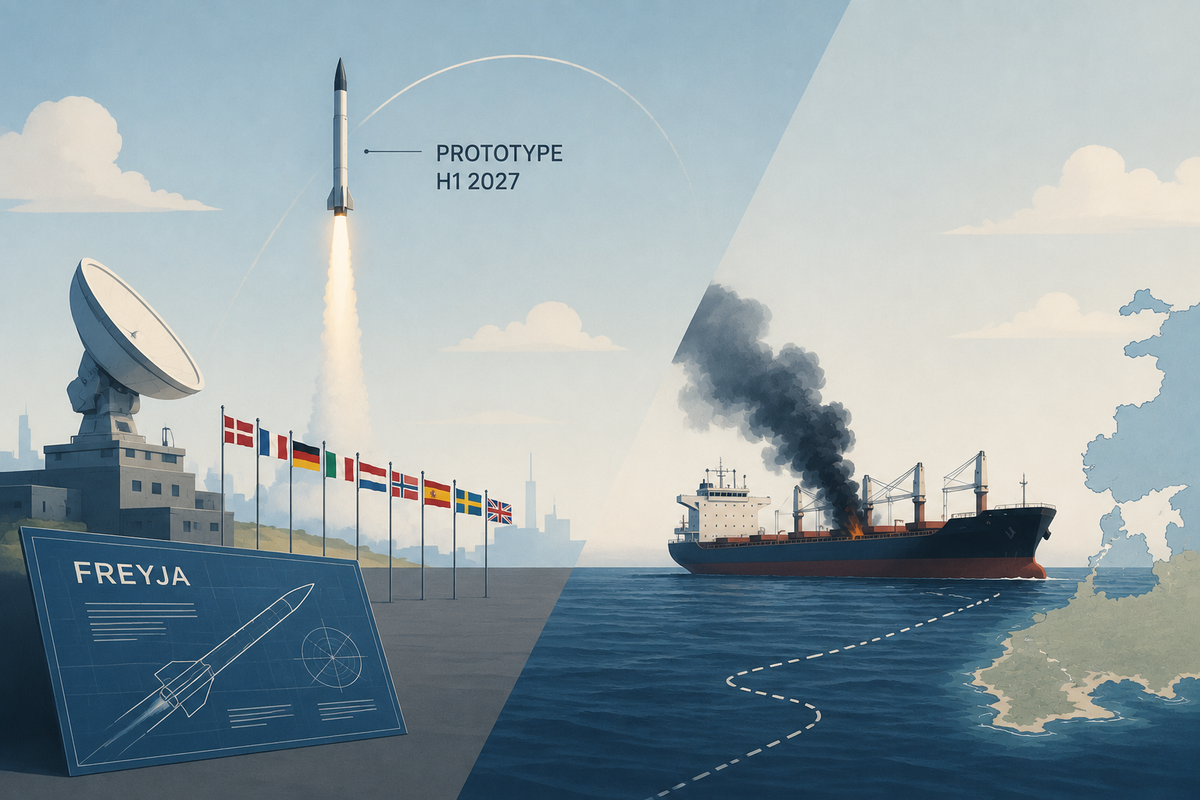
Davyd Aloian, deputy secretary of Ukraine's National Security and Defence Council, said a minimum viable prototype of the European anti-ballistic system FREYJA is targeted for the first half of 2027, and that an international steering committee tasked with costing the R&D will convene for the first time shortly. This is the first concrete timeline attached to the initiative that Ukraine and nine European states — Denmark, France, Germany, Italy, the Netherlands, Norway, Spain, Sweden, and the UK — formally launched in Paris on 13 July.
Kongsberg, Thales, MBDA, Eurosam, Saab, Diehl, HENSOLDT, and Leonardo are already on board, with Ukraine's Fire Point — developer of the Flamingo cruise missile — named as the lead industrial partner on the interceptor side. The system is designed as an open architecture: Denmark can pick a Weibel radar, Sweden can choose a Saab solution, and the components remain interchangeable.
Level Two: What It Means Structurally
FREYJA is moving from political declaration to a program with a deadline and a governing body — precisely the transition that OSINT analysis tends to treat as the more consequential signal, not the statement itself but its institutionalization.
For the region BSM covers, the relevance is direct. Denmark, Norway, and Sweden are founding members; among the industrial partners are Saab, Kongsberg, and Weibel — meaning Nordic defense industry gets a built-in role in a system that could eventually ease NATO's structural dependence on limited Patriot supply. An open architecture means FREYJA's components could, in time, integrate into the regional air and missile defense of the northeastern flank — the same flank whose Border/Air/Maritime index BSM tracks daily.
Level Three: What Stays Uncertain
The first-half-2027 deadline is highly ambitious. R&D costs are not yet defined, and the program depends on merging technology from companies that previously operated in separate, often incompatible supply chains. That's not an obstacle a political statement can remove: integrating one manufacturer's radar with another's interceptor missile is an engineering problem, not a diplomatic one, and the history of comparable multinational defense programs — from SAMP-T to joint European fighter projects — suggests this is exactly the stage where timelines tend to slip.
The Second Story: A Cargo Ship That Took a Week to Sink
The Golden Leo, sailing under a Guinea-Bissau flag, left Chornomorsk with a cargo of corn through Ukraine's maritime corridor toward Romania when it was hit by three Russian Kh-59/Kh-69 cruise missiles on 19 July. It sank off Odesa a week later. Nine crew members and a Ukrainian maritime pilot were killed; eight crew were rescued. Moscow has not commented on the strike.
BSM Assessment: this is not an isolated incident but confirmation that Russia's campaign against Ukrainian ports now extends to international commercial shipping on routes running toward NATO territorial waters. The strike directly raises insurance and operational risk for the Odesa–Romania corridor and adds pressure on NATO's coastal states over shipping protection, surveillance, and response to strikes near Alliance waters. There is, so far, no indication that NATO is preparing a dedicated naval operation or changing escort rules for merchant vessels — the response remains rhetorical while the threat is physical.
Why This Is One Story, Not Two
On paper, FREYJA is a Baltic and Northern European story, and Golden Leo is a Black Sea one. But both measure the same variable: how fast Europe's security architecture is catching up with the reality of the war next to it. For FREYJA, that speed is an encouraging signal — two weeks from a Paris declaration to a concrete deadline and a governing body. For Golden Leo, the signal runs the other way — a week between the strike and the sinking, and no institutional response beyond noting that international law was broken.
Europe is learning to build shared weapons faster than it is learning to protect shared sea lanes. The missile-defense prototype already has a deadline. Protecting shipping still doesn't.
Baltic Security Monitor (osint-baltic.com) — an analytical publication covering security on NATO's northeastern flank.