FREYJA Begins Integration: Europe’s Missile Defence Architecture Moves from Coalition to Engineering Programme

Baltic Security Monitor | Geopolitical AnalysisBased on the Material OSINT Update — 4 August 2026, 20:00
Defence coalitions are often born long before any hardware exists. Memorandums are signed, steering committees are formed, and industrial partners are announced. Yet there comes a moment when a political initiative becomes an engineering programme. For FREYJA, that transition now appears to have begun.
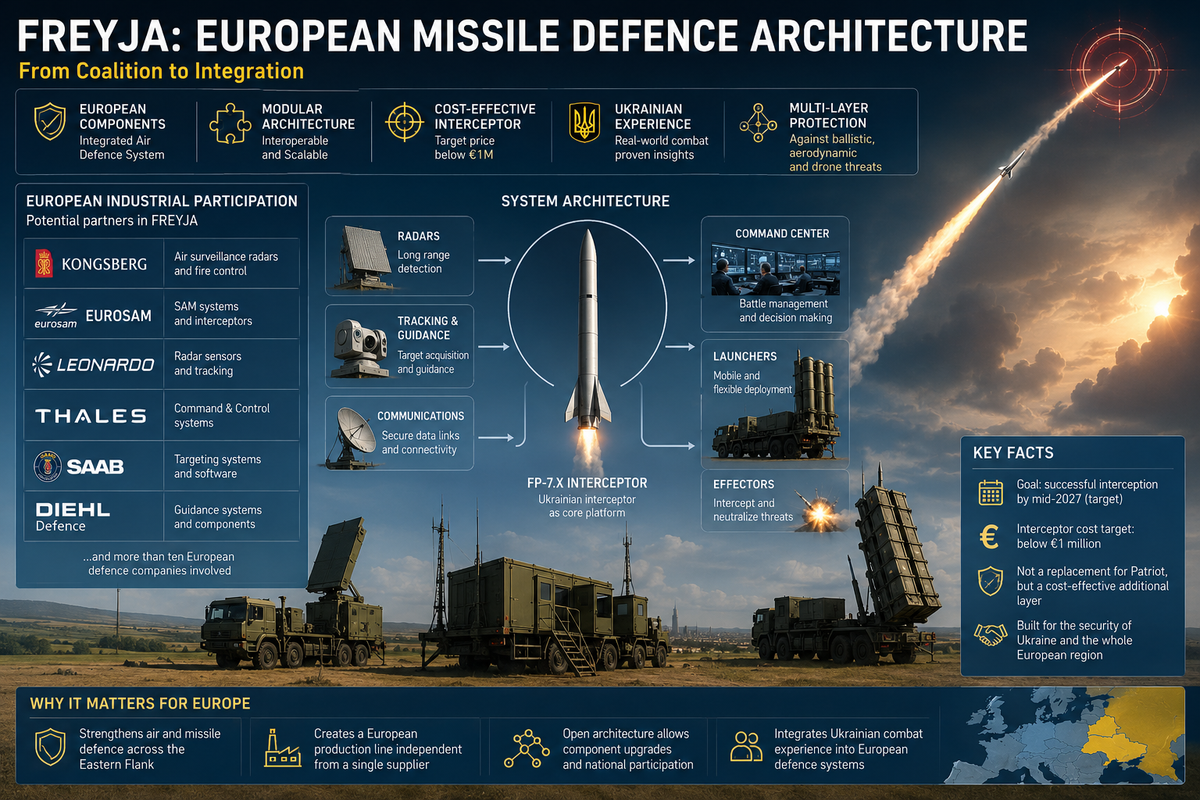
Ukraine’s Fire Point has told Reuters that it has started integrating components from more than ten European defence companies into the future FREYJA missile defence system. Previous announcements focused on building a European-Ukrainian coalition; this development marks the first evidence that individual combat subsystems are being assembled into a single operational architecture.
Potential industrial partners include Kongsberg, Eurosam, Leonardo, Thales, Saab, and Diehl Defence. The concept envisions combining a Ukrainian interceptor missile with European radars, guidance systems, seekers, command-and-control infrastructure, and battle management software.
This shift from partnership announcements to technical integration could become the defining milestone in Europe’s next-generation missile defence effort.
What Has Changed
Only weeks ago, FREYJA remained primarily a political and industrial initiative.
The coalition had established governance structures, identified industrial roles, and defined its strategic objectives. Whether those commitments would evolve into a functioning defence system remained an open question.
Fire Point’s announcement represents the first tangible indication that the programme has entered a new phase.
The work now focuses on integrating concrete system components:
- a Ukrainian interceptor missile;
- European radar systems;
- fire-control and battle management;
- guidance and seeker technologies;
- command-and-control architecture.
In other words, FREYJA is moving beyond institutional coordination and into engineering integration.
This does not mean the system is operational. No prototype has yet demonstrated a confirmed interception of a ballistic target. However, subsystem integration is one of the most critical milestones in developing any modern air and missile defence capability.
Why It Matters
Europe’s missile defence architecture still depends heavily on a limited number of American-made Patriot systems.
Russia’s war against Ukraine has exposed two structural weaknesses.
First, production of expensive interceptor missiles cannot keep pace with wartime consumption.
Second, Europe lacks a scalable indigenous missile defence architecture capable of rapidly expanding across multiple countries.
FREYJA seeks to address both challenges simultaneously.
Rather than developing an entirely new closed system, the programme proposes an open, modular architecture in which different European companies contribute individual subsystems.
This approach resembles modern digital ecosystems: instead of replacing an entire platform, operators can upgrade individual components.
Radars, sensors, guidance technologies, or command systems could be modernised independently without redesigning the entire weapon system.
Such flexibility is increasingly becoming a defining characteristic of advanced defence technologies.
Ukraine’s Battlefield Experience as a European Asset
Ukraine occupies a unique position within the programme.
Most existing European air defence systems were designed during peacetime or for expeditionary operations.
By contrast, Ukrainian engineers have spent more than four years adapting to continuous attacks involving cruise missiles, ballistic missiles, drones, and sophisticated electronic warfare.
That operational experience cannot easily be replicated in laboratories.
FREYJA therefore has the potential to become the first major European missile defence programme built directly upon lessons learned in high-intensity modern warfare.
For NATO, this represents more than a new interceptor.
It represents the transfer of battlefield knowledge into Europe’s future defence architecture.
Implications for the Baltic Region
For Poland, the Baltic States, and Northern Europe, FREYJA’s significance extends well beyond Ukraine.
NATO’s eastern flank increasingly faces the challenge of simultaneously protecting cities, military bases, energy infrastructure, logistics hubs, and seaports.
Such missions require far greater interceptor inventories than existing Patriot stocks can realistically provide.
If FREYJA achieves its stated objectives, it could evolve into a second defensive layer—complementing rather than replacing Patriot.
That prospect explains why manufacturers from multiple European countries are already participating in the programme.
The initiative is no longer simply about developing another missile.
It is about creating a shared European industrial ecosystem capable of producing missile defence at scale.
What Remains Unknown
Despite the importance of this milestone, several critical questions remain unanswered.
The proposed FP-7.X interceptor aims to achieve a successful interception by mid-2027 while keeping the cost of each missile below €1 million.
At present, these figures represent developer targets rather than demonstrated performance. 🟡
Other key uncertainties include:
- the date of the first live-fire tests;
- the range of target types the system will be able to engage;
- its operational interception envelope;
- which participating companies have already signed legally binding contracts.
These factors will ultimately determine whether FREYJA becomes a deployable missile defence system or remains an ambitious technological concept.
Conclusion
The most significant development is not the announcement of another interceptor missile.
The real story is that FREYJA appears to have crossed the threshold from political coordination to engineering integration.
In complex defence programmes, this transition is often the most difficult stage. It is where industrial cooperation must prove that separate technologies can function as a single combat system.
A successful ballistic interception is still some distance away.
Nevertheless, once subsystem integration has begun, FREYJA can no longer be viewed merely as a political declaration. It is increasingly taking shape as a genuine European programme to build the next generation of integrated missile defence.