Four Days Without a Pause: Romania Draws the Line Between Permission to Shoot and Automatic Fire

Baltic Security Monitor | Geopolitical Commentary Based on a Material OSINT Update, 27 July 2026, 20:00
Romania has just given the entire NATO eastern flank a live demonstration: authorization to shoot down drones is not the same thing as automatic fire on every target. Four days running, the airspace over Tulcea County was breached by unmanned aircraft, and Bucharest used weapons in only three of the four cases. The gap between "shoot down" and "track and let go" isn't a system failure — it's the first publicly visible look at the criteria an Alliance member actually uses to decide when to pull the trigger.
Four Days, Chronologically
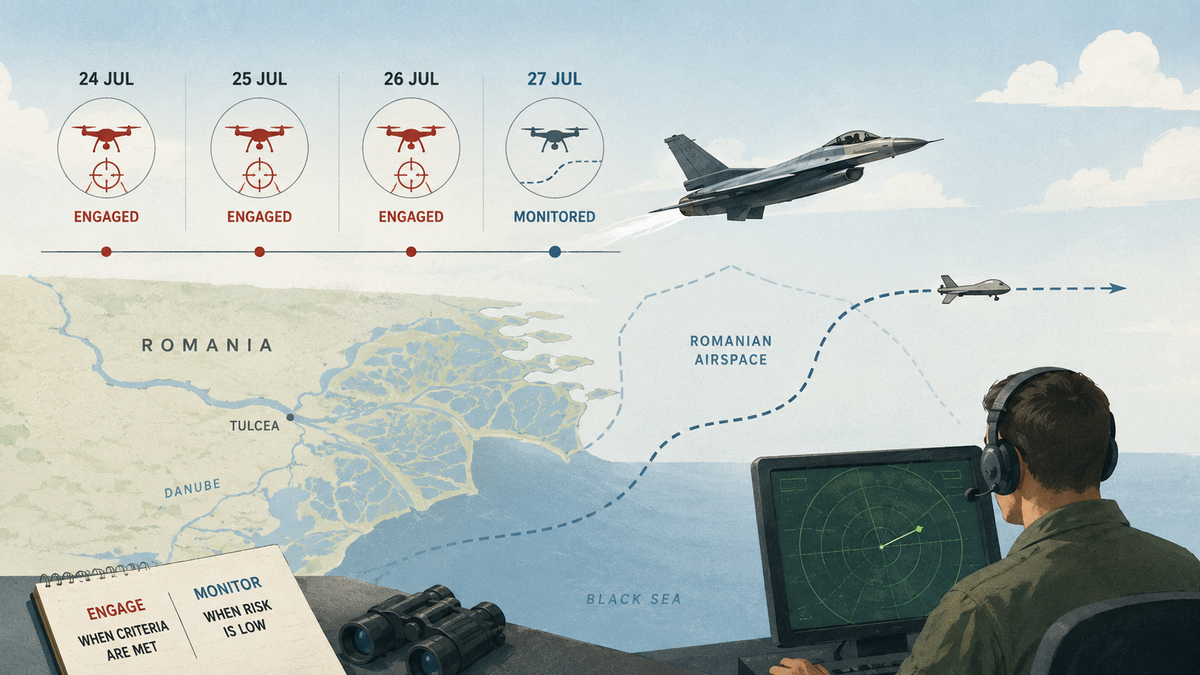
- 24 July — incursion over land, target destroyed.
- 25 July — incursion near the Danube Delta, target destroyed.
- 26 July — a drone shot down over territorial waters near Sulina–Chilia, five minutes after entering Romanian airspace; President Nicușor Dan called it "an inadmissible continuation" by Russia.
- 27 July — a fourth consecutive incursion: Romania's Ministry of Defence radar detected a target 36 km east of Sulina at 08:47, two F-16s from the 86th Air Base at Fetești scrambled at 08:53, and a RO-Alert went out to residents of Tulcea County. The drone briefly entered Romanian airspace before crossing back toward Ukraine; explosions were reported on Ukrainian territory shortly after.
Unlike the previous three days, the 27 July target was not shot down — only tracked.
Diplomatic Escalation
Romania's Foreign Ministry summoned Russian Ambassador Vladimir Lipaev over "repeated violations of Romania's airspace between 24 and 26 July 2026," handed him a formal protest, and gave one Russian diplomat five days to leave the country. Bucharest also recalled its own ambassador from Moscow for consultations. Moscow rejected the accusations. This marks the first shift from purely operational response — intercepting and shooting down drones — to diplomatic sanctions within the current four-day series. Romania's Defence Ministry says this is the 33rd recorded airspace violation by drones since the war began.
BSM Assessment: Why the Fourth Episode Matters More Than the First Three
Three shoot-downs in a row could be written off as a run of isolated incidents. A fourth episode is a statistical pattern — a persistent side-effect of Russian strikes on Ukraine's Danube-corridor targets, not a fluke. But today's response also reveals the boundary of the new practice: having authorization to destroy a target does not mean every target gets destroyed. The decision still depends on trajectory, time spent inside national airspace, whether the object can be identified, and the risk to the population below.
For the Baltic states, this is a direct preview. Romania's model suggests the eastern flank's emerging doctrine is unlikely to be a simple "shoot down every drone" rule — more likely a graduated sequence: detect → identify → assess trajectory → select the response asset → engage only if the criteria are met. That is precisely the operational protocol Baltic NATO members will eventually need to spell out publicly too, given comparably dense airspace and proximity to the Belarusian and Kaliningrad borders.
Regional Context
The series coincides with intensified Russian strikes on Ukraine's Danube ports and Black Sea shipping — meaning drone fragments crossing into Romanian airspace are most likely a byproduct of strikes near Izmail and Chilia rather than a deliberate test of Romania itself. That doesn't lessen the consequences for Bucharest: sustained high alert for Romanian and allied fighters, pressure on NATO to standardize the rules of engagement against drones, faster deployment of cheaper ground-based counter-UAS systems, further deterioration in relations with Moscow, and a rising probability of symmetric Russian diplomatic retaliation.
Conclusion
Romania received permission to shoot down drones back in May. It only worked out, in real time and under the pressure of an actual fourth-day incursion, the criteria for when to pull the trigger versus when to simply track a target out of its airspace. That's the part of a doctrine NATO normally spends years of exercises building — here it's being written live. The Baltic flank is watching a free, if unnerving, masterclass.
Baltic Security Monitor (osint-baltic.com) — an analytical publication covering security on NATO's northeastern flank.