Four Days Running: OSINT Digest, July 13

Baltic Security Monitor | Analytical Briefing Snapshot: 2026-07-13T10:53:43Z
Today's OSINT indices
| Indicator | Value | Movement |
|---|---|---|
| Composite threat index | 0.10 | Δ6h 0.00 · Δ24h 0.00 — flat for a sixth straight snapshot |
| Force Posture | 0.06 | down again, a third swing this week |
| Logistics | 0.00 | back to zero |
| Info/Cyber | 0.07 | off zero for the first time in four snapshots |
| Border/Air/Maritime | 0.26 | fourth straight rise: 0.21 → 0.22 → 0.24 → 0.26 |
Events logged in 24h: 10 · High-confidence: 0 Quarantined: 0 · Source failures: 0
Border/Air/Maritime has now risen for four consecutive snapshots without a single break — no longer a trend, but a steady line. Meanwhile Info/Cyber has moved off zero for the first time in four days. The top five, by contrast, hasn't shifted by a single position: the same five entries as July 10, in the same order, with the same scores. The gap between a "dead" top five and "live" sub-indices is especially stark today.
Top five: unchanged for a fourth straight snapshot
The SNMG2 command handover from Italy to Greece (0.44) has now held first place for four consecutive snapshots — July 6, 7, 10 and 13 — with an identical score each time. Behind it sit the same NATO training catalogue (0.35), the same Maven Smart System milestone (0.28), the same Task Force X-Central Mediterranean launch (0.28), and the same NISRF Exercise ACE wrap-up (0.28).
BSM analysis: This is the longest stretch of complete top-five stasis BSM has observed. The explanation is simple and already confirmed by prior issues: the system pulls the newest, highest-scored material from a limited pool of official NATO sources, and when those sources go quiet for several days running, the index just repeats what's already there. The value of this fact isn't in the entries themselves — it's that it forces a reading of the sub-indices in isolation from the top five, because that's where the real movement is happening today.
The signal the digest missed: two parallel threads
Thread one: the information offensive behind Info/Cyber
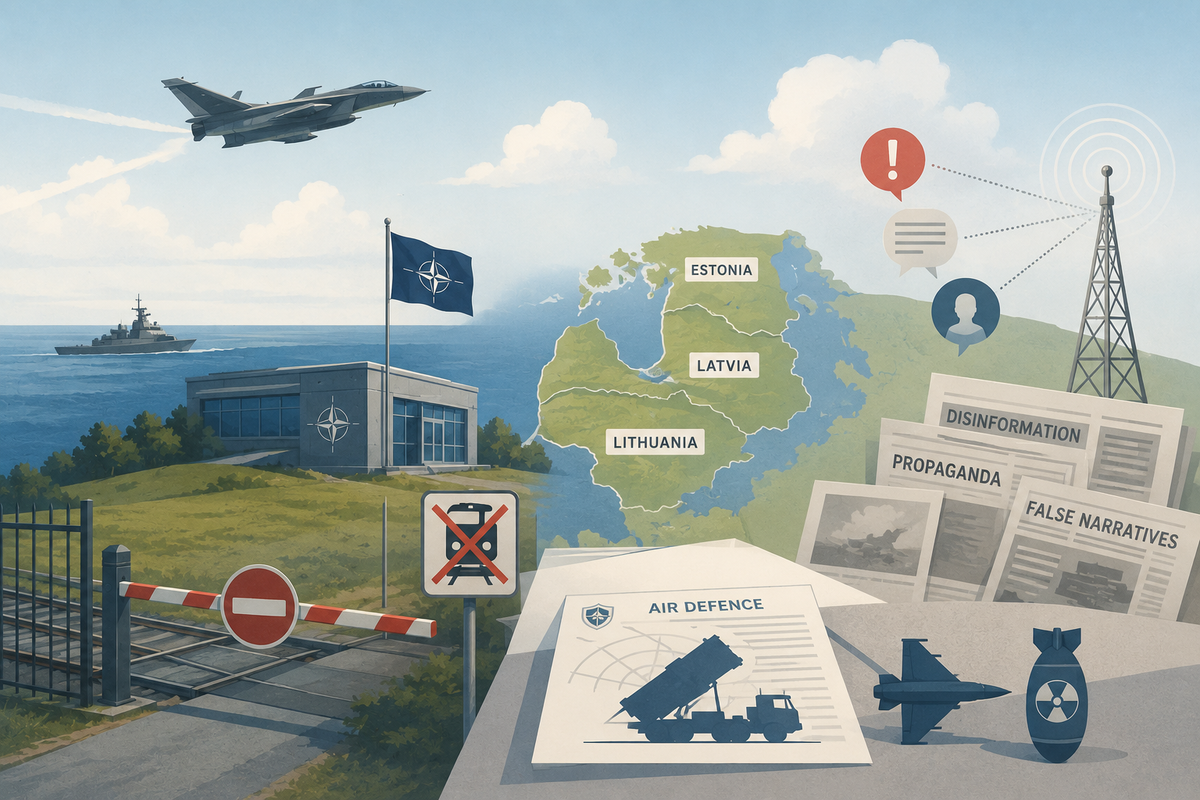
According to an Estonian intelligence assessment, Russia has escalated a propaganda campaign against the Baltic states and Finland in response to the growing effectiveness of Ukrainian strikes on Russian oil refineries. The campaign pushes claims that the Baltic states have allowed Ukraine to use their airspace for strikes on Russia, that a mass deportation of Russian-speaking residents is being planned, and that nuclear weapons are being stationed in Lithuania or Finland. On July 7, a Russian Foreign Ministry human-rights official, Grigory Lukyantsev, publicly claimed the Baltic states were preparing a "mass deportation" — a claim that does not correspond to reality. The Baltic states responded with a formal protest to Russia over the spread of these narratives.
BSM analysis: This is the first day in four snapshots that the Info/Cyber sub-index has moved off zero at all (0.07) — almost certainly not a coincidence. A coordinated disinformation campaign against three countries, met with a formal diplomatic protest, is exactly the kind of information incident that would shape this sub-index, yet it never reached the top five because none of the NATO.int-adjacent sources the system tracks published it.
Thread two: what's behind the fourth day of Border/Air/Maritime growth
Several parallel developments this week bear directly on the region's air and border dimension. Finland received official notification from Russia confirming the closure of railway border crossings — formalizing a decision made without explanation since July 1 — and Helsinki responded by adding counter-drone training to its conscript program. NATO, meanwhile, opened a new command centre near Russia's border tasked with coordinating alliance forces in Estonia and Latvia and overseeing the region's defence in the event of an attack. In parallel, reporting citing Western and Ukrainian intelligence assessments says Russia is forming new military units in the newly created Leningrad Military District near the Baltic border, with readiness assessments for a possible attack pointing tentatively toward 2027.
Against this backdrop, Lithuania is debating whether to lift its constitutional ban on hosting nuclear weapons on its territory; according to Western reporting, Estonia, Latvia, Lithuania and Poland have all expressed interest in potentially hosting bases for US dual-capable aircraft (DCA) able to deliver nuclear strikes.
BSM analysis: No single one of these developments is a clean trigger for the sub-index's rise — but together they form a coherent picture of accumulating air-and-border activity for a fourth straight day: closed crossings, a new command centre, assessments of Russian force buildup, and a live debate over nuclear basing. This is exactly the kind of distributed, multi-source signal the composite index picks up through a sub-index before it shows up as a discrete top-five event.
Regional context
Nine states — the Netherlands, Germany, Finland, Sweden, Lithuania, Estonia, Latvia, Denmark and Poland — have asked the European Commission to swiftly approve the purchase of US-made air-defence missiles using the defence portion of the EU's €90 billion support package for Ukraine in 2026–2027.
On the diplomatic front, Ukraine's military intelligence chief Kyrylo Budanov warned that Poland is preparing a series of "immature escalatory steps" ahead of the anniversary of the Volyn tragedy — a warning that stands in contrast to Polish Defence Minister Władysław Kosiniak-Kamysz's visit to the Volyn region on July 11, where he spoke about the importance of reconciliation and avoiding a "spiral of hatred."
Conclusion
For a sixth straight snapshot the composite index sits flat, and the top five hasn't moved in four days. But beneath that surface stillness run two real, parallel developments: a coordinated Russian disinformation campaign against the Baltic states and Finland, which just moved Info/Cyber off zero for the first time in days, and an accumulation of border-and-air developments — from closed rail crossings to a new NATO command centre to a live nuclear-basing debate — that has pushed Border/Air/Maritime higher for four consecutive days. The digest sees repetition. The region keeps moving.
Baltic Security Monitor (osint-baltic.com) — an analytical publication covering security on NATO's northeastern flank. All OSINT coefficients are calculated by an automated indexing system based on open sources.