Five Days and a Threshold: OSINT Digest, July 15

Baltic Security Monitor | Analytical Briefing Snapshot: 2026-07-15T13:39:19Z
Today's OSINT indices
| Indicator | Value | Movement |
|---|---|---|
| Composite threat index | 0.09 | Δ6h 0.00 · Δ24h 0.00 — a seventh straight flat snapshot |
| Force Posture | 0.00 | back to zero |
| Logistics | 0.00 | back to zero |
| Info/Cyber | 0.05 | down slightly from 0.07 |
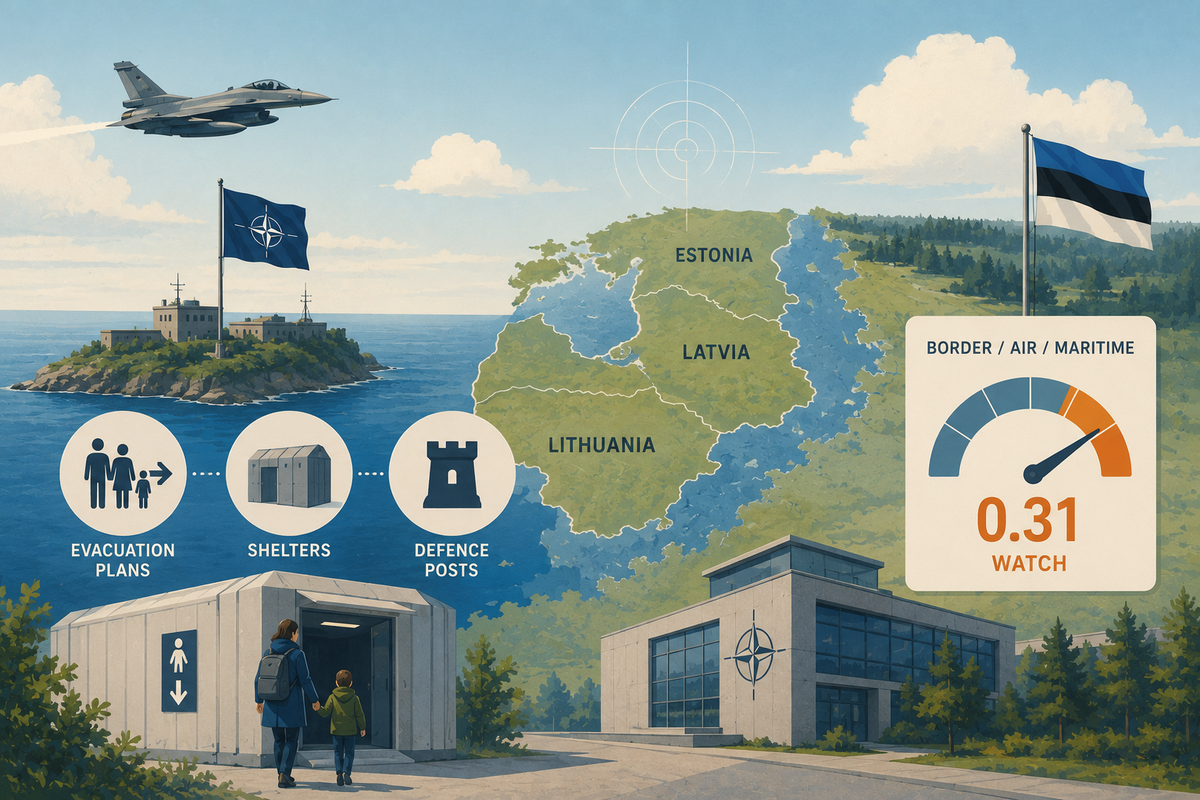
| Border/Air/Maritime | 0.31 | fifth straight rise: 0.21 → 0.22 → 0.24 → 0.26 → 0.31 |
Events logged in 24h: 10 · High-confidence: 0 Quarantined: 0 · Source failures: 0
For the first time since BSM began tracking this digest, a sub-index has crossed the WATCH threshold (0.30) on its own — and it's not a top-five event, it's Border/Air/Maritime, now rising for a fifth consecutive snapshot. In practical terms, the system is rating the cumulative level of activity in the region's air-and-border dimension higher today than every top-five entry except the single top spot. The top five itself, meanwhile, hasn't moved for a fifth straight time.
Top five: unchanged for a fifth snapshot
The same list as July 6, 7, 10 and 13: the SNMG2 command handover (0.44), NATO's training-opportunities catalogue (0.35), Maven Smart System (0.28), Task Force X-Central Mediterranean (0.28), and the NISRF Exercise ACE wrap-up (0.28). No new entries, no score changes.
BSM analysis: Five days of an identical top five is no longer a single-snapshot anomaly — it's a stable feature of the system's source base over the past week. That fact is becoming genuinely useful, methodologically: it confirms that any sub-index growth this week is coming from outside the top five, from the wider pool of lower-scored events beneath the visible ranking. That's where to look to understand what's actually driving the composite index.
The signal behind the threshold crossing
No single event of the past few days explains the sub-index's jump on its own — but the sum of this week's regional decisions adds up to a coherent picture of accelerating preparation across the Baltic air-and-border space.
First, ten Northern European countries have agreed to jointly develop civilian evacuation plans for a large-scale crisis or military conflict in the region, and Estonia, Latvia and Lithuania have separately concluded their own agreement on handling mass population displacement in the event of a military threat. Second, NATO is turning Sweden's Gotland island — a strategic position in the middle of the Baltic Sea — into a key defensive outpost amid concerns over possible Russian aggression. Third, Tallinn has installed its first modular air-raid shelter — a mobile structure that can be quickly relocated, expanded, or deployed at different points around the city.
All of this layers on top of what's already known from earlier this week: the official confirmation of the rail-crossing closures with Finland, NATO's new command centre near the Russian border, and the newly granted authority for Baltic Air Policing fighters to shoot down threatening aerial targets.
BSM analysis: None of these developments would individually score high in a system tuned to official NATO publications — an evacuation agreement, a Tallinn shelter, or a Gotland outpost tend to surface through regional and national sources the index tracks less reliably than shape.nato.int or mc.nato.int. But together they describe a single process: the Baltic states and the wider Nordic region are synchronously building out air-and-border readiness infrastructure — from evacuation planning to physical shelters and forward outposts. That's exactly the kind of distributed signal a sub-index picks up faster than a top-five list of discrete events.
Regional context
Lithuania, Latvia and Estonia continue expanding their mobilisation reserves: Latvia, despite its relatively small population, has set a goal of building a combat-ready reserve of up to 50,000 by 2027. Basic military-training programmes have been restored in schools across the three states, and Estonia has already confirmed plans to raise defence spending to roughly 5.4% of GDP over 2026–2029.
Against this backdrop, Finland, Sweden and the rest of the Nordic region are adapting their own "total defence" concepts — including large mobilisation reserves and tactics tailored to the region's forested terrain, which significantly constrains the use of heavy armour.
Conclusion
For a seventh straight snapshot the composite index sits around 0.10, and the top five hasn't moved in five days. But for the first time since BSM began tracking this digest, one of its sub-indices has independently crossed the WATCH threshold: Border/Air/Maritime has risen for five consecutive days, driven not by any single event but by an accumulation of decisions — from Baltic and Nordic evacuation agreements to a Gotland outpost and Tallinn's first shelters. The digest keeps showing stillness. The region keeps methodically preparing.
Baltic Security Monitor (osint-baltic.com) — an analytical publication covering security on NATO's northeastern flank. All OSINT coefficients are calculated by an automated indexing system based on open sources.