Finland’s Quiet Build-Up: Why Today’s OSINT Digest Matters More Than Its Numbers

Baltic Security Monitor | Analytical ReviewSnapshot: 2026-08-06T10:59:30Z
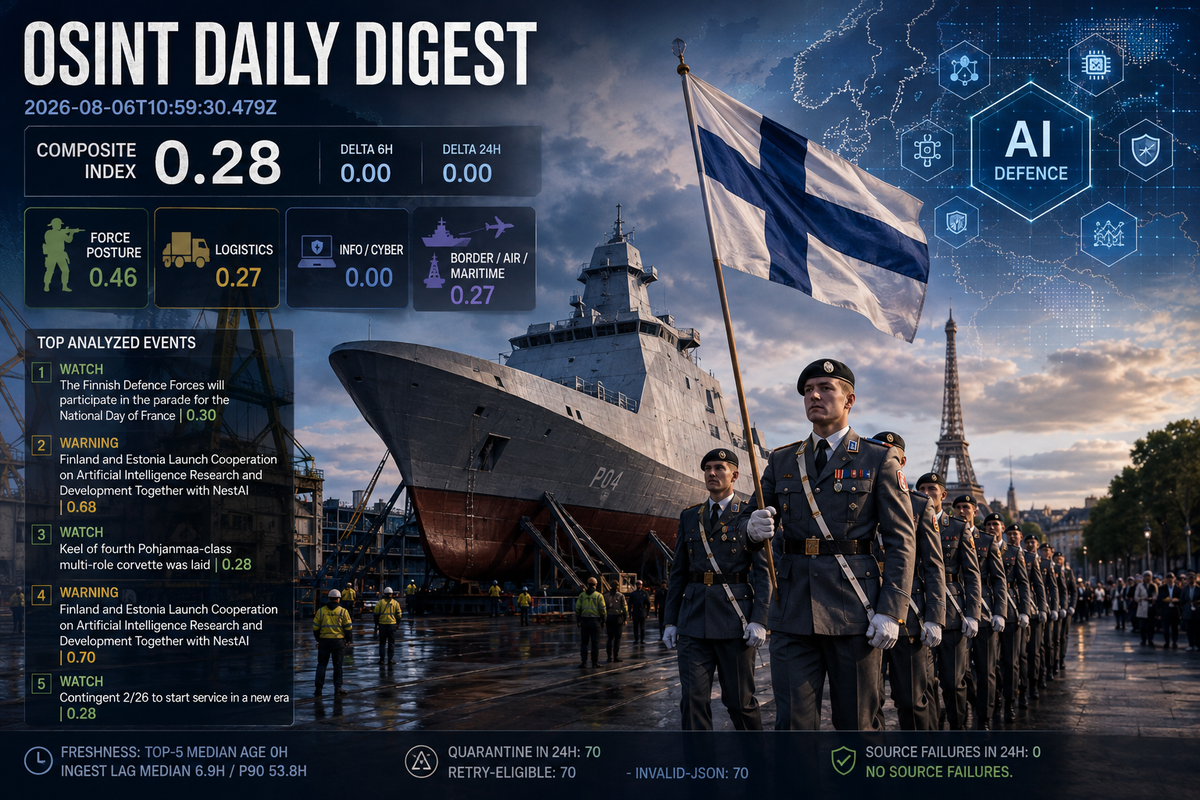
The Composite Threat Index remains unchanged at 0.28 for the second consecutive day. That does not mean nothing is happening. On the contrary, today’s OSINT flow highlights a different pattern: Finland continues to implement its long-term defense strategy through a series of small but interconnected steps. A military parade in Paris, the keel laying of another corvette, a new intake of conscripts, and continued investment in defense AI are not isolated headlines—they are components of the same strategic trajectory.
Today’s OSINT Indicators
|
Indicator |
Value |
Change |
|---|---|---|
|
Composite Threat Index |
0.28 |
Unchanged over the past 6 and 24 hours |
|
Force Posture |
0.46 |
Highest indicator of the day |
|
Logistics |
0.27 |
Stable |
|
Border / Air / Maritime |
0.27 |
Stable |
|
Info / Cyber |
0.00 |
No new significant developments |
What Changed Today
Unlike previous days, when individual high-impact events drove the overall threat picture, today’s snapshot shows remarkable stability.
The most visible development is the participation of the Finnish Defence Forces in France’s Bastille Day military parade. While the event has little direct military significance, it demonstrates Finland’s growing integration into NATO and European defense activities.
At the same time, several long-term programs continue to advance:
- construction of the Pohjanmaa-class multi-role corvettes;
- the ongoing intake and training of a new cohort of conscripts;
- continued Finnish-Estonian cooperation on defense artificial intelligence.
None of these developments is transformative on its own. Together, however, they illustrate a consistent and disciplined defense policy.
Why It Matters
For the Baltic region, today’s most important signal is the absence of volatility.
Since joining NATO, Finland has avoided symbolic one-off gestures in favor of systematic capability building. Naval modernization, expanded military training, technological investment, and regular multinational participation all reinforce a predictable long-term defense posture.
Such consistency often provides a stronger deterrent effect than dramatic political announcements or short-lived military demonstrations.
What the OSINT Picture Shows
The current snapshot does not indicate an immediate increase in military risk.
Instead, it reinforces a trend observed over recent months: countries on NATO’s northern flank are steadily converting defense policy into practical capability development.
For Ukraine, this is also a positive strategic signal. Stronger Finnish and Baltic defense capabilities enhance NATO’s northeastern flank through planned modernization rather than emergency mobilization, increasing regional resilience without creating additional instability.
Bottom Line
Today’s digest offers no dramatic headlines—and that is precisely the story.
The Composite Threat Index remains at 0.28, while Finland continues to strengthen its military capabilities through deliberate, long-term planning. Rather than responding to crises, Helsinki is steadily building the institutions, technology, and forces that will shape the future security balance across Northern Europe.