The EU Opens 17 More Accession Chapters With Ukraine: What the Lifted Hungarian Block Changes, and What It Does Not

Baltic Security Monitor | Material OSINT Update Snapshot: 14 October 2026, 08:00 (Europe/Tallinn)
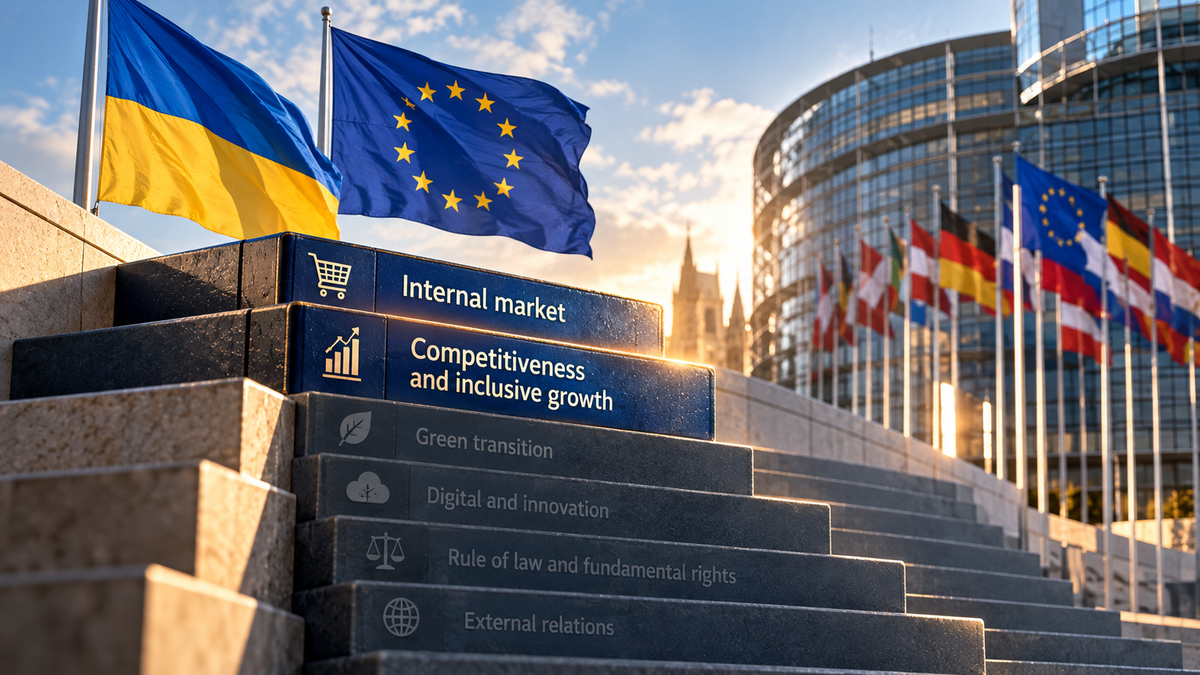
On 13 October in Luxembourg the EU and Ukraine formally opened negotiations on two more clusters: internal market, and competitiveness and inclusive growth. Together that is 17 chapters. It is an adopted institutional decision, not another declaration. But opening chapters brings Ukraine neither membership nor security guarantees.
1. What happened
The Council of the EU confirmed that negotiations opened on two clusters. Internal market has nine chapters: free movement of goods, free movement of workers, right of establishment and services, free movement of capital, company law, intellectual property, competition policy, financial services, and consumer and health protection. Competitiveness and inclusive growth has eight: digital transformation and media, taxation, economic and monetary policy, social policy and employment, enterprise and industrial policy, science and research, education and culture, and the customs union (Council of the EU). The Council also set benchmarks for the eventual provisional closing of the chapters but did not publish their detail.
Why it became possible. Per Euronews, Budapest had made further progress conditional on Kyiv adopting a minority-rights law that strengthens protection for minority languages in schools and at cultural events. Ukraine's parliament voted on 12 October: 266 of 450 deputies in favour. Hungary's new prime minister Péter Magyar had already lifted the veto on the first two clusters in June. Opening a cluster requires unanimity, so lifting Hungary's objection was a key condition. The Council press release does not mention Hungary; the link comes from media reports.
2. Confirmed versus outstanding
| Claim | Status |
|---|---|
| Two clusters and 17 chapters opened | ✅ Council of the EU (9 + 8 chapters) |
| Minority-rights law adopted 12 October | ✅ Euronews (266 votes) |
| Hungary lifted its objection | ✅ Media reports; the Council release does not name it |
| "Four of six clusters now open" | 🟡 The Council page names three open (external relations since July plus these two); whether the fundamentals cluster is also open I have not confirmed |
| Timetable for closing chapters | 🟡 Unknown; benchmarks not published in detail |
| Military or defence consequences | 🟡 None established |
| Publication times per the digest (19:26, 20:33, 22:06 EEST) | 🟡 Digest only |
3. BSM analysis
Opening talks is not membership. Opening chapters means Ukraine must meet benchmarks and member states must assess them. Closing each chapter needs a fresh unanimous decision, so Hungary is not the only possible barrier. It is not a guarantee.
This is not a security act. The new clusters cover markets, competition, taxation and regulation, not defence or NATO. The digest rightly notes that the security chapters are separate and were opened earlier.
One correction to the digest. It says "four of the EU's six clusters" are open. The Council page names only three (external relations in July plus the two new ones). The count may differ if the fundamentals cluster is also open, but I did not verify that, so BSM does not repeat the figure.
For the Baltic states Ukraine's integration into EU legal and market frameworks matters in the long run: it gradually ties together defence industry, trade and logistics. But it is a process of years, not an immediate effect.
WATCH: updates
🟡 Black Sea, rescue from HS Dignity: conflicting figures. BTA at 20:59 on 13 October: of a 16-strong crew, five rescued (four had arrived in Varna, a fifth was expected), 11 unaccounted for, figures from the Varna regional governor. NOVA and Novinite earlier gave six rescued and ten missing. This corrects BSM's 13 October 20:00 report, which presented "six and ten" as the revised figures: the later BTA report again gives five. There is no definitive statement from the rescue service. Next check: a maritime administration statement.
🟡 Poland, Starlink. Per the digest, Reuters reported that Germany's federal police confirmed coordination on three detainees, while the fourth detention is attributed to Polish media. No official confirmation of a fourth. Next check: Polish prosecutors, German police.
Estonia, Rutte's visit. The NATO Secretary General is in Tallinn today. The visit was announced on 9 October and is not material in itself.
Per the digest, not re-verified by me
| Item | State per digest |
|---|---|
| Energy ceasefire | New strikes on Kyiv's energy; Russia has not confirmed a bilateral deal |
| US, warnings of ballistic strikes | Zelensky's office: second case this week; Trump and Sybiha say sharing continues |
| Bulgaria, surveillance measures | Completion not confirmed (see the 13 October 20:00 report) |
| Poland, threats to Tusk and Kosiniak-Kamysz | 66-year-old suspect, nine charges, denies them; no foreign direction shown |
| Ukraine, diesel | No new data on effect on military logistics |
| France, DF Peak | Boarded 12 October; no final judicial outcome |
| NATO, "Theory of Victory" | Presentation held; no decisions |
| Data centres, refineries, sanctions | No new independent confirmation |
| Molesworth, Hanning, Rybar, Lithuania | No new confirmation |
Conclusion
The EU has taken a real institutional step for Ukraine: 17 chapters opened and the Hungarian obstacle removed. But toward membership it is only a start: benchmarks, reforms and fresh unanimous decisions lie ahead.
Next checks: the published benchmarks for the chapters; how Kyiv implements the minority-rights law; Hungary's stance at later stages; the exact count of open clusters.
Baltic Security Monitor (osint-baltic.com) — an analytical outlet on security on NATO's north-eastern flank. All OSINT assessments are prepared by an automated open-source monitoring system.