Eleven Months Instead of Four: Denmark Turns Conscription into an Operational Reserve for the Baltic and the Arctic

Baltic Security Monitor | Geopolitical AnalysisBased on the Material OSINT Update — 4 August 2026, 08:00
Denmark has changed more than the length of military service. It has begun transforming conscription from a short familiarisation programme into a mechanism for building a trained reserve capable of supporting combat units, Arctic operations and the defence of the Baltic Sea approaches. At the same time, Ukrainian strikes against Russia’s oil-refining sector are increasing pressure on Baltic export ports, making the Danish Straits even more significant for controlling Russia’s maritime energy logistics.
Reform Moves from Policy to Implementation
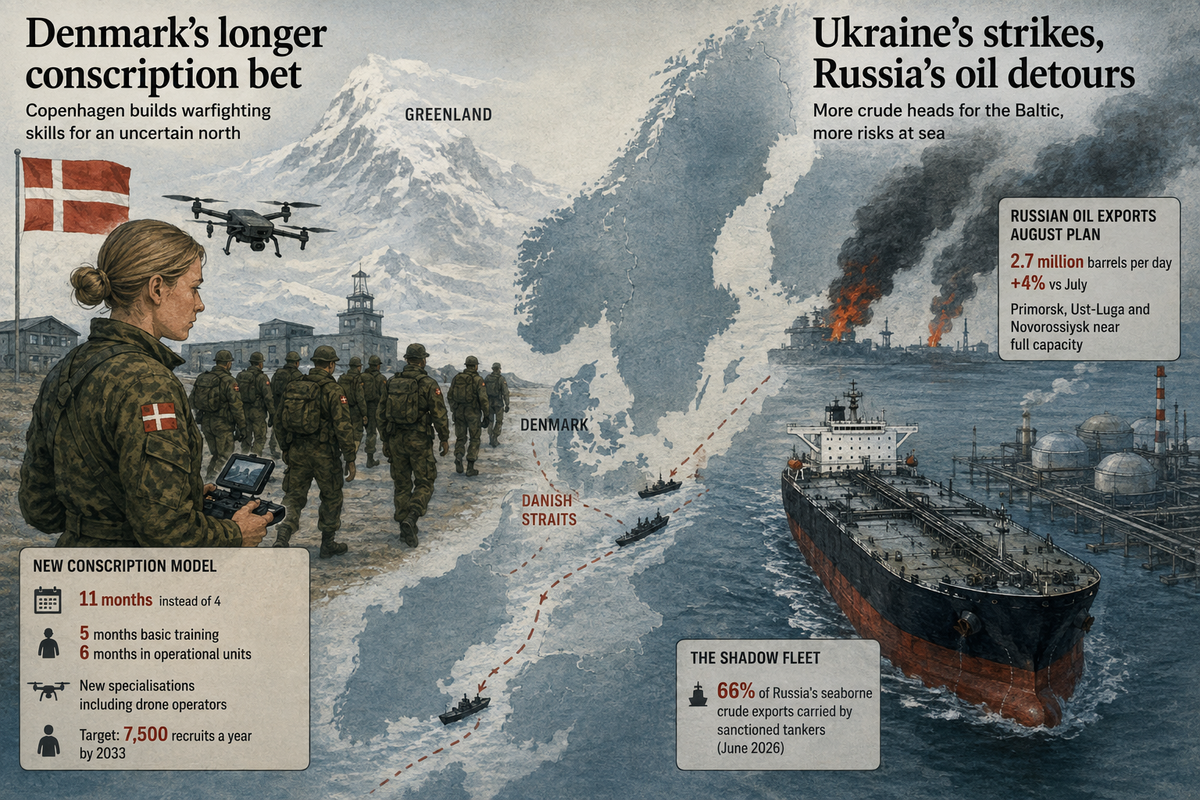
On 3 August, approximately 1,600 recruits began service under Denmark’s new 11-month conscription programme, replacing the previous four-month model.
This is the first full intake under the country’s gender-neutral conscription system. The programme consists of five months of basic military training followed by six months of service in operational units.
Among the newly introduced specialisations is drone operator training, reflecting the growing importance of unmanned systems in modern warfare.
Denmark also plans to increase annual intake from roughly 5,000 to 7,500 conscripts by 2033.
After completing active service, conscripts will remain part of Denmark’s reserve system. Under current legislation, they remain liable for mobilisation for five years, significantly expanding the country’s trained manpower base.
The reform therefore creates not only more recruits each year but also a substantially larger pool of personnel available in the event of war or a major security crisis.
Greenland as the First Operational Test
Later this month, a company of Danish conscripts will deploy to Greenland to participate in the Arctic Endurance exercise.
This marks one of the first occasions on which Denmark’s new conscription model will be tested in an Arctic operational environment.
Importantly, the Danish Armed Forces emphasise that the conscripts are not replacing professional troops. Instead, they will reinforce the overall exercise while providing an opportunity to evaluate how effectively the new system prepares personnel for demanding operational conditions beyond standard garrison service.
Rather than substituting professional forces, Denmark is beginning to use conscripts as an additional operational resource.
Why Drone Training Matters
The introduction of drone operator training illustrates how lessons from the war in Ukraine are reshaping European military education.
Unmanned systems are no longer viewed as a niche capability. Drone operation is increasingly becoming a standard military skill alongside communications, engineering and infantry training.
However, there is currently no publicly announced timetable for creating dedicated conscript-based drone units.
At the same time, Denmark is expanding its professional UAS capability. The Armed Forces are establishing Squadron 729, which will operate long-range unmanned surveillance systems over the Arctic, the North Atlantic and the Baltic Sea. Around one hundred military personnel and technical specialists are expected to form the unit.
These developments represent two complementary trends:
- broad dissemination of drone skills throughout the conscription system;
- parallel expansion of professional unmanned aviation capabilities for more advanced missions.
Why It Matters for the Baltic Region
Denmark controls the maritime and air approaches linking the North Sea and the Baltic Sea. The Danish Straits remain one of NATO’s most important reinforcement corridors for the Alliance’s eastern flank.
As the reform matures, Denmark’s expanded reserve will improve its ability to:
- secure the Danish Straits and reinforcement routes into the Baltic;
- strengthen territorial defence and maritime security operations;
- protect ports, airbases and critical infrastructure;
- increase the number of personnel trained to operate drones and counter-UAS systems;
- support Arctic and North Atlantic missions without relying exclusively on professional troops.
The reform also brings Denmark closer to the defence models used by Finland, Sweden, Norway and the Baltic states, where large, well-trained reserve forces are considered essential for deterrence and sustained defence.
Although the numerical impact will emerge gradually, the institutional shift has already taken place: conscription is becoming a genuine source of operational capability rather than a symbolic element of national defence.
Related Story
Ukrainian Strikes Push More Russian Oil Towards the Baltic Sea
At the same time, Reuters reports another development directly affecting the Baltic region.
Russia plans to increase crude oil exports through its western ports by approximately 4%, to 2.7 million barrels per day during August.
The increase reflects reduced refining capacity following Ukrainian strikes on Russian oil refineries. Crude that can no longer be processed domestically is instead being redirected to export markets.
The Baltic ports of Primorsk and Ust-Luga, together with Novorossiysk on the Black Sea, are expected to operate close to their maximum capacity.
Publicly available loading schedules do not yet indicate how the additional volumes will be divided between the individual ports. Actual exports could also be lower than planned if refinery disruptions, logistical bottlenecks or tanker shortages persist.
The Shadow Fleet Is Already the Main Carrier
The role of Russia’s so-called shadow fleet is no longer speculative.
According to the Centre for Research on Energy and Clean Air (CREA), 66% of Russia’s seaborne crude oil exports in June 2026 were transported by sanctioned vessels operating outside the mainstream shipping market.
Separate analyses of Baltic export routes estimated that roughly 63% of crude exported through the Baltic was already carried by shadow fleet tankers.
While no August breakdown is yet available, the existing structure strongly suggests that much of the additional export volume from Primorsk and Ust-Luga will also rely on these vessels.
For Baltic coastal states, this represents not only a sanctions-enforcement challenge but also an environmental one. Many of these ageing tankers operate under opaque ownership structures, questionable insurance arrangements and complex flag registrations, increasing the risks associated with any maritime accident.
Why This Is Material
Ukraine’s campaign against Russia’s refining sector is beginning to reshape not only Russia’s domestic fuel balance but also the geography of its energy exports.
Reduced refining capacity leaves more crude available for export rather than domestic processing.
For the Baltic Sea, this means:
- heavier utilisation of Primorsk and Ust-Luga;
- increased tanker traffic through the Gulf of Finland and the Danish Straits;
- continued heavy reliance on sanctioned shadow fleet vessels;
- greater demands for maritime surveillance, sanctions enforcement and insurance verification;
- higher environmental risks associated with ageing tanker traffic;
- increased strategic importance of Russian export terminals, together with stronger protection by air defence, electronic warfare and physical security assets.
The Bigger Picture
These two developments converge in the same strategic space.
Denmark is expanding its trained reserve, strengthening its Arctic presence and integrating drone skills into mainstream military training.
Russia, meanwhile, is becoming increasingly dependent on Baltic export routes as damage to its refining infrastructure forces more crude oil onto the international market.
The Danish Straits therefore assume a dual strategic role.
For NATO, they are a critical reinforcement corridor for the Alliance’s northern and eastern flanks.
For Russia, they are an indispensable gateway for a growing share of its seaborne oil exports.
That combination makes Denmark one of the pivotal security actors in the Baltic region today.
Baltic Security Monitor — Assessment
Materiality: Medium–High
Category: Nordic Defence · Mobilisation · Drone Capability · Baltic Oil Logistics