Drone Crossed Romania and Exploded in Bulgaria: Incident Exposes a Gap in NATO Counter-Drone Defence

Baltic Security Monitor | Material OSINT Update
8 August 2026, 20:00
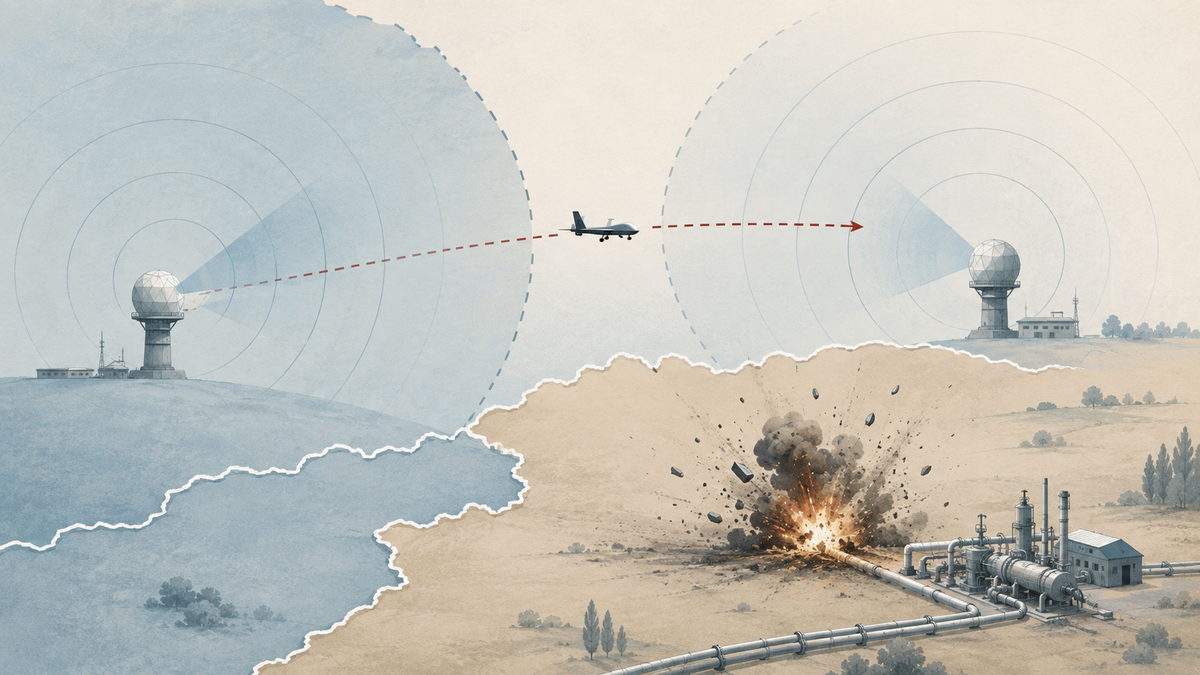
A single drone does not prove that NATO air defence is ineffective. But a flight path through the airspace of one Allied state, an explosion in a second, and the proximity of cross-border gas infrastructure point to a specific weakness: small, low-flying targets can still pass between national surveillance zones.
What happened
On 8 August, a drone entered Bulgarian airspace from Romania and exploded in a field near Kardam, close to the Romanian border. There were no casualties and no reported infrastructure damage.
Bulgarian authorities said the aircraft was most likely a Maya decoy drone, a type widely used by the Ukrainian armed forces. At the same time, Sofia said there was no indication that the drone’s entry into Bulgaria had been intentional.
The key detail is not only the drone’s apparent origin, but its route.
According to Bulgarian Prime Minister Rumen Radev, the aircraft was not detected in time either while crossing Romanian airspace or after entering Bulgaria. Reuters reported that the explosion occurred roughly one kilometre from a Bulgarian compressor station linked to the Trans-Balkan gas network and about 200 metres from a Romanian compressor facility.
Associated Press reported that the drone exploded only around 100 metres inside Bulgarian territory.
Why this incident is different
For NATO’s eastern flank, accidental or uncontrolled incursions by military drones from the war in Ukraine are no longer exceptional.
What makes the Kardam incident materially different is the operational sequence.
This was not simply a short border violation.
According to Bulgarian authorities, the drone appears to have travelled through Romanian airspace, crossed another national border, entered Bulgaria and then exploded — without either country’s surveillance architecture detecting it in time.
That changes the nature of the problem.
The issue is no longer just that “a drone entered NATO territory.” It is whether NATO states have continuous low-altitude detection coverage across national borders.
A drone that slips through one local blind spot is a national problem.
A drone that passes from one Allied airspace into another without timely detection is a systems problem.
MEROPS did not close the gap
The Romanian leg of the route is particularly significant.
On 24 June, Romania’s Ministry of National Defence announced that the U.S.-supplied MEROPS counter-UAS system had been fully integrated into the country’s defence posture.
MEROPS is designed to detect, track and neutralise small, low-flying unmanned aircraft.
The 8 August incident does not demonstrate that MEROPS itself failed. A single counter-UAS system does not create continuous coverage across an entire national territory, and the actual deployment locations of Romanian MEROPS systems are not publicly known.
But the incident illustrates a broader point.
Deploying one specialised counter-drone platform does not solve the low-altitude surveillance problem on its own.
A functioning counter-UAS architecture requires overlapping radars, passive sensors, electronic-support measures, short-range interceptors and, critically, fast cross-border data exchange.
Bulgaria is already changing its posture
Sofia’s response began almost immediately.
Bulgarian authorities announced tighter surveillance and protection of strategic facilities along the Romanian border.
AP reported that counter-drone assets operated by Bulgaria’s border police are expected to be redeployed from the Turkish frontier towards the Romanian border.
The incident is also expected to be raised at NATO level.
Radev separately linked the detection problem to delays in the delivery of modern high-precision radar systems.
The first operational consequence is therefore already visible: counter-UAS deployment inside a NATO country is being adjusted in response to a war-related drone incursion from another Allied direction.
Why the gas infrastructure matters
There is currently no evidence that the nearby compressor stations were deliberately targeted.
Bulgarian authorities instead believe that the drone’s presence over Bulgaria was unintended.
But when assessing physical risk, intent is only one part of the equation.
If an explosive-carrying drone can end up a few hundred metres from cross-border energy infrastructure after an uncontrolled flight, the potential consequences of navigational failure can begin to resemble those of a deliberate strike.
The same logic applies beyond gas pipelines.
Ports, electrical substations, airfields, fuel depots, rail junctions and other strategically important facilities all face a similar low-altitude risk.
The incident therefore highlights not just an air-defence problem, but also a critical-infrastructure protection problem.
The Baltic dimension
For the Baltic states, the significance of this incident is operational rather than geographic.
On 8 July, NATO agreed to broaden Baltic Air Policing into a more active air-defence role, giving Allied forces wider authority to respond to threatening aerial objects.
That shift came after repeated incursions involving drones linked to the war in Ukraine, including incidents over Estonia and Latvia.
The Bulgarian case shows that the same underlying vulnerability is not limited to the Baltic or Black Sea region.
It is increasingly a NATO-wide problem.
Cheap, small and low-flying unmanned aircraft can travel beneath, between or beyond the effective coverage of systems historically designed primarily for aircraft, cruise missiles and ballistic missiles.
The same challenge that exists over the Baltic Sea now appears along the lower Danube and the Black Sea flank.
What remains unknown
The drone’s identity has not yet been established conclusively.
Bulgarian authorities describe the Maya identification as the most likely assessment, rather than a final forensic determination.
AP also reported that the aircraft’s precise origin and its connection to either Ukraine or Russia had not yet been definitively established at the time of publication.
There is also no public reconstruction of the drone’s full route across Romania.
It remains unclear where it entered Romanian airspace, how long it remained over Romanian territory and whether its path crossed the effective coverage zone of deployed MEROPS or other counter-UAS systems.
That will be the next important verification threshold.
If Romania or NATO releases a detailed trajectory reconstruction, it may become possible to determine whether the incident was caused by a local radar shadow, an extremely low flight profile, limitations of specific sensors or a broader interoperability gap between national surveillance networks. 🟡
What happens next
Bulgaria is likely to accelerate the deployment of counter-UAS sensors and short-range interception systems along its northern border and around critical infrastructure. 🟡
Romania may also review radar coverage and the positioning of recently introduced MEROPS systems if the investigation confirms that the drone spent a meaningful period crossing Romanian territory undetected. 🟡
At NATO level, the incident strengthens the case for a more continuous low-altitude detection architecture stretching from the Baltic to the Black Sea, rather than a patchwork of nationally isolated counter-drone zones concentrated only around individual high-value targets. 🟡
Assessment
The explosion near Kardam does not currently appear to have been an attack on Bulgaria.
That is precisely why the incident is so instructive.
A drone does not need to be deliberately aimed at NATO territory to create a serious security risk.
It only needs to lose its intended route, exploit a low-altitude surveillance gap and reach the vicinity of critical infrastructure.
On 8 August, that appears to have happened after the aircraft crossed the airspace of two NATO members.
For the Alliance, the central question is therefore no longer only how to shoot down drones.
It is whether neighbouring states can build a sufficiently continuous system to detect them before the aircraft themselves determine where the incident ends.
Baltic Security Monitor (osint-baltic.com) — analysis of security developments on NATO’s north-eastern flank.