Decree, Not Announcement: Zelenskyy Splits Foreign Intelligence and National Security Coordination Between Umerov and Klymenko

Baltic Security Monitor | Geopolitical CommentaryBased on official presidential decrees and Reuters reporting | 3 August 2026, 20:00
Rustem Umerov’s appointment is no longer a political announcement. Following a new package of presidential decrees signed on Monday evening, Ukraine has formally completed its latest restructuring of the national security leadership. The changes reveal more than a personnel reshuffle—they establish a clearer separation between foreign intelligence and domestic strategic coordination.
What Changed
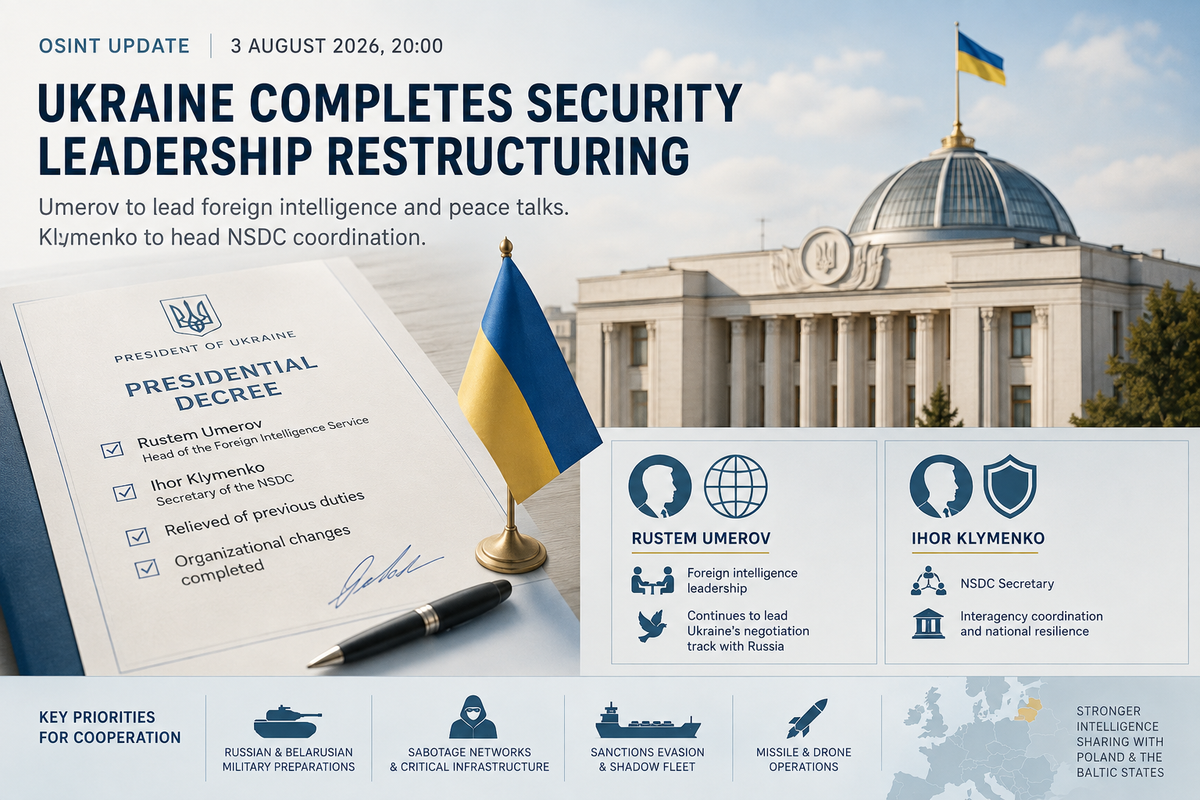
Following the afternoon update, President Volodymyr Zelenskyy signed a package of decrees completing the reorganization of Ukraine’s national security leadership.
The decrees provide that:
- Rustem Umerov has been appointed Head of the Foreign Intelligence Service of Ukraine;
- Ihor Klymenko has been appointed Secretary of the National Security and Defense Council (NSDC);
- Umerov has been relieved of his duties as NSDC Secretary;
- Oleh Luhovskyi has been relieved of his responsibilities as Acting Head of the Foreign Intelligence Service.
Reuters also reports that Umerov will continue leading Ukraine’s negotiation track with Russia while assuming his new intelligence role.
The appointments have therefore moved from political intent to legally enacted institutional decisions.
More Than a Personnel Change
The final package of decrees demonstrates that Kyiv is establishing two distinct centres of responsibility.
Rustem Umerov will oversee Ukraine’s foreign intelligence service while remaining closely involved in negotiations with Russia—a role that directly links diplomatic decision-making with intelligence assessments of Russian intentions, military production and compliance with any future agreements.
Ihor Klymenko, as NSDC Secretary, will be responsible for coordinating policy across Ukraine’s security institutions, government agencies and national resilience structures.
Rather than concentrating these responsibilities in a single office, the new structure separates intelligence leadership from interagency coordination.
Why It Matters for Ukraine and the Baltic Region
Combining leadership of the foreign intelligence service with responsibility for Ukraine’s negotiation track could shorten the distance between intelligence collection and political decision-making.
If implemented effectively, the arrangement may allow Kyiv’s negotiating position to draw more directly on classified assessments regarding:
- Russian political and military intentions;
- defence-industrial production;
- the credibility of potential ceasefire commitments;
- military developments involving Belarus.
For Poland and the Baltic states, the practical significance lies primarily in intelligence cooperation concerning:
- Russian and Belarusian military preparations;
- sabotage networks and threats to critical infrastructure;
- sanctions evasion routes and Russia’s shadow fleet;
- missile and drone operational planning.
🟡 Concentrating both intelligence leadership and negotiation responsibilities in one individual could accelerate decision-making, but it also increases the importance of strong internal coordination, oversight and institutional checks.
Likely Implications
The completed restructuring could produce several practical effects over the coming months.
- Umerov is likely to retain significant influence over the design of any future ceasefire arrangements and their verification mechanisms.
- Ukraine’s Foreign Intelligence Service may gain more direct access to political leadership and negotiations with the United States and European partners.
- Klymenko may strengthen operational coordination between the security services, civil protection authorities and agencies responsible for energy and transport resilience.
- 🟡 Poland and the Baltic states could benefit from a more unified Ukrainian counterpart for intelligence cooperation on Russia, Belarus and broader hybrid threats.
BSM Assessment
MATERIAL UPDATE
The legal completion of the appointments makes this development considerably more significant than the political announcement issued earlier in the day. Ukraine has now formalized a new governance architecture for its security sector.
The key change is not simply who occupies individual positions, but how responsibilities are divided. Foreign intelligence, peace negotiations and national security coordination are now assigned to separate institutional centres while remaining closely connected at the strategic level.
For Ukraine’s NATO partners—particularly Poland and the Baltic states—the new structure may provide a clearer framework for intelligence cooperation and strategic coordination on the Alliance’s eastern flank.
Recommended Reading
- Presidential Decree No. 695/2026 appointing Rustem Umerov as Head of the Foreign Intelligence Service of Ukraine.
- The accompanying presidential decrees appointing Ihor Klymenko and completing the transition of responsibilities.
- Reuters reporting on Umerov’s continuing role in negotiations with Russia and the broader context of Ukraine’s security-sector restructuring.
Category: Security Governance · Foreign Intelligence · Allied Coordination
Materiality: Medium–High