Calm Numbers, Loud Warnings: OSINT Digest, 21 July

Baltic Security Monitor | Analytical Brief Snapshot: 2026-07-21T12:13:09.215Z
Today's OSINT Indices
| Indicator | Value | 24h Movement |
|---|---|---|
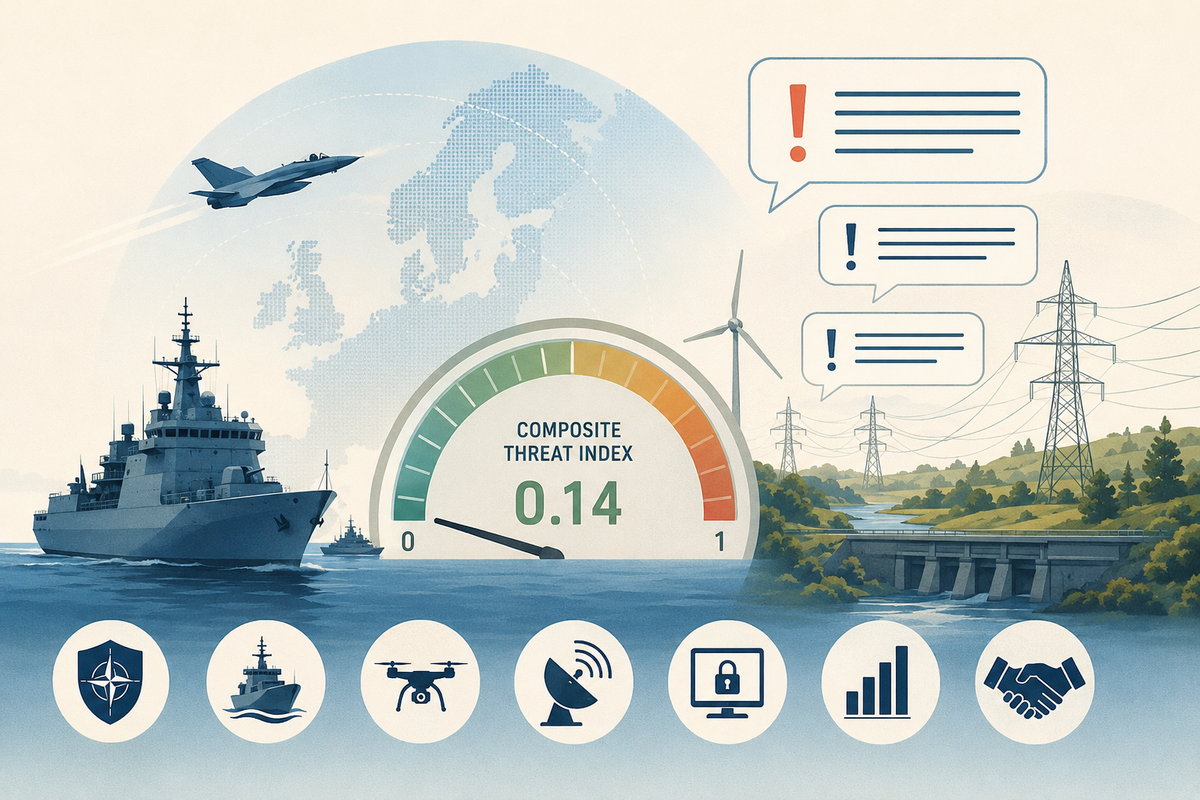
| Composite threat index | 0.14 | flat: 0.00 over 24h, 0.00 over 6h — a complete standstill |
| Force Posture | 0.12 | second-lowest of the four sub-indices |
| Logistics | 0.06 | the day's floor |
| Info/Cyber | 0.10 | moderately low |
| Border/Air/Maritime | 0.25 | today's high sub-index — nearly double the composite |
Events logged in 24h: 10 · High-confidence: 0 Quarantined: 0 · Source failures: 0
The 21 July digest reads as a statistical flatline: the composite hasn't moved in either the six- or twenty-four-hour window, none of the ten logged events cleared the high-confidence bar, and there is neither quarantine nor a source failure to explain away. But flat is not the same as quiet. While the automated system is picking up nothing but NATO institutional activity — a command rotation, an experimentation campaign, a simulation exercise — political leaders in Lithuania, Latvia, Estonia and Poland are publicly warning that Russia may be preparing strikes on energy and transport infrastructure. The gap between what the index measures and what presidents and defence ministers are already saying out loud is the story of the day.
Top 5 Digest Events
🔵 1. Spain takes command of NATO's North Atlantic naval task force
OSINT score: 0.39 — WATCH (new entry)
Spain assumed command of Commander Task Force Atlantic (CTF-AT) within JFC Norfolk's area of responsibility on 14 July 2026; five Spanish ships, a Spanish Marine Corps landing force and eight allied ships will hold the role through June 2027.<cite index="1">From July 2026 to June 2027, NATO's Commander Task Force Atlantic will be led by five Spanish ships, the Spanish Marine Corps landing force and eight ships from allied nations</cite> The area of responsibility spans the waters from North America's east coast to Greenland, Iceland, the UK and Norway — a stretch that carries critical undersea cables and energy infrastructure linking the two continents.<cite index="1">JFC Norfolk oversees NATO's North Atlantic area of responsibility, spanning waters from the east coast of North America to Greenland, Iceland, the United Kingdom, and Norway, including critical sea lines of communication, undersea cables and energy infrastructure</cite> The rotation overlaps with Exercise Neptune Strike 26-3 (17–23 July), which brings together allied maritime, air, land and multinational forces for multi-domain command integration.<cite index="1">Exercise Neptune Strike 26-03 runs from July 17–23, 2026, bringing together Allied maritime, air, land and multinational forces to strengthen NATO's ability to integrate and command multinational forces for multi-domain operations</cite>
BSM analysis: This is a routine command handover, the kind that cycles through the digest regularly on its own — the rotation itself is not an escalation signal. What pushes the score to the week's high (0.39) is that it lands mid-exercise: the index is picking up activity density in the North Atlantic, not a threat.
🔵 2. Task Force X-Central Mediterranean: Italy and ACT trial multi-domain integration on NATO's southern flank
OSINT score: 0.27 — WATCH (new entry)
From 22 June to 10 July, Italy hosted and led Task Force X-Central Mediterranean, which NATO called one of its most ambitious operational experimentation campaigns to date.<cite index="2">From June 22 to July 10, 2026, Italy hosted and led Task Force X – Central Mediterranean, which NATO described as one of its most ambitious operational experimentation campaigns to date</cite> It was the first Task Force X led by an individual ally rather than directly by NATO ACT, the first to be fully multi-domain, and the first on the southern flank.<cite index="2">This was the first Task Force X to be led by an individual Allied nation rather than directly by NATO ACT, the first to be fully multi-domain and the first on NATO's Southern Flank</cite> More than 100 uncrewed air, surface, subsurface and ground systems took part, contributed by five nations: Croatia, Italy, Latvia, Slovenia and the United States.<cite index="2">More than 100 uncrewed air, surface, subsurface and ground systems participated, contributed by five Nations: Croatia, Italy, Latvia, Slovenia, and the United States</cite>
BSM analysis: Latvia's presence among the five contributors is the detail worth noting — a working bridge between the southern and eastern flanks. Sensor-fusion techniques proven in the Mediterranean have an obvious path north to the Baltic theatre.
🔵 3. Synthetic environment Gladiator sharpens eVA Eastern Sentry
OSINT score: 0.23 — WATCH (new entry)
Allied fighter detachments, ground-based air defence units and command elements validated defensive concepts for eVA Eastern Sentry during Exercise Athena Warrior in June 2026.<cite index="3">Allied fighter detachments, surface-based air defence units, and command components successfully validated defensive concepts for eVA Eastern Sentry during exercise Athena Warrior in June 2026</cite> High-fidelity simulation inside the secure Gladiator environment let units from NATO nations remotely connect their own simulators and rehearse the defence of the eastern flank against realistic, high-end threats.<cite index="3">In the secure synthetic environment, Gladiator, units from NATO nations were able to remotely connect their simulators to GLADIATOR and gain realistic experience in the defence of NATO's Eastern flank against high-fidelity threats</cite>
BSM analysis: Eastern Sentry hasn't dropped out of the top five — it's shifted into a refinement phase via simulation. That reads as programme maturity, not stand-down.
🔵 4. NATO's support to Ukraine
OSINT score: 0.22 — WATCH
At the Ankara summit on 8 July, NATO pledged at least €140 billion in military support to Ukraine for 2026–2027, including €70 billion for 2026 alone.<cite index="5">NATO leaders agreed that the Alliance will provide Ukraine with at least €140 billion in military support over 2026-2027, including €70 billion pledged for 2026</cite> Zelensky secured new bilateral agreements with Estonia, the Netherlands and Denmark, while Germany and Ukraine signed a deal on joint production of long-range strike drones.<cite index="5">Zelenskyy secured new agreements with Estonia, the Netherlands and Denmark in Ankara, and Germany and Ukraine signed an agreement on the joint production of deep strike unmanned aerial vehicles</cite>
(Full financial detail — Ankara summit coverage, 8 July.)
🔵 5. RFI ACT JATEC 01-26
OSINT score: 0.21 — WATCH (new entry)
A request for information from ACT's JATEC (joint intelligence, surveillance and target acquisition centre) track — a procedural item reflecting forward planning for the next capability-development cycle.
BSM analysis: The lowest-scoring, least concrete item of the five — a textbook case of a bureaucratic document tripping the index's keyword matching without carrying any operational signal.
The signal missing from the digest
The most important development of 21 July never made it into the digest at all. The presidents of Lithuania and Latvia have publicly warned that Russia is preparing strikes on critical infrastructure in the Baltic states or Poland.<cite index="4">Lithuanian and Latvian leaders warned that Russia is planning attacks on critical infrastructure in the Baltic states or Poland, citing intelligence reports</cite> Lithuanian President Gitanas Nauseda pointed specifically to "energy and transport infrastructure, facilities where damage could disrupt the functioning of the entire energy system."<cite index="4">Lithuanian President Gitanas Nauseda highlighted concerns about "energy and transport infrastructure, facilities where damage could disrupt the functioning of the entire energy system"</cite> Lithuanian Defence Minister Robertas Kaunas said the Kremlin may be weighing the Baltic states and Poland as its next target for escalation.<cite index="4">Lithuanian Defense Minister Robertas Kaunas stated that the Kremlin may consider the Baltic countries and Poland as the next target for escalation</cite>
The region is already acting on it: Latvia has stepped up protection of the Riga hydroelectric plant and the Inčukalns underground gas storage facility, Lithuania has ordered stronger protection of transport and energy infrastructure, Poland has stood up a coordination headquarters and increased funding for energy-facility protection, and Estonia ran a technical "black-start" test — checking whether the power system can be restarted from zero without external power.<cite index="4">In Latvia, the protection of the Riga hydroelectric power station and the Inčukalns underground gas storage facility has been strengthened; in Lithuania, protection of transport and energy infrastructure has been ordered strengthened; in Poland, a coordination headquarters was created with increased funding for energy facility protection; in Estonia, a "black-start test" was conducted, testing the ability to restart the power system from scratch without external power</cite> The Kremlin dismissed the warnings as "another fresh batch of scare stories."<cite index="4">Kremlin spokesman Dmitry Peskov disputed the claims, stating "This is just another fresh batch of scare stories designed to keep the brainwashing going and prepare the population for further militarisation"</cite>
That is the likely explanation for why Border/Air/Maritime is the one sub-index running visibly hotter than the composite: the structural load on the border and infrastructure line is already present in the system's background noise, even though none of this political messaging has yet converted into a high-confidence event.
Regional Context
The warnings land against a backdrop of record defence spending. NATO's pre-Ankara estimates put Lithuania's core defence spending this year at 5.33% of GDP — the alliance's highest — followed by Estonia at 5.1%, Latvia at 4.92% and Poland at 4.68%.<cite index="6">Core defence expenditure is estimated at 5.33% of GDP for Lithuania in 2026, followed by Estonia (5.1%), Latvia (4.92%), and Poland (4.68%)</cite> Together with Greece, these five allies are on track to clear NATO's new 3.5%-of-GDP benchmark nearly a decade ahead of the 2035 deadline.<cite index="6">Five NATO members — Lithuania, Estonia, Latvia, Poland, and Greece — are projected to exceed NATO's new 3.5% core-defense spending target this year, nearly a decade ahead of the 2035 deadline</cite> Put plainly: the region sounding the loudest alarm is also the one spending the most to back it up.
Conclusion
21 July is, on paper, a day of formal calm — zero composite movement, zero high-confidence events, zero quarantine. That is exactly when it pays to look past the numbers. While the automated system logs command rotations, exercises and bureaucratic RFIs, the Baltic region's political leadership is openly discussing Russian preparations for infrastructure strikes. The index and the rhetoric are moving at different speeds right now — the open question is which of the two gets confirmed by an actual event first.
Baltic Security Monitor (osint-baltic.com) — an analytical outlet covering security on NATO's north-eastern flank. All OSINT coefficients are calculated by an automated indexing system based on open sources.