Two NATO countries, not a single shot
Overnight on 11 November a single drone flew through Lithuania and the whole length of Latvia, south to north, and vanished from radar heading for Estonia. NATO fighters followed it, but no shot was fired. That same morning the Leningrad regional governor reported a fire at the port of Ust-Luga…

Baltic Security Monitor | Material Update
Security Watch, 11 November 2026, 14:00 EET · 2 MATERIAL UPDATES · HIGH, MODERATE
Overnight on 11 November a single drone flew through Lithuania and the whole length of Latvia, south to north, and vanished from radar heading for Estonia. NATO fighters followed it, but no shot was fired. That same morning the Leningrad regional governor reported a fire at the port of Ust-Luga, only a few dozen kilometres from the Estonian border. The morning's alerts now have an official timeline, and it reveals not an accident but a gap.
Latvia confirms three incursions; one drone crossed the entire country
Classification: MATERIAL UPDATE · HIGH · NATO airspace / Drones / Baltic security
Latvia's National Armed Forces published a timeline of the night. At about 23:30 on 10 November, two drones entered airspace over Ludza county near the eastern border for one to two minutes. Another approached the border from Belarus in Krāslava and Augšdaugava counties but did not cross. At about 01:00 three drones approached the border near Balvi, then turned north into Russia.
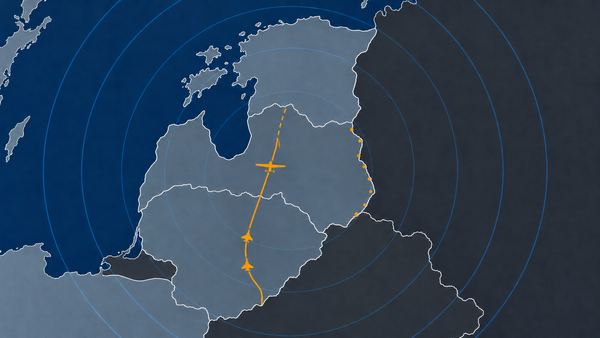
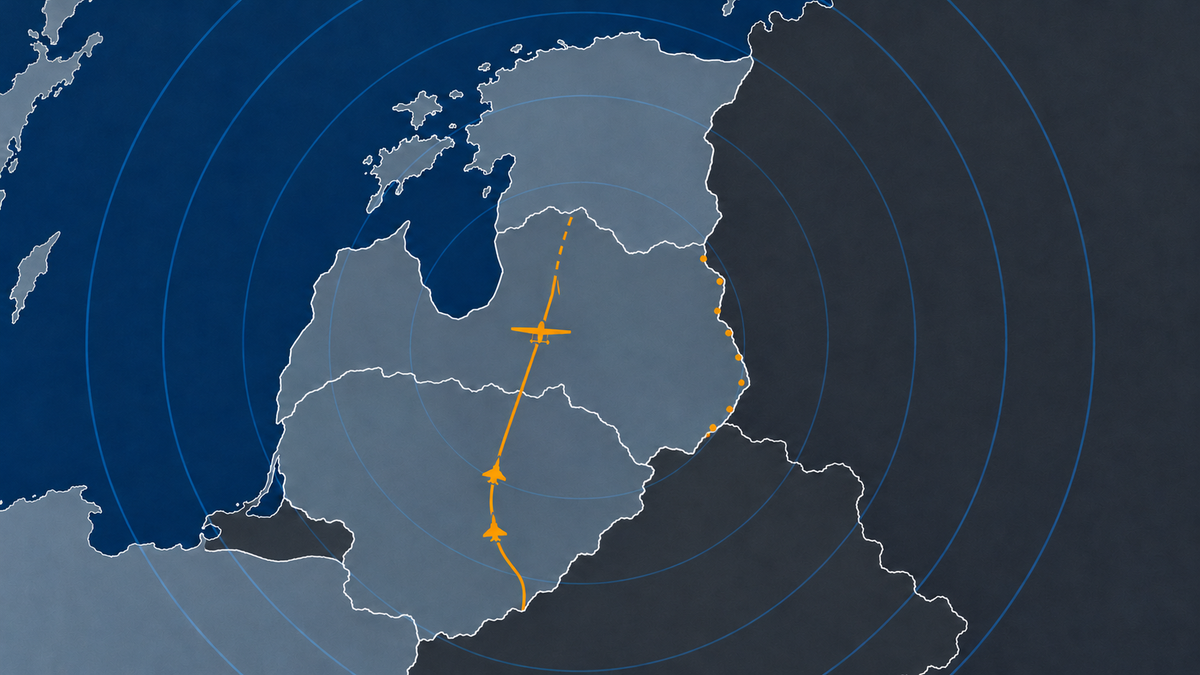
The main episode began at about 02:30. A drone entered Latvia from Lithuania over Aizkraukle, Jēkabpils and Madona counties, moving south to north. By about 03:00 alerts had spread to Madona, Cēsis, Smiltene and Gulbene. The drone then left Latvian airspace heading for Estonia, where sensors lost contact with it.
Latvia activated interceptor drones, ground-based air defence and Baltic Air Policing fighters, which first scrambled from Lithuania and tracked the target over Latvia. The drone was not shot down. The armed forces said the operational conditions for interception did not exist, and civilian safety also weighed on the decision. The statement notes that Latvia's interceptor-drone units are currently deployed only along the eastern border. Latvia will review the night's events with NATO allies.
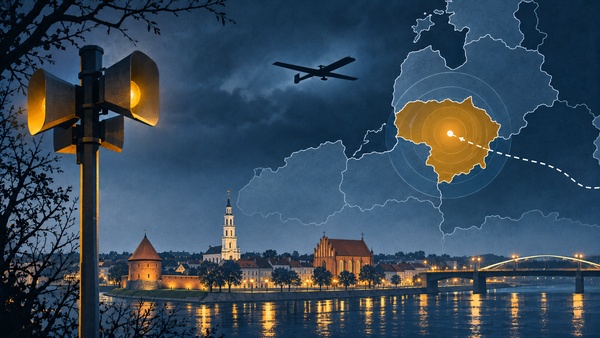
Earlier in the morning, Lithuania said a drone had entered its airspace from Belarus and that fighters made two attempts to shoot it down but held fire near Kaunas because of the risk to people on the ground (see BSM's morning review of 11 November). It has not yet been officially confirmed that the Lithuanian and Latvian drones were the same aircraft, but the timing and direction point that way. Reuters reports at least four drones entered Baltic airspace that night. No one was hurt. The drones' type, operator and reason for straying have not been established. 🟡
BSM analysis
The morning alert looked like one more episode in a series running since March. The official timeline shows something else. What was probably a single aircraft spent more than two hours over two NATO countries, covered hundreds of kilometres under fighter escort and disappeared without being brought down. The problem was not detection. It was tracked from Kaunas to the Estonian border; there was simply no safe means or place to intercept it.
The key line in the Latvian statement is that interceptor drones are deployed only on the eastern border. A target arriving from the south, through Lithuania, bypasses that line entirely. Fast jets are poorly suited to slow, low targets over populated areas. So the issue is architecture, not any single country: each state builds its own line along its own border with Russia or Belarus, while the drone moves between allies. The promised review with NATO should be judged by one test: whether it produces a shared, rather than national, interception layer across the full depth of the Baltic states.
The available evidence does not show a deliberate attack on NATO. The alerts coincided with an attack on the Leningrad region, but coincidence in time is not attribution.
Ust-Luga: fire in the port area, three injured
Classification: MATERIAL UPDATE · MODERATE · Maritime logistics / Critical infrastructure
On 11 November Reuters, citing Leningrad region governor Alexander Drozdenko, reported that a drone attack caused a fire in the Ust-Luga port area. Three workers were injured and the power supply was disrupted. The governor claimed up to 150 drones were intercepted over the region; Reuters could not independently verify this. The morning figure of 92 interceptions should not be added to the later one: they are most likely successive estimates of the same wave.
Ust-Luga is Russia's largest Baltic port and a main export hub for crude, refined products, grain and fertiliser. It has been attacked repeatedly in 2026, including in late March, when fire engulfed an oil terminal. Which terminals were affected this time, and whether ship loading stopped, remains unknown. 🟡
BSM analysis
For the Baltic region, Ust-Luga and the overnight alerts are two sides of the same campaign. The port lies only a few dozen kilometres from the Estonian border, and every wave of strikes on it now echoes in alerts across Estonia, Latvia, Lithuania and Finland. There is no basis yet to raise the materiality to HIGH: that would require confirmed evidence of a prolonged terminal shutdown or a drop in exports. Governors' interception counts are routinely used as information policy, so on their own they say little about the real scale of the strikes.
OSINT check
- The Latvian statement was verified against the primary source (mil.lv). It adds important detail to the Security Watch account: the south-to-north track, loss of contact near Estonia, interceptor deployment only on the eastern border, and the planned review with NATO.
- Inconsistent wording on Ust-Luga. The cycle summary refers to "power disruption at the facility", while the separate material file says a power station was knocked out. Until the governor's original statement is checked, "power supply disrupted" is the safer wording.
- Estonia. There is no official confirmation yet that the drone entered Estonian airspace: Latvian sensors lost contact as it left the country.
- Open WATCH items. The FSB claims to have detained two alleged Polish agents in the Kaliningrad region; Warsaw calls it a provocation, and there is no independent evidence. A week earlier Poland's ABW detained six people suspected of supplying military components to Kaliningrad, so the FSB claim is best read in the context of that tit-for-tat between intelligence services. US–Ukraine–Russia talks in Abu Dhabi are in their second day with no signed outcome.
Conclusion
The morning alert has become a confirmed HIGH incident. No one was hurt, but the conclusion is uncomfortable: a drone that crossed two NATO countries under radar and fighter watch remained an unmanaged risk from the first minute to the last. The review with allies should answer not whose drone it was, but why it could not be stopped.
Seeing the target is half of air defence. The other half is still parked on the eastern border.
Baltic Security Monitor (osint-baltic.com) — an analytical publication on security across NATO's northeastern flank.
Event classification and materiality levels are assigned by an automated open-source monitoring system.