An Italian Eurofighter Downs a Drone Over Latvia: NATO Shifts Again From Watching to Shooting on the Baltic Flank

Baltic Security Monitor | Analytical Brief Snapshot: 14 August 2026, 14:00 · Task run: 14:03–14:04 (Europe/Tallinn)
What happened
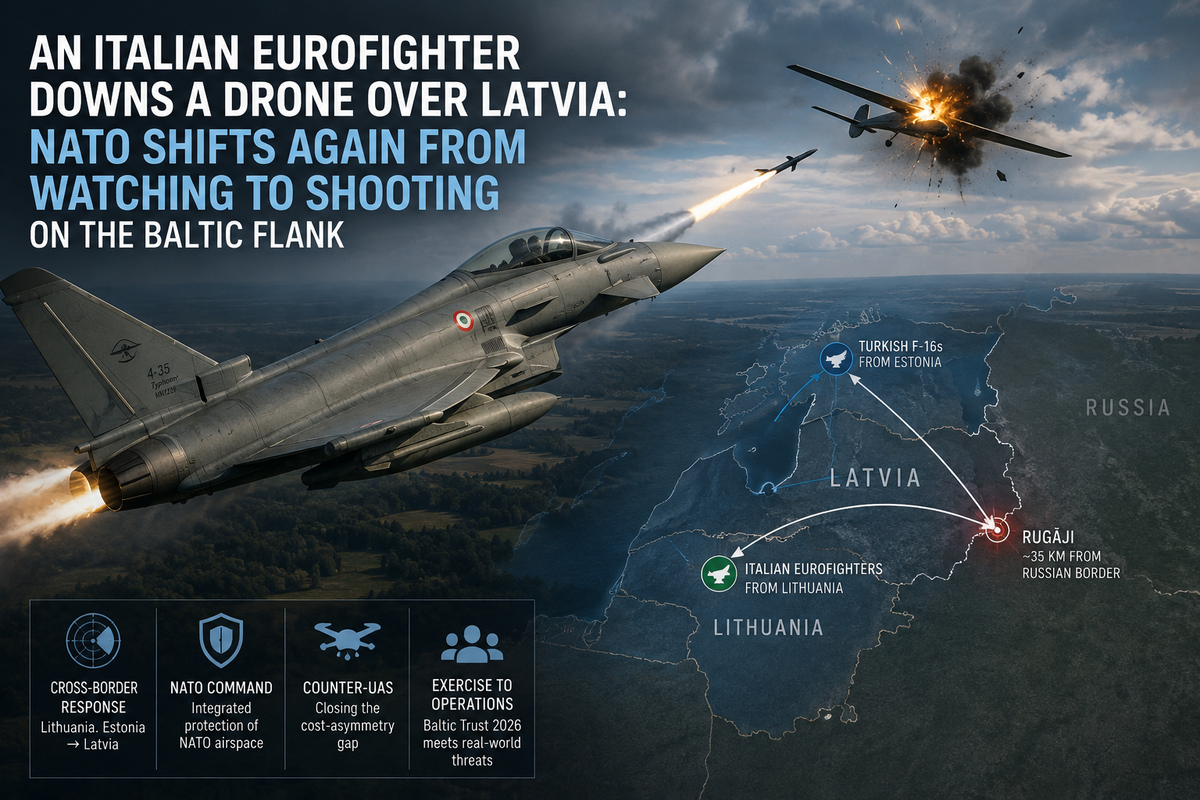
An Italian Eurofighter operating under NATO command shot down an unidentified drone that entered Latvian airspace on 14 August, NATO and Latvian authorities told Reuters. Two Italian Eurofighters scrambled from Lithuania and two Turkish F-16s from Estonia responded to the detection; one of the Italian aircraft identified and destroyed the drone. Latvian forces are searching for wreckage near Rugāji, roughly 35 km from the Russian border. (Reuters, 14 Aug 2026)
The drone's origin has not yet been established. 🟡 Latvian military spokesperson Iveta Bērziņa said investigators could not attribute it before recovering and examining the debris. The incident followed overnight Ukrainian drone attacks on Russian ports near St Petersburg, but temporal proximity alone doesn't establish that the intercepted aircraft was Ukrainian. NATO spokesperson Allison Hart confirmed all responding fighters were operating under NATO command and that the Alliance is investigating together with Latvia. (Reuters, 14 Aug 2026)
Finland simultaneously imposed temporary aviation and maritime restrictions in the eastern Gulf of Finland as a precaution against possible stray drones — widening the operational picture to Latvia, Estonia, Lithuania and Finland at once, during the same window of Ukrainian long-range strikes near Russia's Baltic coast. (Reuters, 14 Aug 2026)
The 14 August interception isn't the first of its kind, but it's the first to show a genuinely cross-border response architecture at work: fighters based in Lithuania and Estonia answered a threat over Latvia instead of the incident being handled by national assets alone. Attribution remains open — and shouldn't be assumed from earlier incidents.
What changed
Drone incursions into Baltic NATO airspace are already an established problem. On 8 June 2026, a French Rafale based at Šiauliai, Lithuania, shot down a drone over Latvia for the first time — the aircraft had entered from Russia's direction near Bērzgale, about 30 km from the border, which the Latvian army linked to Russian electronic warfare. (LSM, 8 Jun 2026)
What's new on 14 August is the scale of the response: forces from two separate Baltic Air Policing locations were activated simultaneously — Italian Eurofighters from Lithuania and Turkish F-16s from Estonia — with the Italian aircraft carrying out the engagement.
The incident also fell on the final day of NATO's Baltic Trust 2026 exercise in Latvia — roughly 650 participants from 24 countries, including Ukrainian, Australian and Japanese personnel, working at the Sēlija range to integrate detection, command-and-control and suppression of unmanned systems under the LCI-X Crucible 3-26 experimentation campaign. (NATO JFC Brunssum, NATO.int) The interception itself was a real-world air-defence action, not part of the exercise, but the overlap shows how closely NATO's counter-UAS experimentation now tracks operational requirements on the eastern flank.
Attribution remains unresolved and shouldn't be inferred from earlier incidents. 🟡
BSM analysis: in the two and a half months between 8 June and 14 August, Latvia moved from a single, unprecedented interception to an incident that pulled in aircraft from two separate basing countries at once. That doesn't necessarily mean incursions are becoming more frequent — it means NATO's Baltic response architecture is now routinely firing as a network rather than a set of national responses.
The cost-asymmetry problem
NATO Secretary General Mark Rutte has repeatedly acknowledged that routinely using expensive fighters and interceptor missiles against comparatively cheap drones is unsustainable. A typical two-fighter interception mission costs upward of €85,000 before any missile is fired, while many strike drones can be built for under €100,000 — and some interceptions of $10,000 drones have used Patriot missiles or F-35s. Rutte has called for accelerating cheaper interception technologies closer in cost to the drones themselves. (Rutte, NATO, 17 Jun 2026)
That is precisely the sensor-to-command-to-interceptor gap Baltic Trust is designed to close — the exercise specifically tests fusing radars, sensors, cameras and electronic-warfare assets into a single system against reconnaissance and strike drones.
Regional context
Latvia had already announced plans for automated counter-drone coverage of its eastern border, with radar and command systems due to be fielded by the end of September 2026. (LSM, 21 Jul 2026) Baltic defence ministers jointly called on 27 March for reinforced NATO air defence and faster deployment of counter-UAS capabilities. (Latvian Ministry of Defence, 27 Mar 2026)
Finland's parallel restrictions in the Gulf of Finland show the problem is no longer purely a Latvian one — the region is responding as a single operational space spanning the Baltic states and Finland, in the same window as Ukrainian long-range strikes near Russia's Baltic coast.
Likely implications
Latvia will likely accelerate its already-announced plans for automated counter-drone coverage of its eastern frontier — new radars, command systems and dedicated counter-UAS effectors. 🟡
Wreckage recovery and forensic examination will be decisive: if the drone is identified as Ukrainian, it would reinforce concerns about Russian electronic warfare diverting Ukrainian systems into NATO territory; if Russian origin or deliberate routing is established, the escalation implications would be substantially greater. 🟡
Repeated real-world interceptions may strengthen Baltic pressure inside NATO for permanent, layered counter-UAS capability rather than continued reliance on fighter aircraft as the primary kinetic response. 🟡 (Latvian Ministry of Defence)
Bottom line
14 August marks a shift from an isolated precedent to a functioning response network: fighters from two basing countries scrambled for a threat over a third. Attribution stays open, and the cost-asymmetry problem remains structurally unresolved — precisely what Baltic Trust is trying to close even as real air-defence engagements happen alongside it. For the Baltic region, it's further evidence that the line between exercise and operation keeps getting thinner.
Baltic Security Monitor (osint-baltic.com) — an analytical outlet covering security on NATO's northeastern flank. All OSINT coefficients are calculated by an automated indexing system based on open sources.