After the Leipzig Explosive Drone, Germany Is Building a Permanent Counter-UAS System

Baltic Security Monitor | Material OSINT Update9 August 2026, 20:00
The discovery of an explosive-equipped drone near Ukrainian transport aircraft in Leipzig is already producing consequences beyond the investigation itself. Germany is establishing a dedicated technology centre for counter-drone security, while federal authorities are reportedly preparing to expand specialised counter-UAS forces. What looked only days ago like an isolated airport security incident is increasingly becoming a catalyst for permanent national security infrastructure.
From investigation to infrastructure
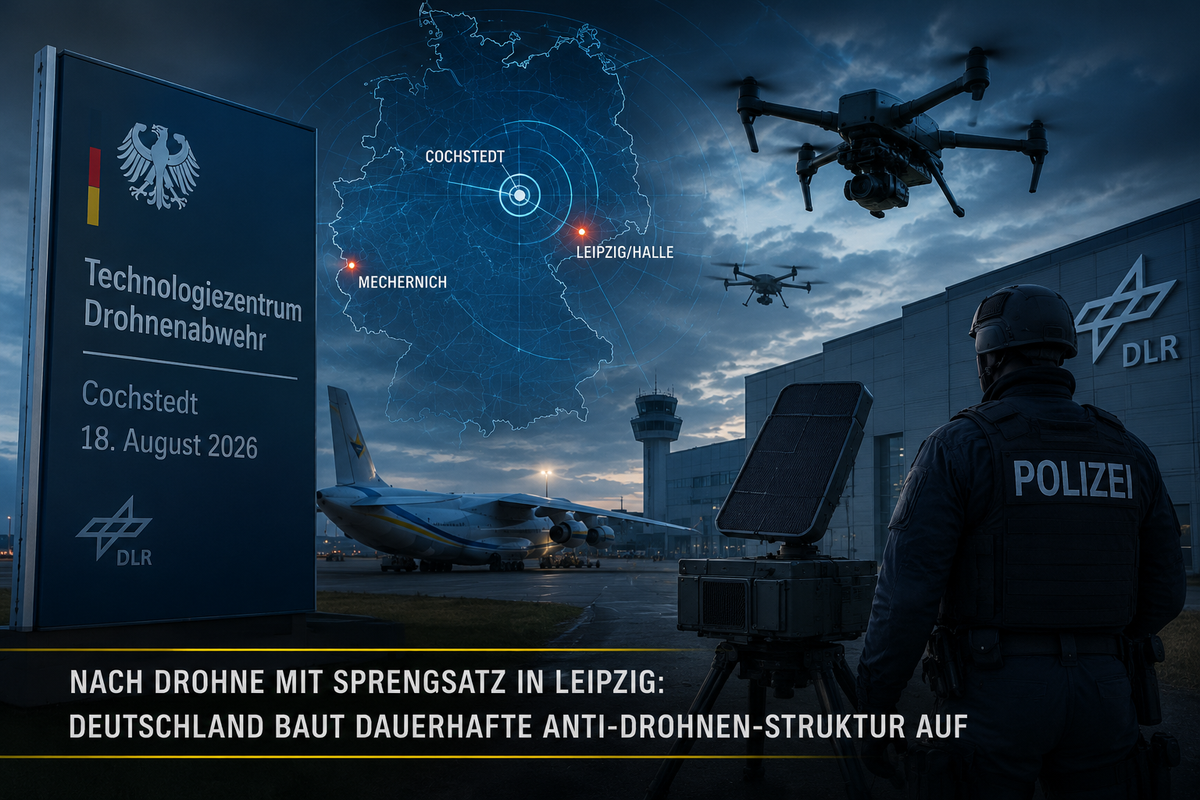
On 18 August, Germany plans to open a new Technology Centre for Drone Security at the German Aerospace Center’s Cochstedt test airfield in Saxony-Anhalt.
Interior Minister Alexander Dobrindt said the centre will bring together research, technology development and testing with the operational requirements of German security agencies. Its purpose is to provide an environment where counter-UAS technologies can be evaluated under conditions closer to real-world deployment.
The shift is significant.
Germany is not simply reinforcing security at one airport after a serious incident. It is creating a permanent institution designed to keep pace with the rapidly evolving capabilities of unmanned systems.
Separately, Reuters reported, citing German government sources, that the Interior Ministry plans to double the federal anti-drone specialist force from approximately 150 to 300 personnel and increase its network of operational bases from four to eight.
The ministry had not independently confirmed those figures to Reuters at the time of publication. 🟡
If implemented, the expansion would provide Germany with a considerably more distributed capability to respond to drone incidents around airports, military facilities and critical infrastructure. 🟡
Leipzig was a catalyst, but the problem is broader
The immediate backdrop is the 5 August incident at Leipzig/Halle Airport.
An unmanned aircraft carrying explosives and a detonator was discovered inside a restricted area near Ukrainian transport aircraft. German authorities subsequently escalated the investigation because of the potential implications for national security.
A separate cargo aircraft also encountered an unidentified small airborne object after an aborted landing or during its subsequent climb. Investigators are examining whether a second drone could have been involved.
The incident has also generated speculation about possible Russian involvement. However, there is still no official German attribution establishing that Russia was responsible.
German politicians have publicly raised such suspicions, while the Russian embassy has rejected them and described the incident as a provocation.
For Baltic Security Monitor, the distinction remains important: a Russian connection is currently a hypothesis under discussion, not an established fact.
Two days after the Leipzig incident, two drones were also reported above a Bundeswehr facility in Mechernich. Military police responded and civilian authorities opened an investigation.
Dobrindt is now placing such incidents within a broader security category that includes espionage, sabotage, cyberattacks and covert foreign operations.
His framing suggests an important institutional change: German authorities increasingly see these threats not as disconnected incidents but as elements of a persistent hybrid-security environment.
Germany’s response is developing on three levels
The Cochstedt centre is not emerging in isolation.
Germany is gradually assembling three interconnected components of a national counter-UAS architecture.
The first is legal authority.
In July, Germany expanded the Federal Police’s powers to respond to dangerous drones. Berlin has also been developing mechanisms allowing the Bundeswehr to support police counter-drone operations under defined circumstances.
The second is operational capacity.
If the reported expansion from 150 to 300 specialists and from four to eight bases is implemented, federal authorities would gain greater ability to deploy trained counter-UAS teams across the country. 🟡
The third is technology development.
The Cochstedt centre is intended to provide permanent infrastructure for researching, testing and evaluating systems for detecting and neutralising unmanned aircraft.
This third component could prove particularly important over the longer term.
Drone technology evolves considerably faster than traditional government procurement cycles. A dedicated test environment could allow authorities to evaluate new sensors, electronic-warfare systems and interception technologies before wider operational deployment. 🟡
Why this matters for Ukraine
Leipzig/Halle is more than a major German cargo airport.
It forms part of the European logistics ecosystem supporting military transport and Ukraine.
The explosive-equipped drone was discovered near Ukrainian An-124 transport aircraft associated with strategic airlift operations serving NATO and EU requirements.
That makes the incident materially different from an ordinary airport airspace violation.
The vulnerability does not disappear once military or dual-use cargo moves hundreds of kilometres west of NATO’s eastern frontier.
Small unmanned systems potentially allow an adversary to threaten military logistics and civilian critical infrastructure deep inside Allied territory without using conventional combat aircraft or missiles.
Strengthening protection around logistics hubs such as Leipzig/Halle therefore has direct implications for the resilience of European support routes to Ukraine.
From a German system toward a regional one
For Estonia, Latvia, Lithuania, Poland and the Nordic states, the German response has another dimension.
Berlin is already attempting to move the issue beyond purely national policy.
Following the Leipzig incident, Dobrindt invited representatives from the Baltic states, Poland, Sweden, Norway, Denmark and other regional partners to talks later in August focused on counter-drone cooperation and critical-infrastructure protection.
That makes the Cochstedt centre potentially more important than a purely German research project.
Countries along NATO’s eastern and north-eastern flank already face several categories of unmanned threats: military drones crossing borders, suspected reconnaissance activity around sensitive sites, and the possibility of drones being used in hybrid operations.
Germany’s emerging infrastructure could eventually provide another platform for technology testing, operational lessons and common procedures. 🟡
This is not yet a unified European counter-UAS system.
But some of the components from which such a system could eventually emerge are becoming visible: national technology centres, expanded police powers, specialised operational units, military-civilian coordination and increasingly structured cooperation between governments. 🟡
The Bundeswehr had already highlighted the scale of the issue before Leipzig. At a national counter-UAS conference in April, German defence officials pointed to hundreds of reported potential drone flights around military installations since 2022 and emphasised that counter-UAS protection is not solely a military problem but also a challenge for critical-infrastructure operators.
The next threshold is capability, not the opening ceremony
Germany will gain a new counter-drone institution on 18 August, but opening the Cochstedt centre will not by itself create a nationwide protective shield.
The next indicators will be more important:
the specific technologies tested at Cochstedt; the security agencies participating in the programme; confirmation and funding of the reported expansion of federal counter-drone units; and the outcome of Germany’s planned regional consultations later in August.
But the underlying shift has already occurred.
After Leipzig, Berlin is increasingly moving beyond treating drones as individual airspace violations to be investigated after the event.
The German response is beginning to acquire the characteristics of a permanent capability: legal powers, specialised personnel, distributed response units, testing infrastructure and international coordination.
That transition — from reacting to individual incidents to building an institutional counter-UAS architecture — is the most important material consequence of the Leipzig case so far.
Baltic Security Monitor (osint-baltic.com) — analysis and OSINT on security developments across NATO’s north-eastern flank.