A Narrower Target Set: Washington Reins In Ukraine's Black Sea Strikes, Novorossiysk Still Burns

Baltic Security Monitor | Analytical Brief Snapshot: 12 August 2026, 14:00
What happened
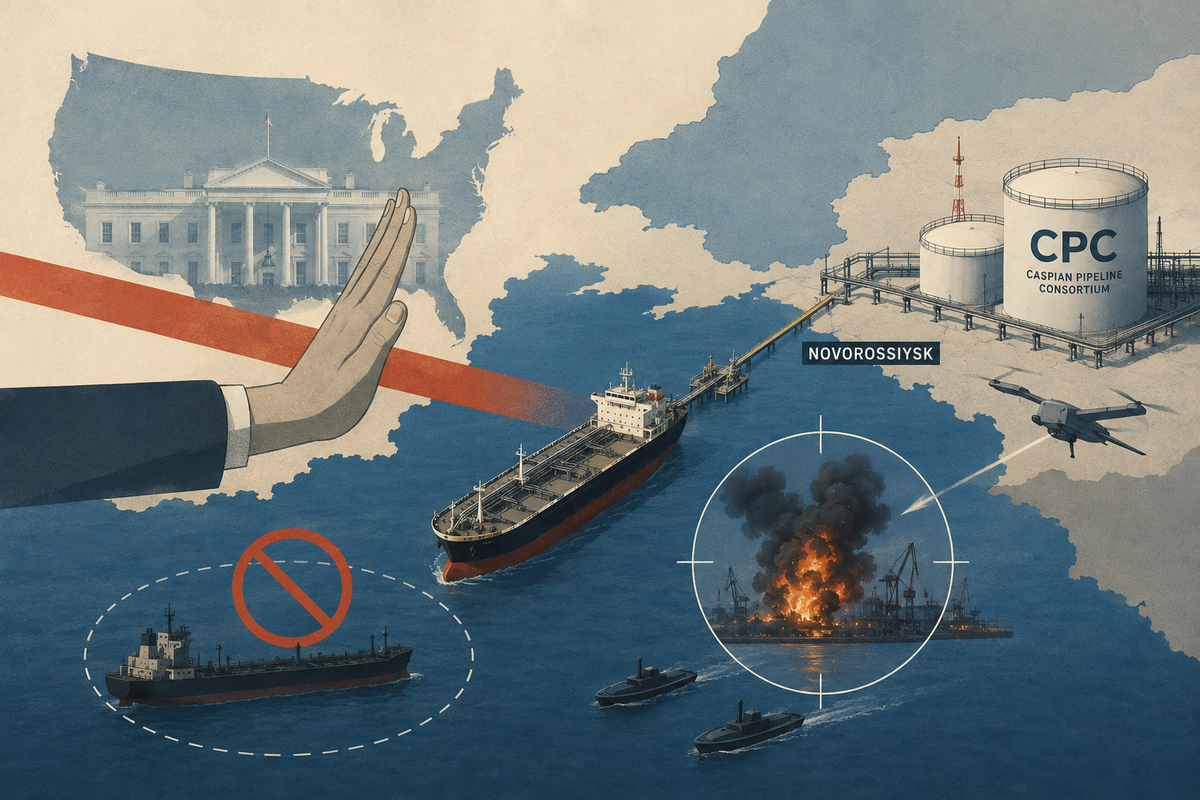
Ukraine has agreed to stop hitting non-Russian-flagged tankers and Caspian Pipeline Consortium (CPC) infrastructure at Novorossiysk, following a request from U.S. Vice President JD Vance. The Financial Times broke the story first; Reuters has since independently confirmed it, with a U.S. official telling the outlet that the administration warned Kyiv to stop attacking non-Russian vessels in the Black Sea. Under the reported terms, Kyiv will avoid CPC infrastructure and non-Russian ships unless they are under Ukrainian sanctions or carrying Russian oil or cargo. (Reuters, 12 Aug 2026)
On the same day, Ukrainian forces struck the military side of the Novorossiysk base with a combined package of anti-ship missiles, jet-powered aerial drones and sea drones, hitting air-defence positions, piers and port infrastructure — according to President Volodymyr Zelenskyy, as cited by AP. Russian regional authorities independently confirmed a major overnight attack, and Reuters reported that at least one grain terminal at the port halted operations after sustaining damage. (AP News, 12 Aug 2026)
This is not a pause in Ukraine's Black Sea campaign — it's a narrowing of the target list under allied pressure. For the first time, Washington has publicly (via a source corroborated across two outlets) shown it can shape which economic and maritime targets Kyiv avoids when strikes threaten allied commercial interests, third-country exports or global energy markets. At the same time, Ukraine is showing that a narrower target list is not a retreat from Russia's military infrastructure: Novorossiysk, as the main base of what remains of Russia's Black Sea Fleet, stays under fire.
What changed
The core factual shift today is the status of the U.S. intervention itself. What was previously a single-source WATCH-level signal has become a substantially corroborated operational constraint: a U.S. official confirmed to the Financial Times that Washington warned Ukraine off attacks on non-Russian Black Sea shipping. As of Reuters' publication, the White House, State Department and Vance's office had not commented publicly. 🟡
Reuters notes that July's strikes disrupted as much as one-fifth of CPC oil loadings and contributed to a 14% month-on-month fall in Kazakh oil production — directly hitting infrastructure used by Chevron and ExxonMobil. (Reuters, 12 Aug 2026) That economic fallout is almost certainly what prompted Washington's intervention in the first place.
Second, today's Novorossiysk strike shows how Kyiv is applying the constraint in practice: precisely, while keeping the military track of the campaign intact. The damage forced a grain terminal to suspend operations while assessors surveyed the site. (Reuters, 12 Aug 2026)
BSM analysis: The precedent matters less as a one-off than as a template. Washington isn't just supplying weapons and intelligence — it's demonstrating the ability to set the boundaries of Kyiv's targeting wherever strikes touch allied commercial interests. For the Baltic Sea, the analogy is direct: the region combines Russian export infrastructure (Primorsk, Ust-Luga) with dense shadow-fleet traffic that is nominally not Russian but functionally exists to evade sanctions. If "narrower targets under allied pressure" becomes the operating model in the Black Sea, it will likely inform any future debate over strikes on Baltic export logistics.
Novorossiysk as a strategic node
Russia relocated much of its surviving fleet to Novorossiysk after repeated Ukrainian strikes on Crimea and Sevastopol; Ukraine's Ministry of Defence has previously described the port as the principal base for relocated missile carriers and other naval assets. (Ukrainian Ministry of Defence). But even this "safe harbor" has proven porous: following an April 6, 2026 strike that reportedly hit the frigate Admiral Makarov, Russia moved several Project 22800 Karakurt-class corvettes to the Caspian Sea, and Moscow is reportedly weighing a new base at Ochamchire in Abkhazia — further from Ukraine's coastline. Defense analysts describe Russia's Black Sea Fleet as "severely weakened" and rarely willing to leave port. (Naval News, April 2026, Defense Express)
Regional context: the Baltic under the same pressure
The Novorossiysk precedent lands alongside a parallel escalation in the Baltic region. On 10–11 August, Reuters reported that Poland, Lithuania, Latvia and Estonia are tightening security around dams, energy facilities and gas infrastructure over fears that Russia could stage a provocation using Ukrainian-made drones as a pretext for escalation. Lithuania said last week that Russia was weighing a staged attack; troops are already helping guard an LNG import terminal, an oil products terminal, a key energy link with Poland, and the Kruonis pumped-storage plant. Latvia has stepped up protection of the Daugava dam near Riga and the Inčukalns underground gas storage facility. (Reuters, 10 Aug 2026)
On 11 August, Estonian air defence shot down a drone over Lake Võrtsjärv and issued an air threat alert for the country's south; Latvia's Ludza and Krāslava municipalities received a cell-broadcast alert over a possible airspace threat. The same day, Latvia joined a U.S.-initiated joint statement on ballistic missile launch notifications. (GlobalSecurity.org, 11 Aug 2026)
The Baltic shadow fleet, meanwhile, remains a structural problem in its own right: the share of non-Western vessels in Baltic oil traffic rose from roughly 25% in 2024 to around 70% in 2025, and by February 2026 about a third of tankers crossing the Baltic were presenting insurance certificates from sanctioned Russian or Russian-linked insurers. Vessels under joint U.S.–UK–EU sanctions climbed from zero in July 2024 to 178 by July 2026. (Atlantic Council, Brookings)
Likely implications
Ukraine will most likely keep striking Russian naval facilities, air defences, sanctioned vessels and explicitly military or Russian-controlled logistics at Novorossiysk, while continuing to avoid CPC infrastructure and qualifying third-country shipping. 🟡
The United States may apply similar pressure in other theatres where Ukrainian strikes create significant collateral economic effects for allies or neutral states — potentially including Russian Baltic export infrastructure. 🟡
The distinction between protected commercial shipping and Russian military or sanctions-evasion logistics is likely to become increasingly central to Ukrainian targeting decisions and to Western diplomatic responses to long-range strikes — including any future debate over the Baltic shadow fleet's status. 🟡
Bottom line
12 August marks a shift in Ukraine's Black Sea campaign toward selective targeting under external oversight: what was an unconfirmed signal yesterday is today a constraint documented on both sides of the Atlantic, coexisting with continued strikes on Russia's own military infrastructure. For the Baltic region, this is not an abstract precedent — Russia's shadow fleet and export infrastructure in the Baltic Sea operate on the same logic of mixed military-commercial nodes now being tested at Novorossiysk.
Baltic Security Monitor (osint-baltic.com) — an analytical outlet covering security on NATO's northeastern flank. All OSINT coefficients are calculated by an automated indexing system based on open sources.